AQA · GCSE · Combined Science
Course version: 8464 · Version from Sept 2018
Effectors, muscles or glands, which bring about responses which restore…
Full specification wording
Homeostasis: effectors, muscles or glands, which bring about responses which restore optimum levels.
Effectors are the output side of every control system.
Checked against the AQA 8464 specification (opens in a new tab) on .
- Point 11 of 11
- 4 key terms
Study notes
From the checked teaching notes for this specification point.
The idea
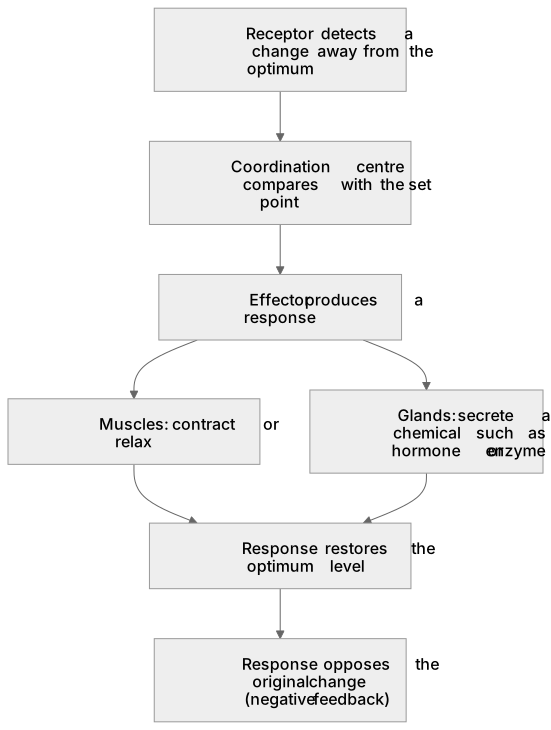
Effectors are the output side of every control system. A receptor detects a change away from the optimum; a coordination centre compares this with the set point; an effector then produces a response that restores the optimum. Two effector types are named: muscles and glands. Muscles respond by contracting or relaxing, changing movement or the diameter of passages. Glands respond by secreting a chemical, such as a hormone or enzyme. For example, when core temperature falls, skeletal muscle contracts rapidly as shivering, releasing extra heat; when blood glucose rises, the pancreas (a gland) secretes insulin. The response is corrective, not merely a change: it opposes the original stimulus, which is why it is called negative feedback.
What earns the marks
- Identifies effectors as the structures that carry out the response, not the structures that detect the stimulus.
- States that muscles respond by contracting or relaxing, producing movement or changing the width of a passage.
- States that glands respond by secreting substances such as hormones or enzymes.
- Explains that the response restores the optimum level by opposing the original change, giving a named example such as shivering or insulin secretion.
- Uses the sequence receptor → coordination centre → effector → response when describing a control pathway.
Common mistakes and how to put them right
Calling the receptor an effector.
Put it right by stressing that receptors detect change while effectors produce the response.
Saying glands 'release electrical impulses'.
Put it right by stating that glands secrete chemicals such as hormones, whereas muscles respond mechanically.
Describing any response as restoring the optimum without checking direction.
Put it right by stating that the response must oppose the original change, as in shivering when too cold.
Exam tips
- Name the effector type explicitly in each answer, for example 'muscle in the skin arteriole wall' or 'the pancreas, a gland'.
- Link each response to the direction of change using 'because the level was too high/low', so the corrective nature is clear.
- Practise writing one full pathway for temperature and one for blood glucose, then adapt the same sequence to other examples.
Try the lesson
The start of the Homeostasis: effectors, muscles or glands, which bring about responses which restore optimum levels. lesson, made from checked teaching notes for this specification point.
Have a go first
Which type of structure acts as an effector to bring about a response that restores optimum levels in the body?
Listen
Effectors are the output side of every control system. A receptor detects a change away from the optimum; a coordination centre compares this with the set point; an effector then produces a response that restores the optimum. Two effector types are named: muscles and glands. Muscles respond by contracting or relaxing, changing movement or the diameter of passages. Glands respond by secreting a chemical, such as a hormone or enzyme. For example, when core temperature falls, skeletal muscle contracts rapidly as shivering, releasing extra heat; when blood glucose rises, the pancreas (a gland) secretes insulin. The response is corrective, not merely a change: it opposes the original stimulus, which is why it is called negative feedback. A strong answer earns marks for these points. Identifies effectors as the structures that carry out the response, not the structures that detect the stimulus. States that muscles respond by contracting or relaxing, producing movement or changing the width of a passage. States that glands respond by secreting substances such as hormones or enzymes. Explains that the response restores the optimum level by opposing the original change, giving a named example such as shivering or insulin secretion. A common slip: Calling the receptor an effector. Instead, stressing that receptors detect change while effectors produce the response. Exam tip: Name the effector type explicitly in each answer, for example 'muscle in the skin arteriole wall' or 'the pancreas, a gland'.
See it
Key words
Say what each word means before you turn the card.
Effectors
Try answering aloud or in your head before turning the card.
Muscles as mechanical effectors
Try answering aloud or in your head before turning the card.
Glands as chemical effectors secreting hormones
Try answering aloud or in your head before turning the card.
Negative feedback and restoration of optimum levels
Try answering aloud or in your head before turning the card.
See every definition
- Effectors
- Muscles or glands which bring about responses which restore optimum levels.
- Muscles as mechanical effectors
- They respond by contracting or relaxing, changing movement or the diameter of passages.
- Glands as chemical effectors secreting hormones
- They respond by secreting a chemical, such as a hormone or enzyme.
- Negative feedback and restoration of optimum levels
- The response is corrective, opposing the original stimulus, which is why it is called negative feedback.
Label the diagram
Some boxes have lost their names. Pick the right name for each number.
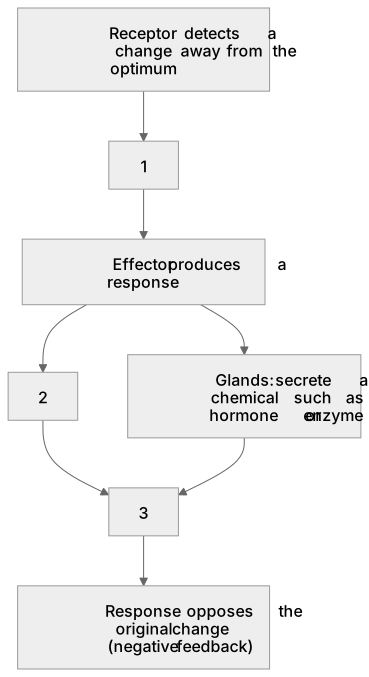
1Box 1
2Box 2
3Box 3
There is more to this lesson
The full lesson goes on to check your understanding and help you earn the marks. Create a free account to carry on, with your progress saved.
A week of Premium from your first lesson · Then the free plan continues · No card, no charge
Test your understanding of Homeostasis: effectors, muscles or glands, which bring about responses which restore optimum levels.
Active recall beats re-reading. Take an instant quiz now to test what you’ve learned and lock it into long-term memory.
A week of Premium from your first lesson · Then the free plan continues · No card, no charge