AQA · GCSE · Combined Science
Course version: 8464 · Version from Sept 2018
Homeostasis: In the human body, these include control of:
Homeostasis keeps the internal environment of the body steady despite changes inside and outside it.
Checked against the AQA 8464 specification (opens in a new tab) on .
- Point 3 of 11
- 4 key terms
Study notes
From the checked teaching notes for this specification point.
The idea
Homeostasis keeps the internal environment of the body steady despite changes inside and outside it. In the human body, the automatic control systems that achieve this include control of blood glucose concentration, body temperature and water and ion balance. Each controlled factor has a normal set point, receptors that detect deviation, a coordination centre such as the brain or pancreas, and effectors such as muscles or glands that restore the set point. For example, if core temperature rises during exercise, sweating and vasodilation increase heat loss; if it falls, shivering and vasoconstriction conserve heat. Negative feedback reverses the original change, so the factor oscillates narrowly around its set point rather than drifting. This statement introduces the list of controlled factors that later statements develop in detail.
What earns the marks
- Homeostasis maintains a stable internal environment despite external and internal changes.
- Human control systems include blood glucose concentration, body temperature, and water and ion balance.
- Each system uses receptors, a coordination centre and effectors in a negative feedback loop.
- Negative feedback reverses a detected change to return a factor towards its set point.
- Effectors are muscles or glands that bring about the corrective response.
- Control is automatic and antagonistic, for example insulin and glucagon or sweating and shivering.
Common mistakes and how to put them right
Thinking homeostasis keeps conditions perfectly constant.
Put it right: It actually keeps them within a narrow range around a set point, so values fluctuate slightly.
Confusing the coordination centre with the effector.
Put it right: The coordination centre processes information, whereas the effector carries out the response.
Describing positive feedback as the usual mechanism.
Put it right: Human homeostasis normally uses negative feedback, which reverses the change.
Exam tips
- Name at least two specific factors controlled in the human body, such as blood glucose concentration and body temperature, rather than saying 'everything'.
- Use the sequence receptor → coordination centre → effector → response when explaining any control system.
- Link each example to negative feedback by stating what the response does to the original change.
Try the lesson
The start of the Homeostasis: In the human body, these include control of: lesson, made from checked teaching notes for this specification point.
Have a go first
Which of the following are examples of conditions controlled by homeostasis in the human body?
Listen
Homeostasis keeps the internal environment of the body steady despite changes inside and outside it. In the human body, the automatic control systems that achieve this include control of blood glucose concentration, body temperature and water and ion balance. Each controlled factor has a normal set point, receptors that detect deviation, a coordination centre such as the brain or pancreas, and effectors such as muscles or glands that restore the set point. For example, if core temperature rises during exercise, sweating and vasodilation increase heat loss; if it falls, shivering and vasoconstriction conserve heat. Negative feedback reverses the original change, so the factor oscillates narrowly around its set point rather than drifting. This statement introduces the list of controlled factors that later statements develop in detail. A strong answer earns marks for these points. Homeostasis maintains a stable internal environment despite external and internal changes. Human control systems include blood glucose concentration, body temperature, and water and ion balance. Each system uses receptors, a coordination centre and effectors in a negative feedback loop. Negative feedback reverses a detected change to return a factor towards its set point. Exam tip: Name at least two specific factors controlled in the human body, such as blood glucose concentration and body temperature, rather than saying 'everything'.
See it
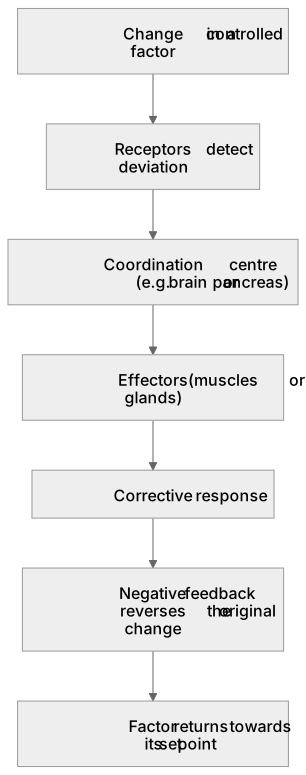
Put it in order
Put these steps in the order they happen.
- 1. Factor returns towards its set point
- 2. Negative feedback reverses the original change
- 3. Coordination centre (e.g. brain or pancreas)
- 4. Corrective response
- 5. Change in a controlled factor
- 6. Receptors detect deviation
- 7. Effectors (muscles or glands)
Key words
Say what each word means before you turn the card.
Homeostasis
Try answering aloud or in your head before turning the card.
Negative feedback
Try answering aloud or in your head before turning the card.
Receptors, coordination centres and effectors
Try answering aloud or in your head before turning the card.
Antagonistic effectors and set points
Try answering aloud or in your head before turning the card.
See every definition
- Homeostasis
- Keeps the internal environment of the body steady despite changes inside and outside it.
- Negative feedback
- Reverses the original change, so the factor oscillates narrowly around its set point rather than drifting.
- Receptors, coordination centres and effectors
- Each controlled factor has receptors that detect deviation, a coordination centre such as the brain or pancreas, and effectors such as muscles or glands that restore the set point.
- Antagonistic effectors and set points
- Each controlled factor has a normal set point, and control is automatic and antagonistic, for example insulin and glucagon or sweating and shivering.
Label the diagram
Some boxes have lost their names. Pick the right name for each number.
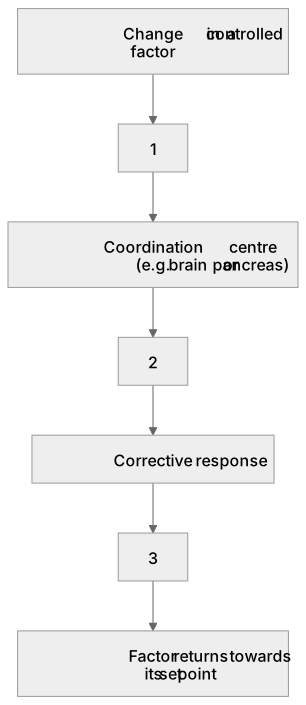
1Box 1
2Box 2
3Box 3
There is more to this lesson
The full lesson goes on to check your understanding and help you earn the marks. Create a free account to carry on, with your progress saved.
A week of Premium from your first lesson · Then the free plan continues · No card, no charge
Test your understanding of Homeostasis: In the human body, these include control of:
Active recall beats re-reading. Take an instant quiz now to test what you’ve learned and lock it into long-term memory.
A week of Premium from your first lesson · Then the free plan continues · No card, no charge