AQA · GCSE · Combined Science
Course version: 8464 · Version from Sept 2018
Oestrogen and progesterone are involved in maintaining the uterus lining.
Full specification wording
Hormones in human reproduction: Oestrogen and progesterone are involved in maintaining the uterus lining.
The uterus lining (endometrium) must be thick and blood-rich so that a fertilised egg can implant and develop.
Checked against the AQA 8464 specification (opens in a new tab) on .
- Point 8 of 10
- 4 key terms
Study notes
From the checked teaching notes for this specification point.
The idea
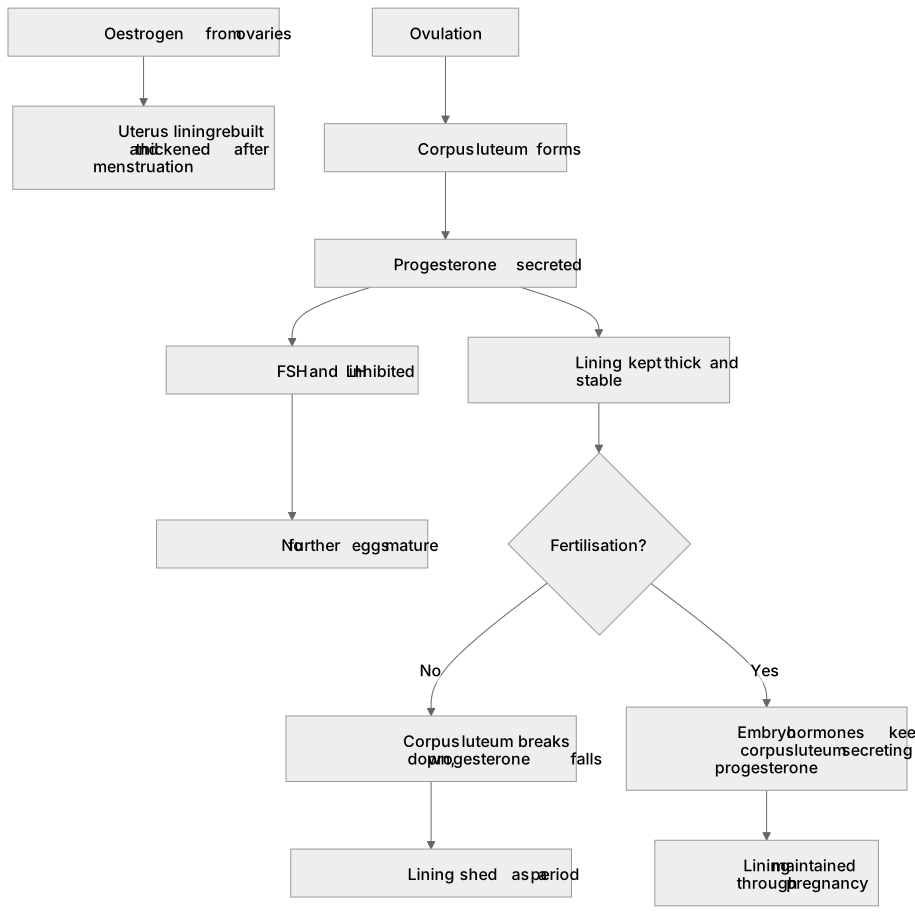
The uterus lining (endometrium) must be thick and blood-rich so that a fertilised egg can implant and develop. Oestrogen, made by the ovaries, stimulates the lining to rebuild and thicken after menstruation. Progesterone, made by the corpus luteum after ovulation, keeps the lining thick and stable, and inhibits FSH and LH so no further eggs mature. If fertilisation does not occur, the corpus luteum breaks down, progesterone falls, and the lining is shed as a period. If fertilisation occurs, the embryo secretes hormones that keep the corpus luteum secreting progesterone, maintaining the lining through pregnancy.
For example: A graph of progesterone through the cycle shows a rise after ovulation and a sharp fall just before menstruation.
What earns the marks
- Oestrogen is secreted by the ovaries and stimulates the repair and thickening of the uterus lining after menstruation.
- Progesterone is secreted by the corpus luteum and maintains the thickened uterus lining so it does not break down.
- Progesterone inhibits FSH and LH, preventing further follicles maturing while the lining is maintained.
- A fall in progesterone when the corpus luteum breaks down causes the uterus lining to be shed as menstruation.
- If fertilisation occurs, continued progesterone secretion maintains the lining during early pregnancy.
- The two hormones act at different stages: oestrogen early in the cycle, progesterone after ovulation.
Common mistakes and how to put them right
Saying oestrogen maintains the lining throughout the cycle.
Put it right by stating oestrogen rebuilds and thickens the lining, while progesterone maintains it after ovulation.
Confusing the ovary and corpus luteum as sources.
Put it right by naming the ovaries for oestrogen and the corpus luteum for progesterone.
Claiming progesterone causes ovulation.
Put it right by stating that a surge of LH triggers ovulation, and progesterone instead maintains the lining and inhibits FSH and LH.
Exam tips
- Link each hormone to its source, its target tissue and its effect in one sentence to show clear cause and effect.
- Use the words rebuild, maintain and shed to describe the lining at the correct stages of the cycle.
- When describing a graph, quote the stage of the cycle and whether the hormone is rising or falling before explaining the effect on the lining.
Try the lesson
The start of the Hormones in human reproduction: Oestrogen and progesterone are involved in maintaining the uterus lining. lesson, made from checked teaching notes for this specification point.
Have a go first
Which hormone is mainly responsible for maintaining the lining of the uterus during pregnancy?
Listen
The uterus lining (endometrium) must be thick and blood-rich so that a fertilised egg can implant and develop. Oestrogen, made by the ovaries, stimulates the lining to rebuild and thicken after menstruation. Progesterone, made by the corpus luteum after ovulation, keeps the lining thick and stable, and inhibits FSH and LH so no further eggs mature. If fertilisation does not occur, the corpus luteum breaks down, progesterone falls, and the lining is shed as a period. If fertilisation occurs, the embryo secretes hormones that keep the corpus luteum secreting progesterone, maintaining the lining through pregnancy. For example, a graph of progesterone through the cycle shows a rise after ovulation and a sharp fall just before menstruation. A strong answer earns marks for these points. Oestrogen is secreted by the ovaries and stimulates the repair and thickening of the uterus lining after menstruation. Progesterone is secreted by the corpus luteum and maintains the thickened uterus lining so it does not break down. Progesterone inhibits FSH and LH, preventing further follicles maturing while the lining is maintained. A fall in progesterone when the corpus luteum breaks down causes the uterus lining to be shed as menstruation. A common slip: Saying oestrogen maintains the lining throughout the cycle. Instead, stating oestrogen rebuilds and thickens the lining, while progesterone maintains it after ovulation. Exam tip: Link each hormone to its source, its target tissue and its effect in one sentence to show clear cause and effect.
See it
Key words
Say what each word means before you turn the card.
Oestrogen
Try answering aloud or in your head before turning the card.
Progesterone
Try answering aloud or in your head before turning the card.
Menstruation
Try answering aloud or in your head before turning the card.
Corpus luteum
Try answering aloud or in your head before turning the card.
See every definition
- Oestrogen
- Secreted by the ovaries, it stimulates the repair and thickening of the uterus lining after menstruation.
- Progesterone
- Secreted by the corpus luteum, it maintains the thickened uterus lining so it does not break down.
- Menstruation
- The shedding of the uterus lining as a period, caused by a fall in progesterone when the corpus luteum breaks down.
- Corpus luteum
- The source of progesterone after ovulation, which breaks down if fertilisation does not occur.
Label the diagram
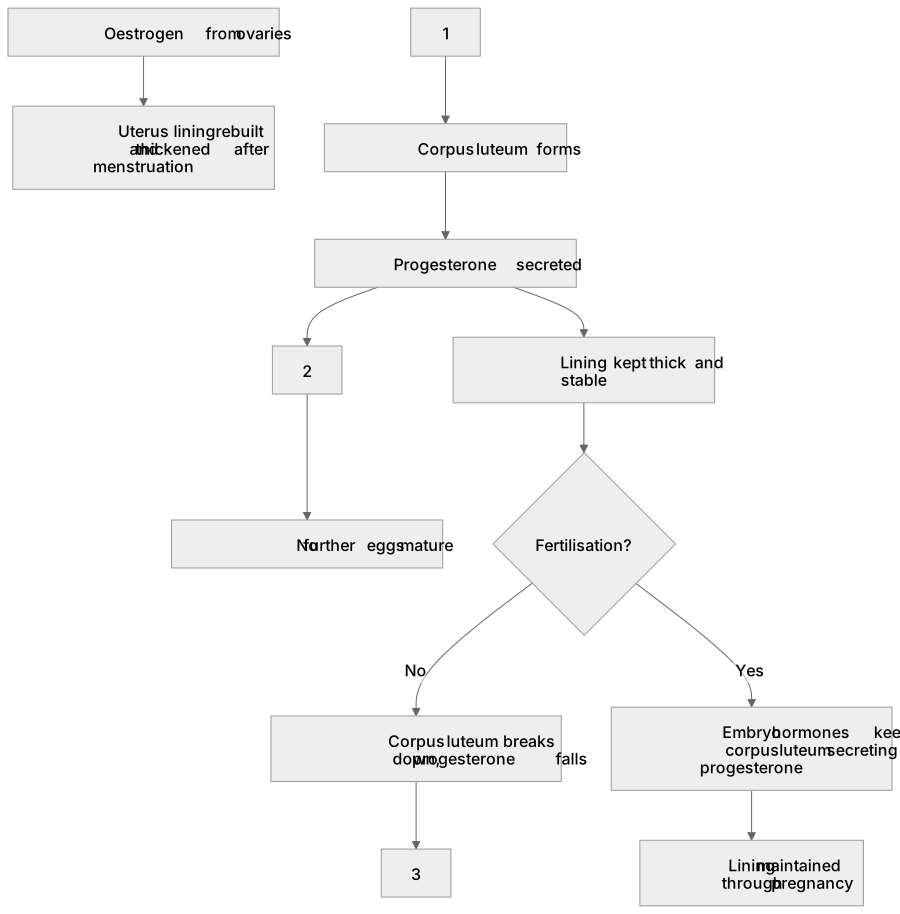
Some boxes have lost their names. Pick the right name for each number.
1Box 1
2Box 2
3Box 3
There is more to this lesson
The full lesson goes on to check your understanding and help you earn the marks. Create a free account to carry on, with your progress saved.
A week of Premium from your first lesson · Then the free plan continues · No card, no charge
Test your understanding of Hormones in human reproduction: Oestrogen and progesterone are involved in maintaining the uterus lining.
Active recall beats re-reading. Take an instant quiz now to test what you’ve learned and lock it into long-term memory.
A week of Premium from your first lesson · Then the free plan continues · No card, no charge