AQA · GCSE · Combined Science
Course version: 8464 · Version from Sept 2018
Students should be able to describe the roles of hormones in human…
Full specification wording
Hormones in human reproduction: Students should be able to describe the roles of hormones in human reproduction, including the menstrual cycle.
Reproduction is controlled by hormones carried in the blood.
Checked against the AQA 8464 specification (opens in a new tab) on .
- Point 1 of 10
- 4 key terms
Study notes
From the checked teaching notes for this specification point.
The idea
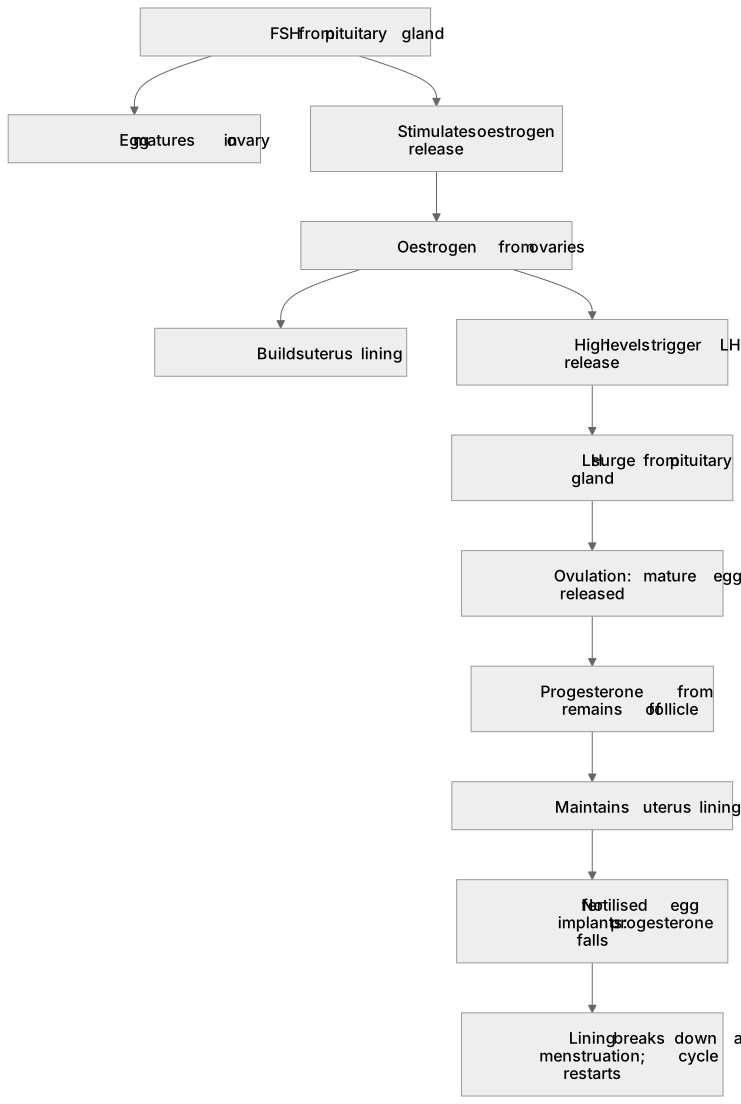
Reproduction is controlled by hormones carried in the blood. In females, FSH from the pituitary gland causes an egg to mature in an ovary and stimulates oestrogen release. Oestrogen from the ovaries builds the uterus lining and, at high levels, triggers LH release. A surge of LH from the pituitary gland causes ovulation, the release of a mature egg. After ovulation, the remains of the follicle secrete progesterone, which maintains the uterus lining. If no fertilised egg implants, progesterone falls, the lining breaks down as menstruation, and the cycle restarts. In males, testosterone from the testes stimulates sperm production. These hormones also form the basis of fertility treatments and contraception.
What earns the marks
- FSH is secreted by the pituitary gland and causes an egg to mature in the ovary.
- Oestrogen is secreted by the ovaries and causes the uterus lining to thicken and repair.
- LH is secreted by the pituitary gland and triggers ovulation.
- Progesterone is secreted by the ovary after ovulation and maintains the uterus lining.
- Testosterone is secreted by the testes and stimulates sperm production.
- A full description sequences the hormones across the cycle and links each to its effect on the ovary or uterus.
Common mistakes and how to put them right
Confusing the roles of FSH and LH.
Put it right: FSH matures the egg, while LH triggers ovulation.
Saying oestrogen maintains the uterus lining throughout the cycle.
Put it right: Oestrogen builds the lining, but progesterone maintains it after ovulation.
Naming the ovaries as the source of FSH and LH.
Put it right: FSH and LH come from the pituitary gland, while oestrogen and progesterone come from the ovaries.
Exam tips
- Learn the order FSH, oestrogen, LH, progesterone and link each to one clear effect.
- Use the terms 'mature the egg', 'build the lining', 'ovulation' and 'maintain the lining' precisely.
- If asked to compare, set out male and female hormones side by side rather than mixing them in one paragraph.
Try the lesson
The start of the Hormones in human reproduction: Students should be able to describe the roles of hormones in human reproduction, including the menstrual cycle. lesson, made from checked teaching notes for this specification point.
Have a go first
Which hormone causes the lining of the uterus to thicken during the menstrual cycle?
Listen
Reproduction is controlled by hormones carried in the blood. In females, FSH from the pituitary gland causes an egg to mature in an ovary and stimulates oestrogen release. Oestrogen from the ovaries builds the uterus lining and, at high levels, triggers LH release. A surge of LH from the pituitary gland causes ovulation, the release of a mature egg. After ovulation, the remains of the follicle secrete progesterone, which maintains the uterus lining. If no fertilised egg implants, progesterone falls, the lining breaks down as menstruation, and the cycle restarts. In males, testosterone from the testes stimulates sperm production. These hormones also form the basis of fertility treatments and contraception. A strong answer earns marks for these points. FSH is secreted by the pituitary gland and causes an egg to mature in the ovary. Oestrogen is secreted by the ovaries and causes the uterus lining to thicken and repair. LH is secreted by the pituitary gland and triggers ovulation. Progesterone is secreted by the ovary after ovulation and maintains the uterus lining. A common slip: Confusing the roles of FSH and LH. Instead, FSH matures the egg, while LH triggers ovulation. Exam tip: Learn the order FSH, oestrogen, LH, progesterone and link each to one clear effect.
See it
Key words
Say what each word means before you turn the card.
FSH
Try answering aloud or in your head before turning the card.
Oestrogen
Try answering aloud or in your head before turning the card.
LH
Try answering aloud or in your head before turning the card.
Progesterone
Try answering aloud or in your head before turning the card.
See every definition
- FSH
- Secreted by the pituitary gland, it causes an egg to mature in the ovary and stimulates oestrogen release.
- Oestrogen
- Secreted by the ovaries, it builds the uterus lining and, at high levels, triggers LH release.
- LH
- Secreted by the pituitary gland, a surge of it causes ovulation, the release of a mature egg.
- Progesterone
- Secreted by the remains of the follicle after ovulation, it maintains the uterus lining.
Label the diagram
Some boxes have lost their names. Pick the right name for each number.
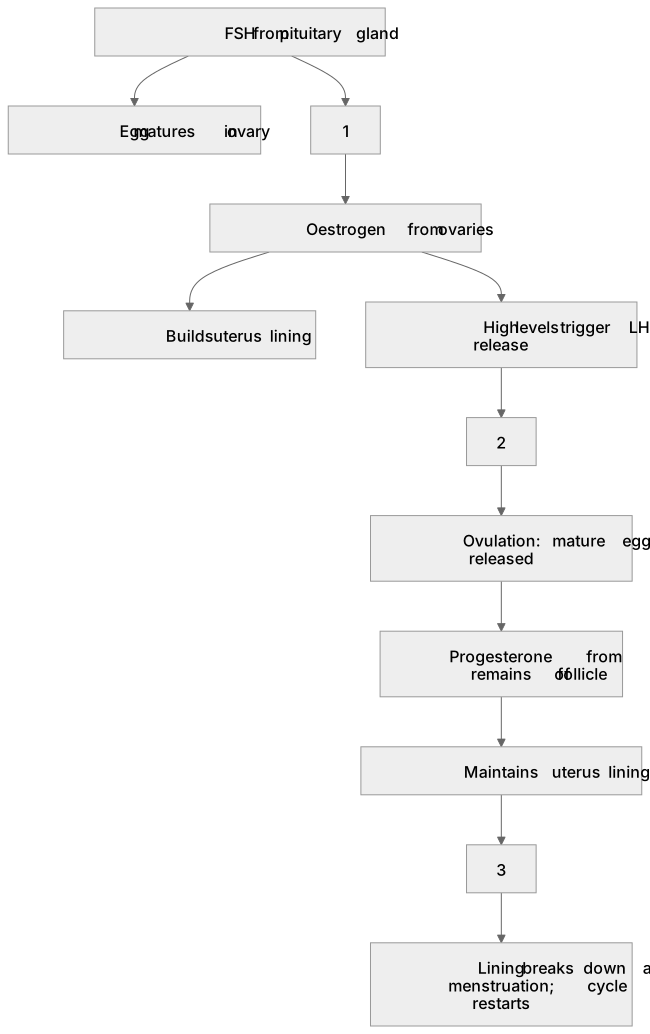
1Box 1
2Box 2
3Box 3
There is more to this lesson
The full lesson goes on to check your understanding and help you earn the marks. Create a free account to carry on, with your progress saved.
A week of Premium from your first lesson · Then the free plan continues · No card, no charge
Test your understanding of Hormones in human reproduction: Students should be able to describe the roles of hormones in human reproduction, including the menstrual cycle.
Active recall beats re-reading. Take an instant quiz now to test what you’ve learned and lock it into long-term memory.
A week of Premium from your first lesson · Then the free plan continues · No card, no charge