AQA · GCSE · Combined Science
Course version: 8464 · Version from Sept 2018
Students should be able to explain the role of microorganisms in cycling…
Full specification wording
How materials are cycled: Students should be able to explain the role of microorganisms in cycling materials through an ecosystem by returning carbon to the atmosphere as carbon dioxide and mineral ions to the soil.
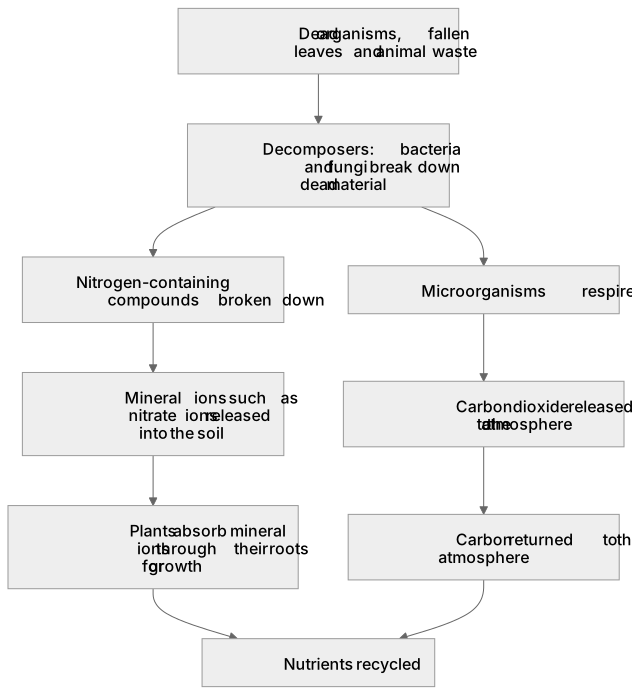
Microorganisms act as decomposers, breaking down dead organisms, fallen leaves and animal waste.
Checked against the AQA 8464 specification (opens in a new tab) on .
- Point 6 of 6
- 4 key terms
Study notes
From the checked teaching notes for this specification point.
The idea
Microorganisms act as decomposers, breaking down dead organisms, fallen leaves and animal waste. As they digest this dead material, they respire, releasing carbon back to the atmosphere as carbon dioxide. They also break down proteins and other nitrogen-containing compounds, releasing mineral ions such as nitrate ions into the soil, where plants absorb them through their roots. For example, fungi and bacteria on a fallen log digest it, respire carbon dioxide, and release nitrate ions into the soil. Without this decomposition, carbon and mineral ions would remain locked in dead matter, so plants could not obtain the nutrients they need and the carbon cycle would stall.
What earns the marks
- Decomposers such as bacteria and fungi break down dead organisms, fallen leaves and animal waste.
- Respiration by microorganisms releases carbon dioxide into the atmosphere.
- Breakdown of nitrogen-containing compounds releases mineral ions such as nitrate ions into the soil.
- Plants absorb mineral ions from the soil through their roots for growth.
- Without decomposition, carbon and mineral ions remain locked in dead material and are not recycled.
Common mistakes and how to put them right
Saying microorganisms release carbon dioxide by photosynthesis.
Put it right: They release it by respiration.
Stating that decomposition returns carbon to the soil rather than to the atmosphere.
Put it right: Carbon returns to the atmosphere as carbon dioxide, while mineral ions return to the soil.
Confusing mineral ions with carbon dioxide.
Put it right: Mineral ions such as nitrate ions enter the soil, whereas carbon dioxide is a gas released to the air.
Exam tips
- Link each product to its destination: carbon dioxide to the atmosphere, mineral ions to the soil.
- Use the term decomposers and name bacteria and fungi to show precise knowledge.
- Explain the consequence of no decomposition to demonstrate understanding of cycling, not just recall.
Try the lesson
The start of the How materials are cycled: Students should be able to explain the role of microorganisms in cycling materials through an ecosystem by returning carbon to the atmosphere as carbon dioxide and mineral ions to the soil. lesson, made from checked teaching notes for this specification point.
Have a go first
Dead leaves fall from a tree onto the soil. Which gas do microorganisms release into the atmosphere as they break down the dead leaves?
Listen
Microorganisms act as decomposers, breaking down dead organisms, fallen leaves and animal waste. As they digest this dead material, they respire, releasing carbon back to the atmosphere as carbon dioxide. They also break down proteins and other nitrogen-containing compounds, releasing mineral ions such as nitrate ions into the soil, where plants absorb them through their roots. For example, fungi and bacteria on a fallen log digest it, respire carbon dioxide, and release nitrate ions into the soil. Without this decomposition, carbon and mineral ions would remain locked in dead matter, so plants could not obtain the nutrients they need and the carbon cycle would stall. A strong answer earns marks for these points. Decomposers such as bacteria and fungi break down dead organisms, fallen leaves and animal waste. Respiration by microorganisms releases carbon dioxide into the atmosphere. Breakdown of nitrogen-containing compounds releases mineral ions such as nitrate ions into the soil. Plants absorb mineral ions from the soil through their roots for growth. A common slip: Saying microorganisms release carbon dioxide by photosynthesis. Instead, they release it by respiration. Exam tip: Link each product to its destination: carbon dioxide to the atmosphere, mineral ions to the soil.
See it
Key words
Say what each word means before you turn the card.
Decomposition
Try answering aloud or in your head before turning the card.
Carbon cycle
Try answering aloud or in your head before turning the card.
Mineral ion cycling
Try answering aloud or in your head before turning the card.
Microorganisms as decomposers
Try answering aloud or in your head before turning the card.
See every definition
- Decomposition
- The breaking down of dead organisms, fallen leaves and animal waste by decomposers such as bacteria and fungi.
- Carbon cycle
- The cycling of carbon, in which respiration by microorganisms releases carbon dioxide into the atmosphere and without decomposition it would stall.
- Mineral ion cycling
- The release of mineral ions such as nitrate ions into the soil when microorganisms break down nitrogen-containing compounds, where plants absorb them through their roots.
- Microorganisms as decomposers
- Bacteria and fungi that break down dead material and waste, respiring carbon dioxide to the atmosphere and releasing mineral ions into the soil.
Label the diagram
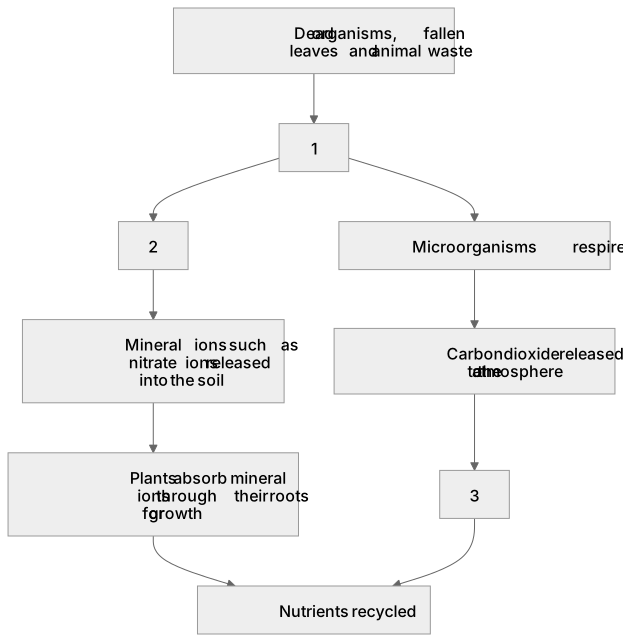
Some boxes have lost their names. Pick the right name for each number.
1Box 1
2Box 2
3Box 3
There is more to this lesson
The full lesson goes on to check your understanding and help you earn the marks. Create a free account to carry on, with your progress saved.
A week of Premium from your first lesson · Then the free plan continues · No card, no charge
Test your understanding of How materials are cycled: Students should be able to explain the role of microorganisms in cycling materials through an ecosystem by returning carbon to the atmosphere as carbon dioxide and mineral ions to the soil.
Active recall beats re-reading. Take an instant quiz now to test what you’ve learned and lock it into long-term memory.
A week of Premium from your first lesson · Then the free plan continues · No card, no charge