AQA · GCSE · Combined Science
Course version: 8464 · Version from Sept 2018
Human defence systems: antibody production
Antibodies are Y-shaped proteins made by white blood cells called lymphocytes.
Checked against the AQA 8464 specification (opens in a new tab) on .
- Point 10 of 11
- 4 key terms
Study notes
From the checked teaching notes for this specification point.
The idea
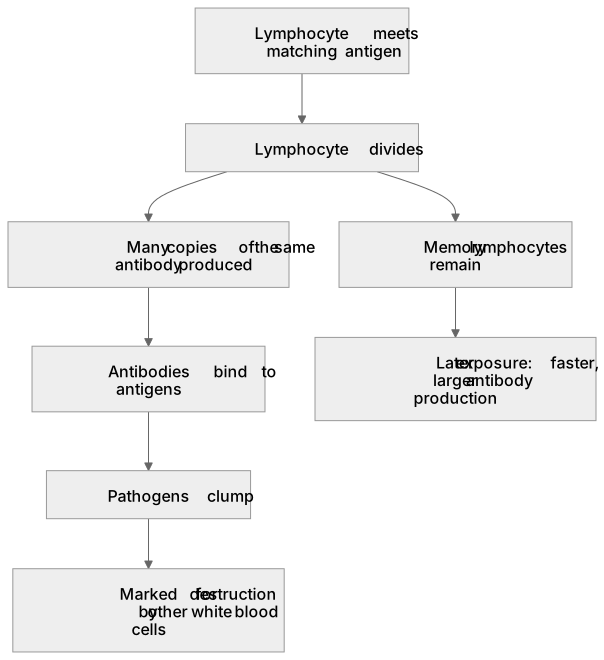
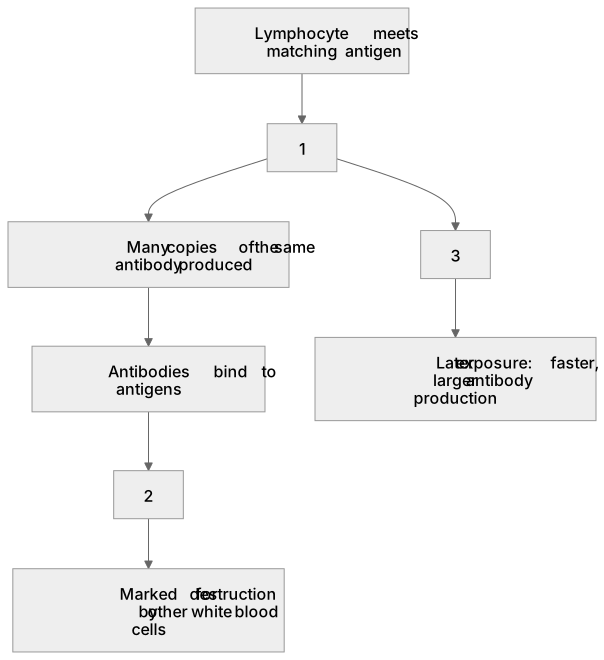
Antibodies are Y-shaped proteins made by white blood cells called lymphocytes. Each antibody has binding sites whose shape is complementary to a specific antigen on a pathogen. When a lymphocyte meets its matching antigen, it divides and produces many copies of the same antibody, which bind to the antigens. This clumping immobilises pathogens and marks them for destruction by other white blood cells. Antibodies also give immunity: memory lymphocytes remain after an infection, so a later exposure triggers faster, larger antibody production. For example, after measles infection, measles-specific antibodies appear in the blood and prevent reinfection. Antibody production is a specific, adaptive response, unlike phagocytosis, which is non-specific.
What earns the marks
- Antibodies are proteins produced by lymphocytes (a type of white blood cell).
- Each antibody has binding sites with a shape complementary to a specific antigen.
- Binding of antibodies to antigens clumps pathogens and marks them for destruction by phagocytes.
- Lymphocytes that recognise an antigen divide to produce many identical antibody molecules.
- Memory lymphocytes allow faster, greater antibody production on a later exposure to the same antigen.
Common mistakes and how to put them right
Saying antibodies kill pathogens directly.
Put it right: Antibodies bind and clump pathogens, and phagocytes then ingest them.
Confusing antibodies with antibiotics.
Put it right: Antibodies are proteins made by lymphocytes, whereas antibiotics are medicines that kill bacteria.
Stating that one antibody binds any antigen.
Put it right: Antibody binding sites are complementary to one specific antigen shape.
Exam tips
- Use the word 'complementary' when linking antibody binding sites to antigen shape.
- Name the white blood cell type as a lymphocyte rather than just 'white blood cell'.
- Link antibody production to immunity by mentioning memory lymphocytes and a faster second response.
Try the lesson
The start of the Human defence systems: antibody production lesson, made from checked teaching notes for this specification point.
Have a go first
Which type of white blood cell produces antibodies?
Listen
Antibodies are Y-shaped proteins made by white blood cells called lymphocytes. Each antibody has binding sites whose shape is complementary to a specific antigen on a pathogen. When a lymphocyte meets its matching antigen, it divides and produces many copies of the same antibody, which bind to the antigens. This clumping immobilises pathogens and marks them for destruction by other white blood cells. Antibodies also give immunity: memory lymphocytes remain after an infection, so a later exposure triggers faster, larger antibody production. For example, after measles infection, measles-specific antibodies appear in the blood and prevent reinfection. Antibody production is a specific, adaptive response, unlike phagocytosis, which is non-specific. A strong answer earns marks for these points. Antibodies are proteins produced by lymphocytes (a type of white blood cell). Each antibody has binding sites with a shape complementary to a specific antigen. Binding of antibodies to antigens clumps pathogens and marks them for destruction by phagocytes. Lymphocytes that recognise an antigen divide to produce many identical antibody molecules. A common slip: Saying antibodies kill pathogens directly. Instead, antibodies bind and clump pathogens, and phagocytes then ingest them. Exam tip: Use the word 'complementary' when linking antibody binding sites to antigen shape.
See it
Key words
Say what each word means before you turn the card.
Antigen-antibody binding
Try answering aloud or in your head before turning the card.
White blood cells and lymphocytes
Try answering aloud or in your head before turning the card.
Immunity and memory cells
Try answering aloud or in your head before turning the card.
Specific immune response
Try answering aloud or in your head before turning the card.
See every definition
- Antigen-antibody binding
- Binding sites on an antibody have a shape complementary to a specific antigen on a pathogen, and binding clumps pathogens and marks them for destruction.
- White blood cells and lymphocytes
- Antibodies are proteins produced by lymphocytes, which are a type of white blood cell.
- Immunity and memory cells
- Memory lymphocytes remain after an infection, so a later exposure to the same antigen triggers faster, larger antibody production.
- Specific immune response
- Antibody production is a specific, adaptive response, unlike phagocytosis, which is non-specific.
Label the diagram
Some boxes have lost their names. Pick the right name for each number.
1Box 1
2Box 2
3Box 3
There is more to this lesson
The full lesson goes on to check your understanding and help you earn the marks. Create a free account to carry on, with your progress saved.
A week of Premium from your first lesson · Then the free plan continues · No card, no charge
Test your understanding of Human defence systems: antibody production
Active recall beats re-reading. Take an instant quiz now to test what you’ve learned and lock it into long-term memory.
A week of Premium from your first lesson · Then the free plan continues · No card, no charge