AQA · GCSE · Combined Science
Course version: 8464 · Version from Sept 2018
Human defence systems: nose
The nose is part of the body's first line of defence against pathogens.
Checked against the AQA 8464 specification (opens in a new tab) on .
- Point 3 of 11
- 3 key terms
Study notes
From the checked teaching notes for this specification point.
The idea
The nose is part of the body's first line of defence against pathogens. As air is breathed in, it passes over hairs and a sticky mucous membrane. Hairs trap larger particles such as dust and some microorganisms, while mucus traps smaller particles and pathogens. Cilia, tiny hair-like structures on epithelial cells, beat rhythmically to sweep mucus containing trapped microbes towards the throat, where it is swallowed. Stomach acid then destroys many of the swallowed pathogens. This prevents most airborne microorganisms from reaching the lungs, where they could cause infection. The nose therefore provides a non-specific physical and chemical defence.
What earns the marks
- Hairs in the nose trap larger particles and some microorganisms from inhaled air.
- Mucus produced by the mucous membrane traps smaller particles and pathogens.
- Cilia beat to move mucus containing trapped pathogens towards the throat.
- Swallowed mucus carries pathogens to the stomach, where acid destroys them.
- Nose defences are non-specific and reduce the number of pathogens reaching the lungs.
Common mistakes and how to put them right
Saying cilia push mucus out of the nose.
Put it right by stating cilia sweep mucus towards the throat to be swallowed.
Confusing mucus with cilia.
Put it right: State that mucus is the sticky substance that traps pathogens, while cilia are the structures that move it.
Claiming the nose destroys all inhaled pathogens.
Put it right by explaining it traps and removes many, with stomach acid destroying those swallowed.
Exam tips
- Describe the journey of trapped pathogens from nose to stomach in the correct order.
- Use the terms mucus, cilia and stomach acid accurately in your answer.
- Link nose defences to preventing lung infections rather than treating them.
Try the lesson
The start of the Human defence systems: nose lesson, made from checked teaching notes for this specification point.
Have a go first
Which part of the human body traps pathogens in mucus as part of the defence against disease?
Listen
The nose is part of the body's first line of defence against pathogens. As air is breathed in, it passes over hairs and a sticky mucous membrane. Hairs trap larger particles such as dust and some microorganisms, while mucus traps smaller particles and pathogens. Cilia, tiny hair-like structures on epithelial cells, beat rhythmically to sweep mucus containing trapped microbes towards the throat, where it is swallowed. Stomach acid then destroys many of the swallowed pathogens. This prevents most airborne microorganisms from reaching the lungs, where they could cause infection. The nose therefore provides a non-specific physical and chemical defence. A strong answer earns marks for these points. Hairs in the nose trap larger particles and some microorganisms from inhaled air. Mucus produced by the mucous membrane traps smaller particles and pathogens. Cilia beat to move mucus containing trapped pathogens towards the throat. Swallowed mucus carries pathogens to the stomach, where acid destroys them. A common slip: Saying cilia push mucus out of the nose. Instead, stating cilia sweep mucus towards the throat to be swallowed. Exam tip: Describe the journey of trapped pathogens from nose to stomach in the correct order.
See it
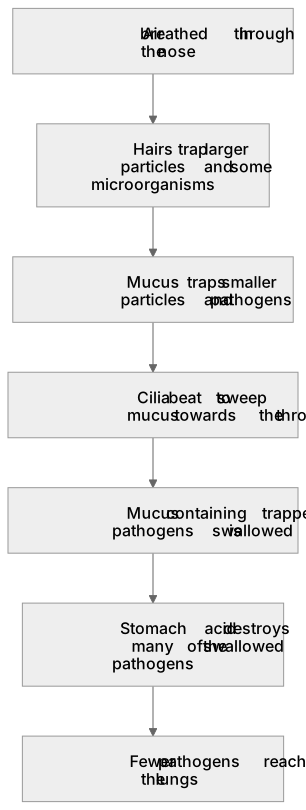
Put it in order
Put these steps in the order they happen.
- 1. Fewer pathogens reach the lungs
- 2. Stomach acid destroys many of the swallowed pathogens
- 3. Mucus traps smaller particles and pathogens
- 4. Mucus containing trapped pathogens is swallowed
- 5. Air breathed in through the nose
- 6. Hairs trap larger particles and some microorganisms
- 7. Cilia beat to sweep mucus towards the throat
Key words
Say what each word means before you turn the card.
Trapping pathogens
Try answering aloud or in your head before turning the card.
Cilia action
Try answering aloud or in your head before turning the card.
Pathogen removal
Try answering aloud or in your head before turning the card.
See every definition
- Trapping pathogens
- Hairs trap larger particles such as dust and some microorganisms, while mucus traps smaller particles and pathogens.
- Cilia action
- Tiny hair-like structures on epithelial cells beat rhythmically to sweep mucus containing trapped microbes towards the throat.
- Pathogen removal
- Swallowed mucus carries pathogens to the stomach, where acid destroys them, reducing the number reaching the lungs.
Label the diagram
Some boxes have lost their names. Pick the right name for each number.
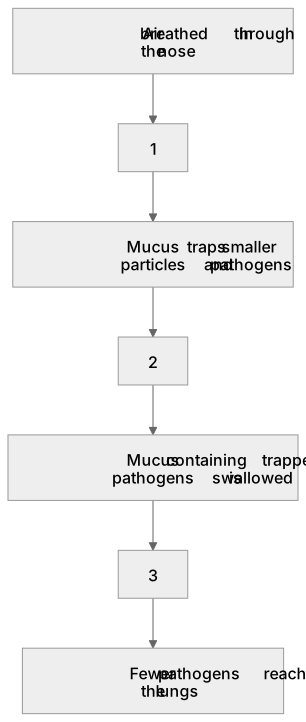
1Box 1
2Box 2
3Box 3
There is more to this lesson
The full lesson goes on to check your understanding and help you earn the marks. Create a free account to carry on, with your progress saved.
A week of Premium from your first lesson · Then the free plan continues · No card, no charge
Test your understanding of Human defence systems: nose
Active recall beats re-reading. Take an instant quiz now to test what you’ve learned and lock it into long-term memory.
A week of Premium from your first lesson · Then the free plan continues · No card, no charge