AQA · GCSE · Combined Science
Course version: 8464 · Version from Sept 2018
When a metal atom reacts with a non-metal atom electrons in the outer…
Full specification wording
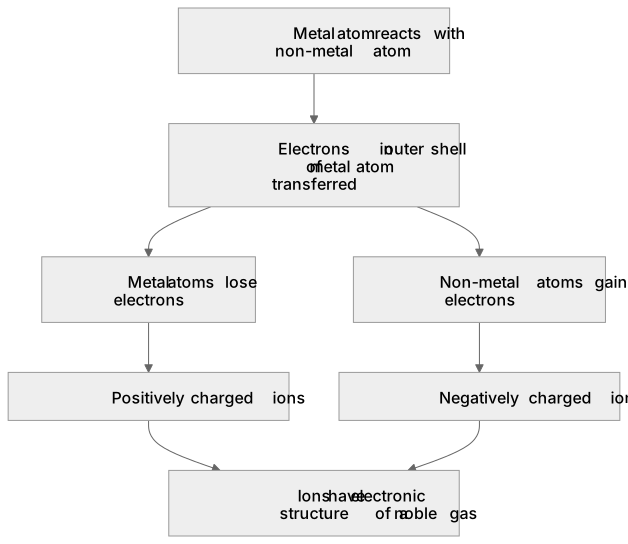
Ionic bonding: When a metal atom reacts with a non-metal atom electrons in the outer shell of the metal atom are transferred. Metal atoms lose electrons to become positively charged ions. Non-metal atoms gain electrons to become negatively charged ions. The ions produced by metals in Groups 1 and 2 and by non-metals in Groups 6 and 7 have the electronic structure of a noble gas (Group 0).
Ionic bonding occurs when a metal atom reacts with a non-metal atom.
Checked against the AQA 8464 specification (opens in a new tab) on .
- Point 1 of 5
- 4 key terms
Study notes
From the checked teaching notes for this specification point.
The idea
Ionic bonding occurs when a metal atom reacts with a non-metal atom. The metal atom transfers electrons from its outer shell to the non-metal atom. By losing electrons, the metal atom forms a positive ion; by gaining electrons, the non-metal atom forms a negative ion. For example, sodium (2,8,1) loses one electron to become Na⁺ with the electronic structure 2,8, matching neon. Chlorine (2,8,7) gains one electron to become Cl⁻ with the electronic structure 2,8,8, matching argon. Metals in Group 1 lose one electron to form 1⁺ ions; Group 2 metals lose two electrons to form 2⁺ ions. Non-metals in Group 6 gain two electrons to form 2⁻ ions; Group 7 non-metals gain one electron to form 1⁻ ions. In each case, the resulting ion has the same electronic structure as a noble gas.
What earns the marks
- Electrons in the outer shell of the metal atom are transferred to the non-metal atom during reaction.
- Metal atoms lose electrons and become positively charged ions.
- Non-metal atoms gain electrons and become negatively charged ions.
- Group 1 metals lose one electron to form 1⁺ ions; Group 2 metals lose two electrons to form 2⁺ ions.
- Group 6 non-metals gain two electrons to form 2⁻ ions; Group 7 non-metals gain one electron to form 1⁻ ions.
- The ions formed have the electronic structure of a noble gas, such as Na⁺ (2,8) and Cl⁻ (2,8,8).
Common mistakes and how to put them right
Writing that metal atoms gain electrons to become positive ions.
Put it right by stating that metals lose electrons and become positive ions.
Stating that non-metal atoms lose electrons to become negative ions.
Put it right by stating that non-metals gain electrons and become negative ions.
Giving ion charges without the correct sign or number, such as writing Na²⁺ for sodium.
Put it right by using the group number to determine the charge, so Group 1 gives 1⁺ and Group 2 gives 2⁺.
Exam tips
- Link the group number of the metal to the number of electrons lost and the charge on the positive ion.
- Link the group number of the non-metal to the number of electrons gained and the charge on the negative ion.
- Check that the electron configuration of each ion matches that of a noble gas, such as 2,8 for Na⁺ and 2,8,8 for Cl⁻.
Try the lesson
The start of the Ionic bonding: When a metal atom reacts with a non-metal atom electrons in the outer shell of the metal atom are transferred. Metal atoms lose electrons to become positively charged ions. Non-metal atoms gain electrons to become negatively charged ions. The ions produced by metals in Groups 1 and 2 and by non-metals in Groups 6 and 7 have the electronic structure of a noble gas (Group 0). lesson, made from checked teaching notes for this specification point.
Have a go first
A sodium atom in Group 1 reacts with a chlorine atom in Group 7. What happens to the outer shell electron of the sodium atom?
Listen
Ionic bonding occurs when a metal atom reacts with a non-metal atom. The metal atom transfers electrons from its outer shell to the non-metal atom. By losing electrons, the metal atom forms a positive ion; by gaining electrons, the non-metal atom forms a negative ion. For example, sodium (2,8,1) loses one electron to become Na⁺ with the electronic structure 2,8, matching neon. Chlorine (2,8,7) gains one electron to become Cl⁻ with the electronic structure 2,8,8, matching argon. Metals in Group 1 lose one electron to form 1⁺ ions; Group 2 metals lose two electrons to form 2⁺ ions. Non-metals in Group 6 gain two electrons to form 2⁻ ions; Group 7 non-metals gain one electron to form 1⁻ ions. In each case, the resulting ion has the same electronic structure as a noble gas. A strong answer earns marks for these points. Electrons in the outer shell of the metal atom are transferred to the non-metal atom during reaction. Metal atoms lose electrons and become positively charged ions. Non-metal atoms gain electrons and become negatively charged ions. Group 1 metals lose one electron to form 1⁺ ions; Group 2 metals lose two electrons to form 2⁺ ions. A common slip: Writing that metal atoms gain electrons to become positive ions. Instead, stating that metals lose electrons and become positive ions. Exam tip: Link the group number of the metal to the number of electrons lost and the charge on the positive ion.
See it
Key words
Say what each word means before you turn the card.
Electron transfer
Try answering aloud or in your head before turning the card.
Positive ion
Try answering aloud or in your head before turning the card.
Negative ion
Try answering aloud or in your head before turning the card.
Noble gas electronic structure
Try answering aloud or in your head before turning the card.
See every definition
- Electron transfer
- When a metal atom reacts with a non-metal atom, electrons in the outer shell of the metal atom are transferred.
- Positive ion
- A metal atom loses electrons to become a positively charged ion.
- Negative ion
- A non-metal atom gains electrons to become a negatively charged ion.
- Noble gas electronic structure
- The ions produced by metals in Groups 1 and 2 and by non-metals in Groups 6 and 7 have the electronic structure of a noble gas (Group 0).
Label the diagram
Some boxes have lost their names. Pick the right name for each number.
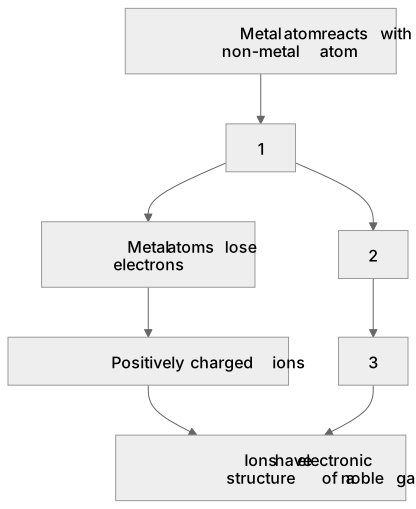
1Box 1
2Box 2
3Box 3
There is more to this lesson
The full lesson goes on to check your understanding and help you earn the marks. Create a free account to carry on, with your progress saved.
A week of Premium from your first lesson · Then the free plan continues · No card, no charge
Test your understanding of Ionic bonding: When a metal atom reacts with a non-metal atom electrons in the outer shell of the metal atom are transferred. Metal atoms lose electrons to become positively charged ions. Non-metal atoms gain electrons to become negatively charged ions. The ions produced by metals in Groups 1 and 2 and by non-metals in Groups 6 and 7 have the electronic structure of a noble gas (Group 0).
Active recall beats re-reading. Take an instant quiz now to test what you’ve learned and lock it into long-term memory.
A week of Premium from your first lesson · Then the free plan continues · No card, no charge