AQA · GCSE · Combined Science
Course version: 8464 · Version from Sept 2018
Key ideas: electron transfer
Electron transfer is the movement of electrons between species and explains redox reactions.
Checked against the AQA 8464 specification (opens in a new tab) on .
- Point 18 of 26
- 4 key terms
Study notes
From the checked teaching notes for this specification point.
The idea
Electron transfer is the movement of electrons between species and explains redox reactions. Oxidation is loss of electrons; reduction is gain of electrons. In a reaction, the species that loses electrons is oxidised and acts as the reducing agent, while the species that gains electrons is reduced and acts as the oxidising agent. For example, in 2Mg + O₂ → 2MgO, magnesium atoms lose electrons to form Mg²⁺ and oxygen atoms gain electrons to form O²⁻. In displacement, Zn + Cu²⁺ → Zn²⁺ + Cu, zinc loses electrons and copper ions gain them.
What earns the marks
- States that oxidation is loss of electrons and reduction is gain of electrons, using OIL RIG or equivalent reasoning.
- Identifies the species oxidised and the species reduced in a given reaction by tracking electron loss and gain.
- Writes half-equations such as Mg → Mg²⁺ + 2e⁻ and O₂ + 4e⁻ → 2O²⁻, balancing charge and atoms.
- Explains redox in terms of electron transfer, including the roles of oxidising and reducing agents.
- Links electron transfer to observable changes, for example displacement of copper by zinc or colour change in a solution.
Common mistakes and how to put them right
Saying oxidation is gain of oxygen only.
Put it right: In terms of electrons, oxidation is loss of electrons, even when oxygen is not involved.
Writing half-equations that are not charge-balanced.
Put it right: Add electrons to the side that needs negative charge so total charge is equal on both sides.
Confusing the oxidising agent with the species oxidised.
Put it right: The oxidising agent gains electrons and is itself reduced.
Exam tips
- Use OIL RIG to check which species loses and which gains electrons before answering.
- Balance half-equations for both atoms and charge, then combine them so electrons cancel.
- When asked to explain a displacement, name the electron transfer and the observation, such as a pink-brown solid forming.
Try the lesson
The start of the Key ideas: electron transfer lesson, made from checked teaching notes for this specification point.
Have a go first
In the reaction between sodium and chlorine, each sodium atom loses one electron to a chlorine atom. What is the charge on the sodium ion that is formed?
Listen
Electron transfer is the movement of electrons between species and explains redox reactions. Oxidation is loss of electrons; reduction is gain of electrons. In a reaction, the species that loses electrons is oxidised and acts as the reducing agent, while the species that gains electrons is reduced and acts as the oxidising agent. For example, in 2Mg + O₂ → 2MgO, magnesium atoms lose electrons to form Mg²⁺ and oxygen atoms gain electrons to form O²⁻. In displacement, Zn + Cu²⁺ → Zn²⁺ + Cu, zinc loses electrons and copper ions gain them. A strong answer earns marks for these points. States that oxidation is loss of electrons and reduction is gain of electrons, using OIL RIG or equivalent reasoning. Identifies the species oxidised and the species reduced in a given reaction by tracking electron loss and gain. Writes half-equations such as Mg → Mg²⁺ + 2e⁻ and O₂ + 4e⁻ → 2O²⁻, balancing charge and atoms. Explains redox in terms of electron transfer, including the roles of oxidising and reducing agents. A common slip: Saying oxidation is gain of oxygen only. Instead, in terms of electrons, oxidation is loss of electrons, even when oxygen is not involved. Exam tip: Use OIL RIG to check which species loses and which gains electrons before answering.
See it
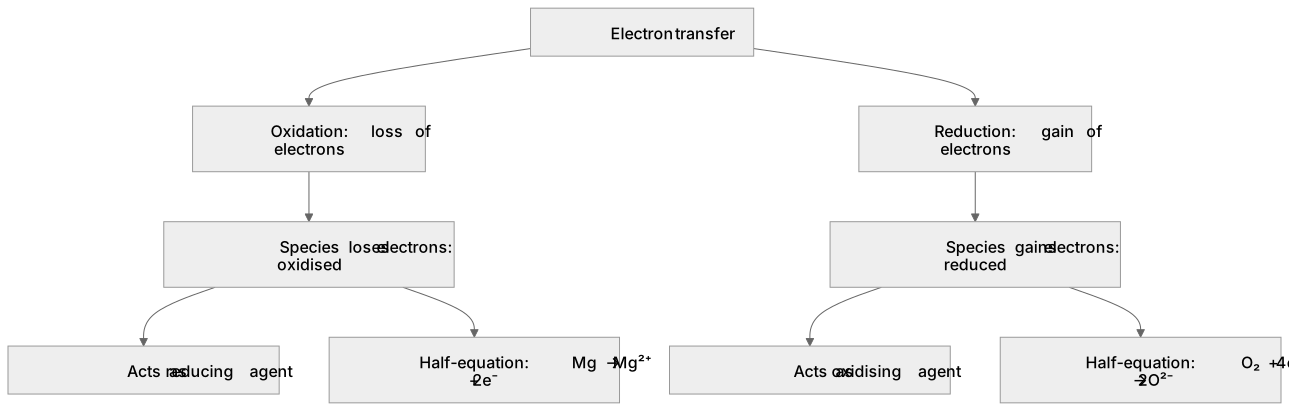
Key words
Say what each word means before you turn the card.
Oxidation
Try answering aloud or in your head before turning the card.
Reduction
Try answering aloud or in your head before turning the card.
Reducing agent
Try answering aloud or in your head before turning the card.
Oxidising agent
Try answering aloud or in your head before turning the card.
See every definition
- Oxidation
- Loss of electrons by a species in a reaction.
- Reduction
- Gain of electrons by a species in a reaction.
- Reducing agent
- The species that loses electrons and is itself oxidised.
- Oxidising agent
- The species that gains electrons and is itself reduced.
Label the diagram
Some boxes have lost their names. Pick the right name for each number.
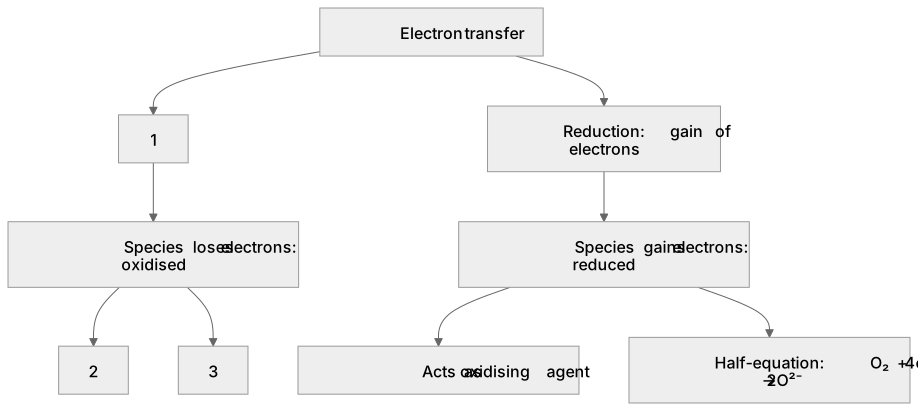
1Box 1
2Box 2
3Box 3
There is more to this lesson
The full lesson goes on to check your understanding and help you earn the marks. Create a free account to carry on, with your progress saved.
A week of Premium from your first lesson · Then the free plan continues · No card, no charge
Test your understanding of Key ideas: electron transfer
Active recall beats re-reading. Take an instant quiz now to test what you’ve learned and lock it into long-term memory.
A week of Premium from your first lesson · Then the free plan continues · No card, no charge