AQA · GCSE · Combined Science
Course version: 8464 · Version from Sept 2018
Matter is composed of tiny particles called atoms and there are about 100…
Full specification wording
Key ideas: matter is composed of tiny particles called atoms and there are about 100 different naturally occurring types of atoms called elements
Matter is made of tiny particles called atoms.
Checked against the AQA 8464 specification (opens in a new tab) on .
- Point 10 of 26
- 4 key terms
Study notes
From the checked teaching notes for this specification point.
The idea
Matter is made of tiny particles called atoms. An element is a substance containing only one type of atom, and about 100 elements occur naturally. Each element has a unique atomic number, which is the number of protons in its nucleus, so atoms of different elements differ in proton number. Atoms of the same element can have different mass numbers because they may be different isotopes, but they remain the same element. Elements are arranged in the periodic table in order of atomic number. You need to use this idea to explain why there are so many substances: atoms of different elements join in fixed ratios to form compounds, while mixtures contain elements or compounds not chemically combined.
What earns the marks
- Matter is composed of tiny particles called atoms.
- An element is a substance made of only one type of atom.
- There are about 100 naturally occurring elements.
- Each element has a unique atomic number equal to the number of protons in its atoms.
- Isotopes are atoms of the same element with different numbers of neutrons and therefore different mass numbers.
- Elements are arranged in the periodic table in order of increasing atomic number.
Common mistakes and how to put them right
Saying an atom is the smallest particle that exists.
Put it right by noting that atoms contain protons, neutrons and electrons, and that 'smallest part of an element' is the useful definition.
Confusing atomic number with mass number.
Put it right by stating that atomic number counts protons, while mass number counts protons plus neutrons.
Thinking all atoms of an element are identical in mass.
Put it right by explaining isotopes and relative atomic mass.
Exam tips
- Learn the definitions of atom, element, compound and mixture, and be ready to classify a substance from its formula or particle diagram.
- When asked about isotopes, quote proton number and neutron number separately before comparing mass numbers.
- Use the periodic table's order to justify why elements are placed in a particular group or period.
Try the lesson
The start of the Key ideas: matter is composed of tiny particles called atoms and there are about 100 different naturally occurring types of atoms called elements lesson, made from checked teaching notes for this specification point.
Have a go first
Which tiny particles make up all matter?
Listen
Matter is made of tiny particles called atoms. An element is a substance containing only one type of atom, and about 100 elements occur naturally. Each element has a unique atomic number, which is the number of protons in its nucleus, so atoms of different elements differ in proton number. Atoms of the same element can have different mass numbers because they may be different isotopes, but they remain the same element. Elements are arranged in the periodic table in order of atomic number. You need to use this idea to explain why there are so many substances: atoms of different elements join in fixed ratios to form compounds, while mixtures contain elements or compounds not chemically combined. A strong answer earns marks for these points. Matter is composed of tiny particles called atoms. An element is a substance made of only one type of atom. There are about 100 naturally occurring elements. Each element has a unique atomic number equal to the number of protons in its atoms. A common slip: Saying an atom is the smallest particle that exists. Instead, noting that atoms contain protons, neutrons and electrons, and that 'smallest part of an element' is the useful definition. Exam tip: Learn the definitions of atom, element, compound and mixture, and be ready to classify a substance from its formula or particle diagram.
See it
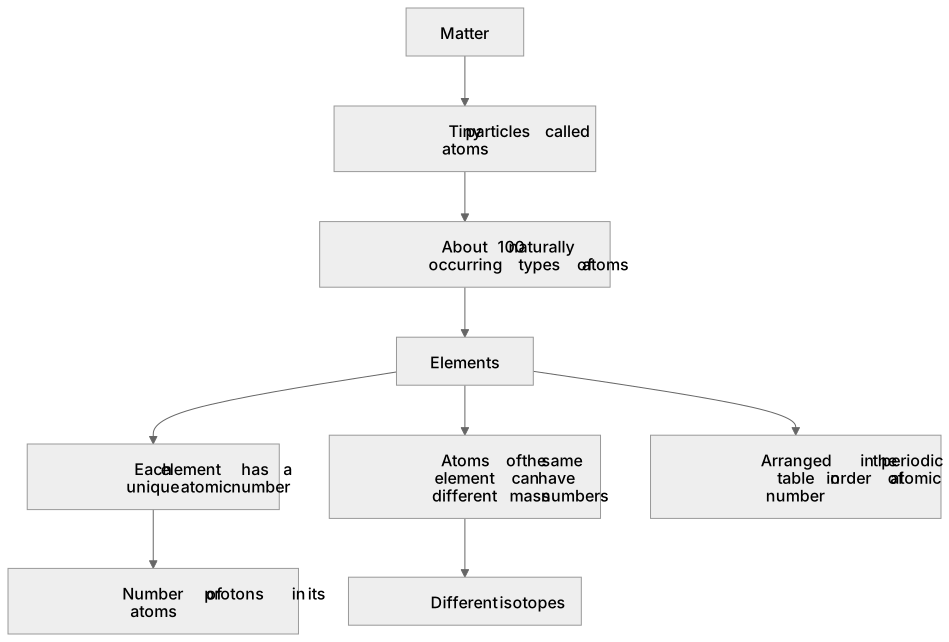
Key words
Say what each word means before you turn the card.
Atom
Try answering aloud or in your head before turning the card.
Element
Try answering aloud or in your head before turning the card.
Atomic number
Try answering aloud or in your head before turning the card.
Isotopes
Try answering aloud or in your head before turning the card.
See every definition
- Atom
- A tiny particle of which matter is composed.
- Element
- A substance made of only one type of atom, of which about 100 occur naturally.
- Atomic number
- The number of protons in an atom's nucleus, which is unique to each element.
- Isotopes
- Atoms of the same element with different numbers of neutrons and therefore different mass numbers.
Label the diagram
Some boxes have lost their names. Pick the right name for each number.
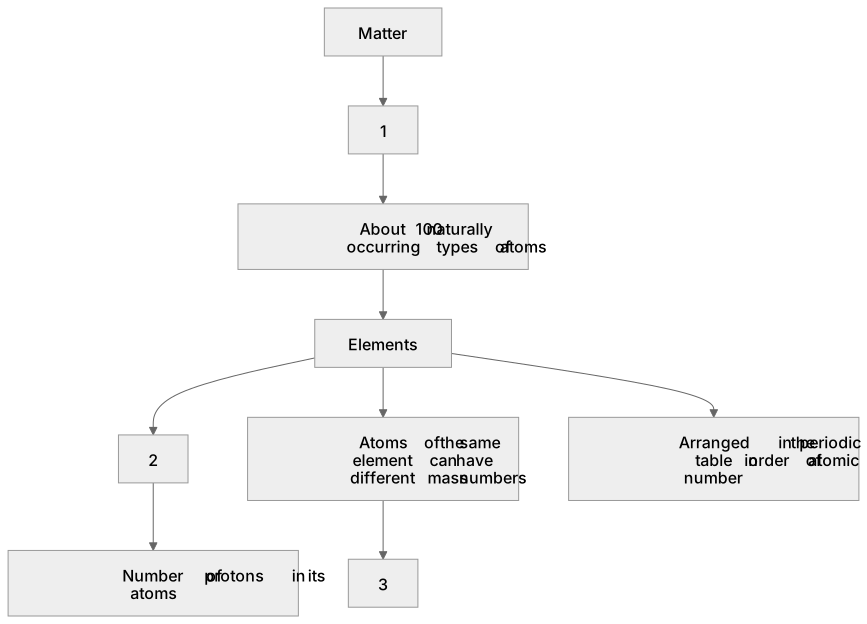
1Box 1
2Box 2
3Box 3
There is more to this lesson
The full lesson goes on to check your understanding and help you earn the marks. Create a free account to carry on, with your progress saved.
A week of Premium from your first lesson · Then the free plan continues · No card, no charge
Test your understanding of Key ideas: matter is composed of tiny particles called atoms and there are about 100 different naturally occurring types of atoms called elements
Active recall beats re-reading. Take an instant quiz now to test what you’ve learned and lock it into long-term memory.
A week of Premium from your first lesson · Then the free plan continues · No card, no charge