AQA · GCSE · Combined Science
Course version: 8464 · Version from Sept 2018
Key ideas: that physical laws and models are expressed in mathematical form.
Physics uses mathematics as its language: a physical law links measurable quantities through an equation, and a model simplifies a real system so those quantities can be calculated.
Checked against the AQA 8464 specification (opens in a new tab) on .
- Point 26 of 26
- 3 key terms
Study notes
From the checked teaching notes for this specification point.
The idea
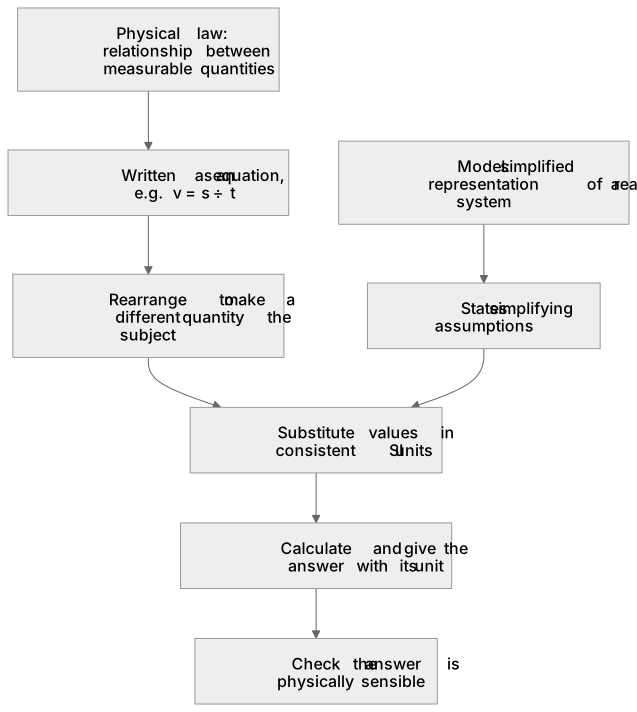
Physics uses mathematics as its language: a physical law links measurable quantities through an equation, and a model simplifies a real system so those quantities can be calculated. For example, speed is modelled as distance divided by time, v = s ÷ t, so a car travelling 150 m in 10 s has a speed of 15 m/s. The equation is the law; the assumption of steady motion is the model. Rearranging, substituting consistent SI units and checking that the answer is sensible are all part of expressing physics mathematically. Graphs, proportionality and standard form also communicate relationships. This idea underpins every calculation in the specification, so you should practise moving between words, symbols and numbers confidently.
What earns the marks
- Recognises that a physical law is a relationship between measurable quantities that can be written as an equation, such as v = s ÷ t or F = m × a.
- Explains that a model is a simplified representation of a real system, for example treating a moving car as a point object with constant speed.
- Uses correct symbols, units and standard form when substituting values into an equation, converting units such as cm to m or g to kg before calculating.
- Rearranges an equation to make a different quantity the subject, for example changing v = s ÷ t into s = v × t.
- Interprets a graph or proportionality relationship, such as recognising that current is directly proportional to potential difference for a fixed resistor.
- Checks that a calculated answer is physically sensible and carries the correct unit, for example a speed of 15 m/s rather than 15 m.
Common mistakes and how to put them right
Substituting values without converting units first, for example using 150 cm as 150 m.
Put it right by converting every quantity to SI units before calculating.
Treating a model as an exact description of reality.
Put it right by stating the simplifying assumptions, such as ignoring air resistance or friction.
Rearranging an equation incorrectly, for example writing s = v ÷ t from v = s ÷ t.
Put it right by using inverse operations and checking by substitution.
Exam tips
- Write the equation, then substitute numbers with units, then give the answer with its unit; this makes your method clear to the examiner.
- Show each rearrangement step rather than jumping straight to the final line, so any slip is easy to spot and credit.
- When a question asks you to explain a model, name the assumption made and say how it affects the calculation.
Try the lesson
The start of the Key ideas: that physical laws and models are expressed in mathematical form. lesson, made from checked teaching notes for this specification point.
Have a go first
Scientists use physical laws to describe how the universe works. For example, the relationship between distance, speed and time is a physical law. How are physical laws like this usually expressed so that they can be used to calculate unknown values?
Listen
Physics uses mathematics as its language: a physical law links measurable quantities through an equation, and a model simplifies a real system so those quantities can be calculated. For example, speed is modelled as distance divided by time, v = s ÷ t, so a car travelling 150 m in 10 s has a speed of 15 m/s. The equation is the law; the assumption of steady motion is the model. Rearranging, substituting consistent SI units and checking that the answer is sensible are all part of expressing physics mathematically. Graphs, proportionality and standard form also communicate relationships. This idea underpins every calculation in the specification, so you should practise moving between words, symbols and numbers confidently. A strong answer earns marks for these points. Recognises that a physical law is a relationship between measurable quantities that can be written as an equation, such as v = s ÷ t or F = m × a. Explains that a model is a simplified representation of a real system, for example treating a moving car as a point object with constant speed. Uses correct symbols, units and standard form when substituting values into an equation, converting units such as cm to m or g to kg before calculating. Rearranges an equation to make a different quantity the subject, for example changing v = s ÷ t into s = v × t. A common slip: Substituting values without converting units first, for example using 150 cm as 150 m. Instead, converting every quantity to SI units before calculating. Exam tip: Write the equation, then substitute numbers with units, then give the answer with its unit; this makes your method clear to the examiner.
See it
Key words
Say what each word means before you turn the card.
Physical law
Try answering aloud or in your head before turning the card.
Model
Try answering aloud or in your head before turning the card.
Standard form
Try answering aloud or in your head before turning the card.
See every definition
- Physical law
- A relationship between measurable quantities that can be written as an equation.
- Model
- A simplified representation of a real system, such as treating a moving car as a point object with constant speed.
- Standard form
- A way of expressing numbers that, with correct symbols and units, is used when substituting values into an equation.
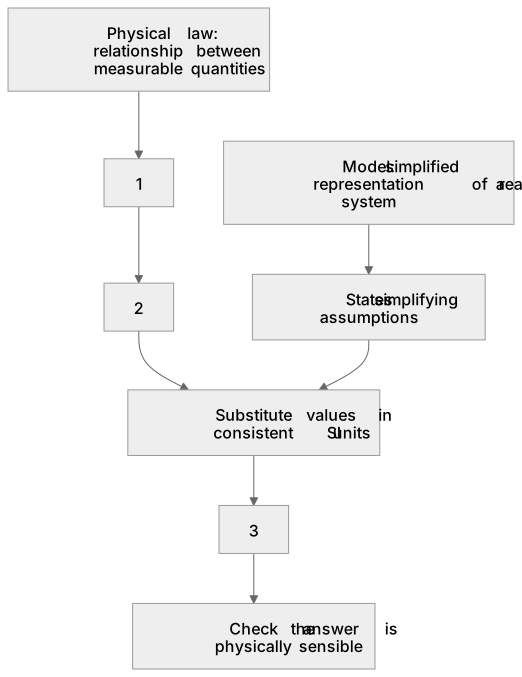
Label the diagram
Some boxes have lost their names. Pick the right name for each number.
1Box 1
2Box 2
3Box 3
There is more to this lesson
The full lesson goes on to check your understanding and help you earn the marks. Create a free account to carry on, with your progress saved.
A week of Premium from your first lesson · Then the free plan continues · No card, no charge
Test your understanding of Key ideas: that physical laws and models are expressed in mathematical form.
Active recall beats re-reading. Take an instant quiz now to test what you’ve learned and lock it into long-term memory.
A week of Premium from your first lesson · Then the free plan continues · No card, no charge