AQA · GCSE · Combined Science
Course version: 8464 · Version from Sept 2018
Recycling resources rather than dumping waste in landfill.
Full specification wording
Maintaining biodiversity: recycling resources rather than dumping waste in landfill.
Recycling processes used materials into new products instead of sending them to landfill.
Checked against the AQA 8464 specification (opens in a new tab) on .
- Point 8 of 8
- 4 key terms
Study notes
From the checked teaching notes for this specification point.
The idea
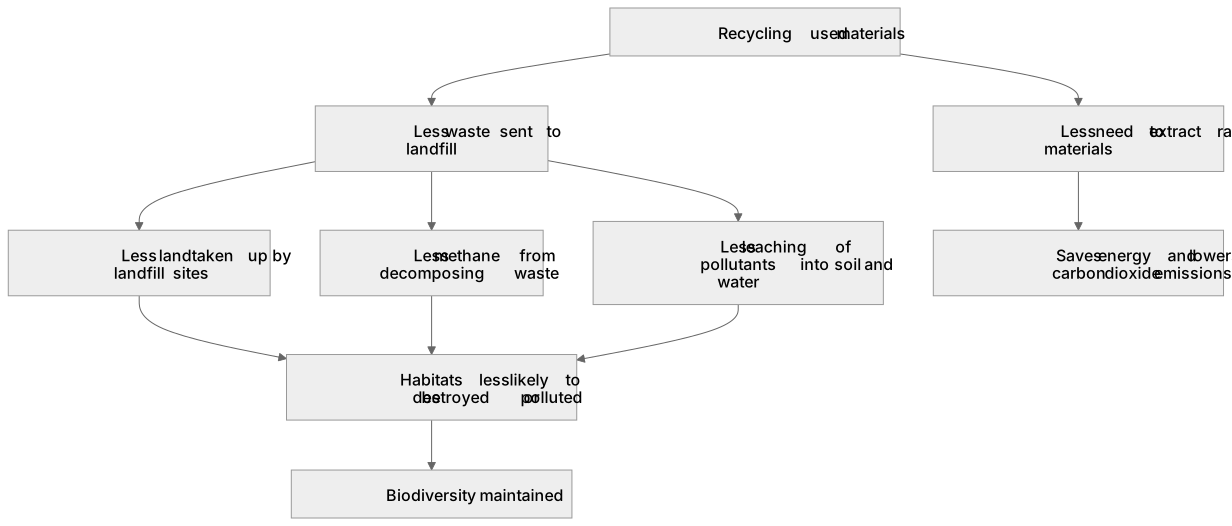
Recycling processes used materials into new products instead of sending them to landfill. This reduces the volume of waste buried, so less land is taken up by landfill sites and habitats are less likely to be destroyed or polluted. Recycling also reduces the need to extract and process raw materials such as metal ores, crude oil and timber, which saves energy and lowers carbon dioxide emissions. Less landfill means less methane produced by decomposing waste, and fewer pollutants can leach into soil and water. For example, recycling aluminium cans uses much less energy than extracting aluminium from its ore, and recycling paper reduces the number of trees felled. Overall, recycling helps maintain biodiversity by reducing habitat destruction, pollution and resource extraction.
What earns the marks
- Recycling reduces the quantity of waste sent to landfill, so less land is used for waste disposal and habitats are preserved.
- Recycling reduces the need to extract raw materials such as metal ores, crude oil and timber, conserving natural resources.
- Recycling often uses less energy than producing materials from raw sources, lowering carbon dioxide emissions.
- Less landfill reduces methane production from decomposing waste and reduces leaching of pollutants into soil and water.
- Protecting habitats from landfill and pollution helps maintain biodiversity and ecosystem stability.
- Recycling schemes may require collection, sorting and processing, which can have their own energy costs and limitations.
Common mistakes and how to put them right
Thinking recycling only saves resources and has no effect on biodiversity.
Put it right: Less landfill and less extraction protect habitats and reduce pollution.
Believing all materials can be recycled endlessly.
Put it right: Materials such as paper fibres shorten with each cycle, and some plastics are difficult to recycle.
Assuming recycling has no environmental cost.
Put it right: Collection and processing use energy and transport, so the benefit depends on the material and scheme.
Exam tips
- Compare recycling with landfill by naming the specific harm avoided, such as habitat loss, methane or leaching.
- Use a named material example, such as aluminium or paper, to show how recycling saves energy or trees.
- If asked to evaluate, state one advantage and one limitation of recycling rather than only listing benefits.
Try the lesson
The start of the Maintaining biodiversity: recycling resources rather than dumping waste in landfill. lesson, made from checked teaching notes for this specification point.
Have a go first
Which action helps to maintain biodiversity by reducing the amount of waste sent to landfill?
Listen
Recycling processes used materials into new products instead of sending them to landfill. This reduces the volume of waste buried, so less land is taken up by landfill sites and habitats are less likely to be destroyed or polluted. Recycling also reduces the need to extract and process raw materials such as metal ores, crude oil and timber, which saves energy and lowers carbon dioxide emissions. Less landfill means less methane produced by decomposing waste, and fewer pollutants can leach into soil and water. For example, recycling aluminium cans uses much less energy than extracting aluminium from its ore, and recycling paper reduces the number of trees felled. Overall, recycling helps maintain biodiversity by reducing habitat destruction, pollution and resource extraction. A strong answer earns marks for these points. Recycling reduces the quantity of waste sent to landfill, so less land is used for waste disposal and habitats are preserved. Recycling reduces the need to extract raw materials such as metal ores, crude oil and timber, conserving natural resources. Recycling often uses less energy than producing materials from raw sources, lowering carbon dioxide emissions. Less landfill reduces methane production from decomposing waste and reduces leaching of pollutants into soil and water. A common slip: Thinking recycling only saves resources and has no effect on biodiversity. Instead, less landfill and less extraction protect habitats and reduce pollution. Exam tip: Compare recycling with landfill by naming the specific harm avoided, such as habitat loss, methane or leaching.
See it
Key words
Say what each word means before you turn the card.
Waste management and landfill
Try answering aloud or in your head before turning the card.
Conservation of natural resources
Try answering aloud or in your head before turning the card.
Energy use and carbon dioxide emissions
Try answering aloud or in your head before turning the card.
Biodiversity and habitat protection
Try answering aloud or in your head before turning the card.
See every definition
- Waste management and landfill
- Recycling processes used materials into new products instead of sending them to landfill, reducing the volume of waste buried.
- Conservation of natural resources
- Recycling reduces the need to extract and process raw materials such as metal ores, crude oil and timber.
- Energy use and carbon dioxide emissions
- Recycling saves energy and lowers carbon dioxide emissions compared with extracting and processing raw materials.
- Biodiversity and habitat protection
- Recycling helps maintain biodiversity by reducing habitat destruction, pollution and resource extraction.
Label the diagram
Some boxes have lost their names. Pick the right name for each number.
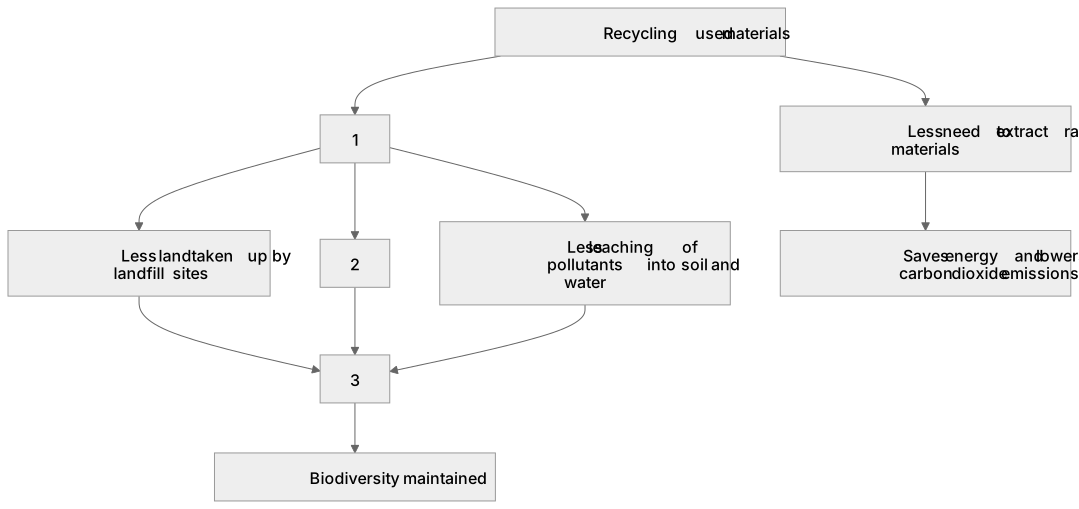
1Box 1
2Box 2
3Box 3
There is more to this lesson
The full lesson goes on to check your understanding and help you earn the marks. Create a free account to carry on, with your progress saved.
A week of Premium from your first lesson · Then the free plan continues · No card, no charge
Test your understanding of Maintaining biodiversity: recycling resources rather than dumping waste in landfill.
Active recall beats re-reading. Take an instant quiz now to test what you’ve learned and lock it into long-term memory.
A week of Premium from your first lesson · Then the free plan continues · No card, no charge