AQA · GCSE · Combined Science
Course version: 8464 · Version from Sept 2018
Reintroduction of field margins and hedgerows in agricultural areas where…
Full specification wording
Maintaining biodiversity: reintroduction of field margins and hedgerows in agricultural areas where farmers grow only one type of crop
Monoculture means growing one crop over a large area, which reduces plant variety and removes food and shelter for many animals.
Checked against the AQA 8464 specification (opens in a new tab) on .
- Point 6 of 8
- 4 key terms
Study notes
From the checked teaching notes for this specification point.
The idea
Monoculture means growing one crop over a large area, which reduces plant variety and removes food and shelter for many animals. Reintroducing field margins and hedgerows breaks up that uniformity. A field margin is an uncropped strip around a field, often sown with wildflowers or left as rough grass. A hedgerow is a line of shrubs and trees along a boundary. Together they provide nesting sites, nectar, berries and overwintering cover, and they act as wildlife corridors linking patches of habitat. This raises species richness and supports pollinators and natural predators of pests, which can also help the farmer.
What earns the marks
- Monoculture reduces biodiversity because a single crop supports fewer species than a varied plant community.
- Field margins are uncropped strips around fields that provide food, shelter and nesting sites for invertebrates, birds and small mammals.
- Hedgerows are lines of shrubs and trees that give cover, berries and corridors for wildlife moving between habitats.
- Reintroducing these features increases species richness and can support pollinators and predators of crop pests.
- The benefit is assessed by comparing species counts in fields with margins and hedgerows against fields without them.
Common mistakes and how to put them right
Saying hedgerows only look attractive.
Put it right: They are habitat and wildlife corridors, not just scenery.
Forgetting that field margins are left uncropped.
Put it right: If they are sprayed or cropped they lose much of their value.
Claiming biodiversity rises instantly.
Put it right: New hedgerows take years to mature and support a full community.
Exam tips
- Link each feature to a specific need, such as nectar for pollinators or berries for birds in winter.
- Use the term monoculture correctly and explain why it lowers biodiversity before describing the fix.
- If asked to evaluate, mention that hedgerows and margins take land out of production, so there is a trade-off with yield.
Try the lesson
The start of the Maintaining biodiversity: reintroduction of field margins and hedgerows in agricultural areas where farmers grow only one type of crop lesson, made from checked teaching notes for this specification point.
Have a go first
In agricultural areas where farmers grow only one type of crop, how does the reintroduction of field margins help to maintain biodiversity?
Listen
Monoculture means growing one crop over a large area, which reduces plant variety and removes food and shelter for many animals. Reintroducing field margins and hedgerows breaks up that uniformity. A field margin is an uncropped strip around a field, often sown with wildflowers or left as rough grass. A hedgerow is a line of shrubs and trees along a boundary. Together they provide nesting sites, nectar, berries and overwintering cover, and they act as wildlife corridors linking patches of habitat. This raises species richness and supports pollinators and natural predators of pests, which can also help the farmer. A strong answer earns marks for these points. Monoculture reduces biodiversity because a single crop supports fewer species than a varied plant community. Field margins are uncropped strips around fields that provide food, shelter and nesting sites for invertebrates, birds and small mammals. Hedgerows are lines of shrubs and trees that give cover, berries and corridors for wildlife moving between habitats. Reintroducing these features increases species richness and can support pollinators and predators of crop pests. Exam tip: Link each feature to a specific need, such as nectar for pollinators or berries for birds in winter.
See it
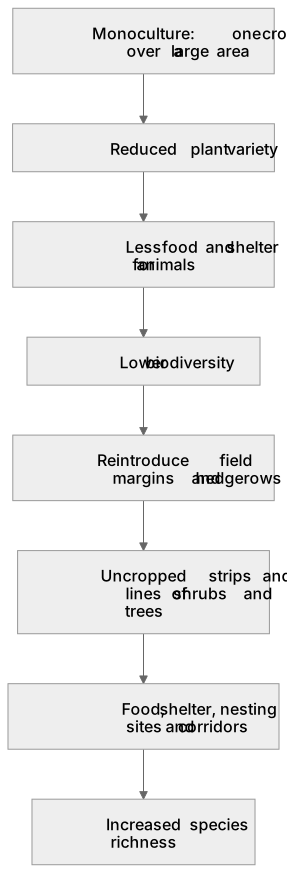
Put it in order
Put these steps in the order they happen.
- 1. Reintroduce field margins and hedgerows
- 2. Increased species richness
- 3. Uncropped strips and lines of shrubs and trees
- 4. Monoculture: one crop over a large area
- 5. Reduced plant variety
- 6. Food, shelter, nesting sites and corridors
- 7. Less food and shelter for animals
- 8. Lower biodiversity
Key words
Say what each word means before you turn the card.
Monoculture
Try answering aloud or in your head before turning the card.
Field margin
Try answering aloud or in your head before turning the card.
Hedgerow
Try answering aloud or in your head before turning the card.
Wildlife corridors
Try answering aloud or in your head before turning the card.
See every definition
- Monoculture
- Growing one crop over a large area, which reduces plant variety and removes food and shelter for many animals.
- Field margin
- An uncropped strip around a field, often sown with wildflowers or left as rough grass, providing food, shelter and nesting sites.
- Hedgerow
- A line of shrubs and trees along a boundary that gives cover, berries and corridors for wildlife moving between habitats.
- Wildlife corridors
- Features that link patches of habitat, allowing wildlife to move between them.
Label the diagram
Some boxes have lost their names. Pick the right name for each number.
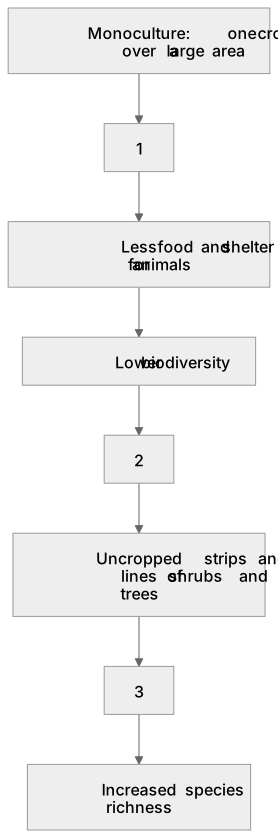
1Box 1
2Box 2
3Box 3
There is more to this lesson
The full lesson goes on to check your understanding and help you earn the marks. Create a free account to carry on, with your progress saved.
A week of Premium from your first lesson · Then the free plan continues · No card, no charge
Test your understanding of Maintaining biodiversity: reintroduction of field margins and hedgerows in agricultural areas where farmers grow only one type of crop
Active recall beats re-reading. Take an instant quiz now to test what you’ve learned and lock it into long-term memory.
A week of Premium from your first lesson · Then the free plan continues · No card, no charge