AQA · GCSE · Combined Science
Course version: 8464 · Version from Sept 2018
Meiosis: copies of the genetic information are made
Before a cell divides by meiosis, its genetic information must be copied so that each new cell receives a complete set.
Checked against the AQA 8464 specification (opens in a new tab) on .
- Point 4 of 7
- 4 key terms
Study notes
From the checked teaching notes for this specification point.
The idea
Before a cell divides by meiosis, its genetic information must be copied so that each new cell receives a complete set. The genetic information is the DNA packaged into chromosomes, found in the nucleus of the cell. Before division, the DNA is replicated, so each chromosome forms two identical copies. This copying is essential because meiosis involves two divisions, producing four gametes. Without replication, the four gametes could not each receive a single set of chromosomes.
For example: A human body cell has 46 chromosomes; after copying, there are still 46 chromosomes but each consists of two identical copies, ready for the first meiotic division.
What earns the marks
- Genetic information is carried as DNA in chromosomes in the nucleus.
- The DNA is copied before meiosis begins.
- After copying, each chromosome consists of two identical copies of the DNA.
- The number of chromosomes is unchanged by copying, but the amount of DNA is doubled.
- Copying ensures each of the four gametes can receive one full set of chromosomes.
Common mistakes and how to put them right
Thinking the chromosome number doubles during copying.
Put it right: The number of chromosomes stays the same, but each chromosome now has two identical copies of DNA.
Confusing copying with the first meiotic division.
Put it right: Copying happens before division begins.
Believing gametes are produced directly from the original cell without replication.
Put it right: Replication must occur first so that four gametes each receive a complete set.
Exam tips
- Link copying to the need for four gametes each with a single set of chromosomes.
- Clearly state that the genetic material is copied before the cell divides.
- State that copying occurs before meiosis, not during it.
Try the lesson
The start of the Meiosis: copies of the genetic information are made lesson, made from checked teaching notes for this specification point.
Have a go first
What happens to the genetic information in a cell immediately before meiosis begins?
Listen
Before a cell divides by meiosis, its genetic information must be copied so that each new cell receives a complete set. The genetic information is the DNA packaged into chromosomes, found in the nucleus of the cell. Before division, the DNA is replicated, so each chromosome forms two identical copies. This copying is essential because meiosis involves two divisions, producing four gametes. Without replication, the four gametes could not each receive a single set of chromosomes. For example, a human body cell has 46 chromosomes; after copying, there are still 46 chromosomes but each consists of two identical copies, ready for the first meiotic division. A strong answer earns marks for these points. Genetic information is carried as DNA in chromosomes in the nucleus. The DNA is copied before meiosis begins. After copying, each chromosome consists of two identical copies of the DNA. The number of chromosomes is unchanged by copying, but the amount of DNA is doubled. A common slip: Thinking the chromosome number doubles during copying. Instead, the number of chromosomes stays the same, but each chromosome now has two identical copies of DNA. Exam tip: Link copying to the need for four gametes each with a single set of chromosomes.
See it
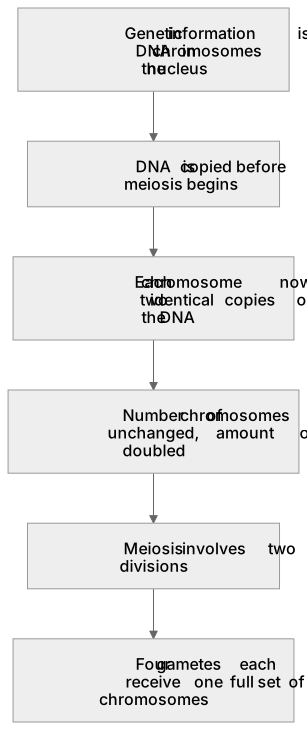
Put it in order
Put these steps in the order they happen.
- 1. Each chromosome now has two identical copies of the DNA
- 2. DNA is copied before meiosis begins
- 3. Genetic information is DNA in chromosomes in the nucleus
- 4. Four gametes each receive one full set of chromosomes
- 5. Meiosis involves two divisions
- 6. Number of chromosomes unchanged, amount of DNA doubled
Key words
Say what each word means before you turn the card.
DNA replication
Try answering aloud or in your head before turning the card.
Chromosomes and DNA
Try answering aloud or in your head before turning the card.
Cell cycle and copying
Try answering aloud or in your head before turning the card.
Genetic continuity
Try answering aloud or in your head before turning the card.
See every definition
- DNA replication
- The DNA is copied before meiosis begins, so each chromosome forms two identical copies.
- Chromosomes and DNA
- Genetic information is carried as DNA in chromosomes in the nucleus.
- Cell cycle and copying
- Copying happens before division begins, and the number of chromosomes is unchanged by copying.
- Genetic continuity
- Copying ensures each of the four gametes can receive one full set of chromosomes.
Label the diagram
Some boxes have lost their names. Pick the right name for each number.
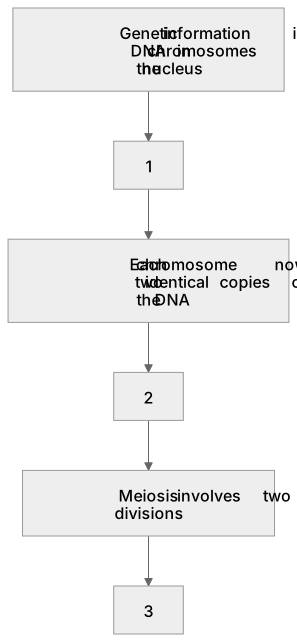
1Box 1
2Box 2
3Box 3
There is more to this lesson
The full lesson goes on to check your understanding and help you earn the marks. Create a free account to carry on, with your progress saved.
A week of Premium from your first lesson · Then the free plan continues · No card, no charge
Test your understanding of Meiosis: copies of the genetic information are made
Active recall beats re-reading. Take an instant quiz now to test what you’ve learned and lock it into long-term memory.
A week of Premium from your first lesson · Then the free plan continues · No card, no charge