AQA · GCSE · Combined Science
Course version: 8464 · Version from Sept 2018
Mixtures can be separated by physical processes such as filtration,…
Full specification wording
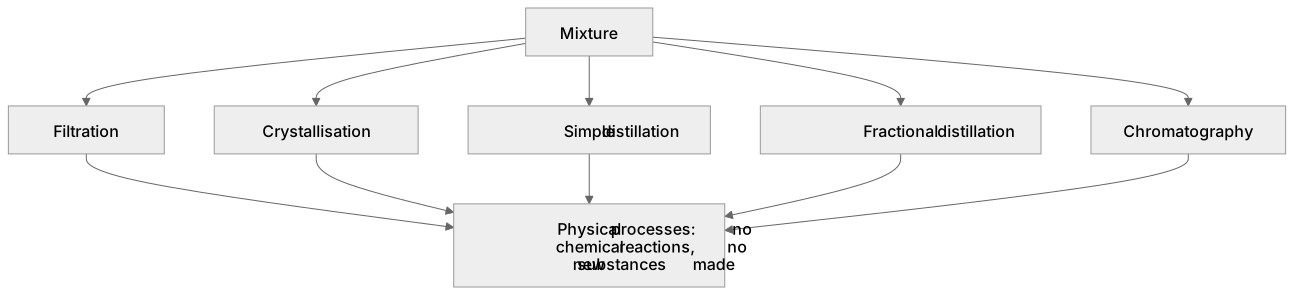
Mixtures: Mixtures can be separated by physical processes such as filtration, crystallisation, simple distillation, fractional distillation and chromatography. These physical processes do not involve chemical reactions and no new substances are made.
A mixture contains two or more substances not chemically joined, so each keeps its own properties and can be separated by physical processes.
Checked against the AQA 8464 specification (opens in a new tab) on .
- Point 2 of 4
- 4 key terms
Study notes
From the checked teaching notes for this specification point.
The idea
A mixture contains two or more substances not chemically joined, so each keeps its own properties and can be separated by physical processes. Filtration separates an insoluble solid from a liquid, for example sand from salty water, using filter paper and a funnel. Crystallisation recovers a dissolved solid by gently evaporating solvent until crystals form. Simple distillation separates a solvent from a solution, for example pure water from salty water, by boiling then condensing the vapour. Fractional distillation separates miscible liquids with different boiling points, such as ethanol and water, using a fractionating column. Chromatography separates dissolved substances by how far they travel up a stationary phase, useful for identifying dyes. In every case no chemical reaction occurs and no new substances are made; the substances are only separated physically.
What earns the marks
- State that a mixture contains two or more substances that are not chemically combined, so each substance keeps its own properties.
- Describe filtration as separating an insoluble solid from a liquid using filter paper, with the solid left as residue and the liquid passing through as filtrate.
- Describe crystallisation as evaporating solvent from a solution to leave the dissolved solid as crystals, without chemically changing that solid.
- Describe simple distillation as separating a solvent from a solution by evaporation followed by condensation, giving a pure solvent.
- Describe fractional distillation as separating miscible liquids with different boiling points using a fractionating column, collecting fractions at different temperatures.
- Describe chromatography as separating dissolved substances using a stationary phase and a mobile phase, where different substances travel different distances.
- Explain that these processes are physical because no new substances are made and no chemical bonds are broken or formed.
Common mistakes and how to put them right
Thinking filtration separates a dissolved solid from a solution.
Put it right by stating filtration only removes an insoluble solid, while crystallisation or distillation is needed for a dissolved solid.
Believing distillation involves a chemical reaction because heating is used.
Put it right by explaining that boiling and condensing are physical changes of state only.
Confusing simple and fractional distillation.
Put it right by noting simple distillation separates a solvent from a solution, while fractional distillation separates two or more miscible liquids with different boiling points.
Exam tips
- Name the process first, then state the property it depends on, such as solubility for filtration or boiling point for distillation.
- Use the terms residue and filtrate correctly when describing filtration, and solvent and solution when describing crystallisation.
- When asked whether a change is physical or chemical, justify your answer by stating that no new substances are made.
Try the lesson
The start of the Mixtures: Mixtures can be separated by physical processes such as filtration, crystallisation, simple distillation, fractional distillation and chromatography. These physical processes do not involve chemical reactions and no new substances are made. lesson, made from checked teaching notes for this specification point.
Have a go first
Which physical process is used to separate a solid that does not dissolve in a liquid from the liquid?
Listen
A mixture contains two or more substances not chemically joined, so each keeps its own properties and can be separated by physical processes. Filtration separates an insoluble solid from a liquid, for example sand from salty water, using filter paper and a funnel. Crystallisation recovers a dissolved solid by gently evaporating solvent until crystals form. Simple distillation separates a solvent from a solution, for example pure water from salty water, by boiling then condensing the vapour. Fractional distillation separates miscible liquids with different boiling points, such as ethanol and water, using a fractionating column. Chromatography separates dissolved substances by how far they travel up a stationary phase, useful for identifying dyes. In every case no chemical reaction occurs and no new substances are made; the substances are only separated physically. A strong answer earns marks for these points. State that a mixture contains two or more substances that are not chemically combined, so each substance keeps its own properties. Describe filtration as separating an insoluble solid from a liquid using filter paper, with the solid left as residue and the liquid passing through as filtrate. Describe crystallisation as evaporating solvent from a solution to leave the dissolved solid as crystals, without chemically changing that solid. Describe simple distillation as separating a solvent from a solution by evaporation followed by condensation, giving a pure solvent. A common slip: Thinking filtration separates a dissolved solid from a solution. Instead, stating filtration only removes an insoluble solid, while crystallisation or distillation is needed for a dissolved solid. Exam tip: Name the process first, then state the property it depends on, such as solubility for filtration or boiling point for distillation.
See it
Key words
Say what each word means before you turn the card.
Separation techniques
Try answering aloud or in your head before turning the card.
Physical changes
Try answering aloud or in your head before turning the card.
Mixtures and purity
Try answering aloud or in your head before turning the card.
Properties of substances
Try answering aloud or in your head before turning the card.
See every definition
- Separation techniques
- Physical processes such as filtration, crystallisation, simple distillation, fractional distillation and chromatography separate mixtures without chemical reactions.
- Physical changes
- Processes that do not involve chemical reactions and make no new substances, so substances are only separated physically.
- Mixtures and purity
- A mixture contains two or more substances not chemically joined, so each keeps its own properties and can be separated by physical processes.
- Properties of substances
- Each substance in a mixture keeps its own properties, and separation depends on a property such as solubility or boiling point.
Label the diagram
Some boxes have lost their names. Pick the right name for each number.
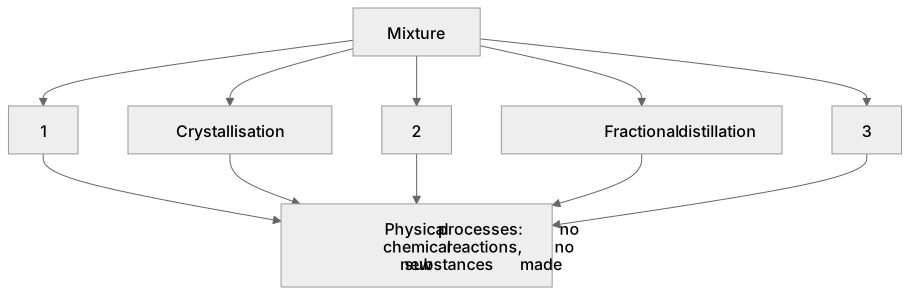
1Box 1
2Box 2
3Box 3
There is more to this lesson
The full lesson goes on to check your understanding and help you earn the marks. Create a free account to carry on, with your progress saved.
A week of Premium from your first lesson · Then the free plan continues · No card, no charge
Test your understanding of Mixtures: Mixtures can be separated by physical processes such as filtration, crystallisation, simple distillation, fractional distillation and chromatography. These physical processes do not involve chemical reactions and no new substances are made.
Active recall beats re-reading. Take an instant quiz now to test what you’ve learned and lock it into long-term memory.
A week of Premium from your first lesson · Then the free plan continues · No card, no charge