AQA · GCSE · Combined Science
Course version: 8464 · Version from Sept 2018
Suggest suitable separation and purification techniques for mixtures when…
Full specification wording
Mixtures: suggest suitable separation and purification techniques for mixtures when given appropriate information.
When a question supplies information about a mixture, you must choose a technique that matches the physical properties given.
Checked against the AQA 8464 specification (opens in a new tab) on .
- Point 4 of 4
- 4 key terms
Study notes
From the checked teaching notes for this specification point.
The idea
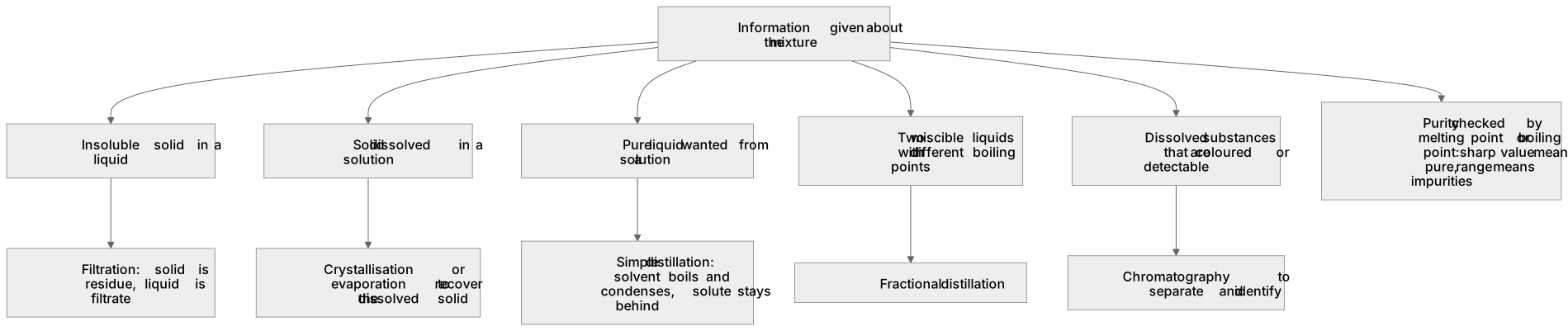
When a question supplies information about a mixture, you must choose a technique that matches the physical properties given. If the mixture is a solid and a liquid and the solid is insoluble, filtration separates them. If the solid is dissolved, evaporating the solvent or crystallising the solution recovers it. If a pure liquid is wanted from a solution, simple distillation is suitable because the solvent boils and condenses while the solute stays behind. If two miscible liquids have different boiling points, fractional distillation separates them. If substances are dissolved and coloured or otherwise detectable, chromatography can separate and identify them. Purity can be checked by melting point or boiling point: a pure substance melts or boils sharply at one temperature, while an impure sample melts or boils over a range.
What earns the marks
- Select filtration when the mixture contains an insoluble solid in a liquid, and identify the solid as residue and the liquid as filtrate.
- Select crystallisation or evaporation when a dissolved solid must be recovered from its solution, choosing crystallisation when crystals are wanted.
- Select simple distillation when a solvent must be separated from a solution and collected as a pure liquid.
- Select fractional distillation when two or more miscible liquids have different boiling points and both components are needed.
- Select chromatography when dissolved substances need separating for identification, for example dyes or sugars in a mixture.
- Use melting point or boiling point data to judge purity, recognising that a sharp value indicates a pure substance and a range indicates impurities.
- Justify the choice by referring to the property given, such as insoluble, dissolved, different boiling points or different solubilities.
Common mistakes and how to put them right
Choosing filtration for a solution of salt in water.
Put it right: Use crystallisation or evaporation to recover the salt.
Choosing simple distillation to separate ethanol and water completely.
Put it right: Use fractional distillation with a fractionating column.
Treating a boiling point range as evidence of purity.
Put it right: State that a pure substance has a sharp, single melting or boiling point.
Ignoring the information given and naming a favourite technique.
Put it right: Quote the relevant property before naming the method.
Exam tips
- Underline the key property in the question, such as insoluble, dissolved or different boiling points, before choosing a technique.
- Name the technique and then justify it in one sentence using the property, for example filtration works because the solid is insoluble.
- If the question asks for purification as well as separation, mention how purity could be checked, such as by melting point.
- Avoid listing several techniques without choosing: a clear decision with a reason scores better than a list of possibilities.
Try the lesson
The start of the Mixtures: suggest suitable separation and purification techniques for mixtures when given appropriate information. lesson, made from checked teaching notes for this specification point.
Have a go first
A student has a mixture of sand and salty water. Which technique is most suitable for separating the sand from the salty water?
Listen
When a question supplies information about a mixture, you must choose a technique that matches the physical properties given. If the mixture is a solid and a liquid and the solid is insoluble, filtration separates them. If the solid is dissolved, evaporating the solvent or crystallising the solution recovers it. If a pure liquid is wanted from a solution, simple distillation is suitable because the solvent boils and condenses while the solute stays behind. If two miscible liquids have different boiling points, fractional distillation separates them. If substances are dissolved and coloured or otherwise detectable, chromatography can separate and identify them. Purity can be checked by melting point or boiling point: a pure substance melts or boils sharply at one temperature, while an impure sample melts or boils over a range. A strong answer earns marks for these points. Select filtration when the mixture contains an insoluble solid in a liquid, and identify the solid as residue and the liquid as filtrate. Select crystallisation or evaporation when a dissolved solid must be recovered from its solution, choosing crystallisation when crystals are wanted. Select simple distillation when a solvent must be separated from a solution and collected as a pure liquid. Select fractional distillation when two or more miscible liquids have different boiling points and both components are needed. A common slip: Choosing filtration for a solution of salt in water: the dissolved salt passes through the filter paper with the water. Instead, use crystallisation or evaporation to recover the salt. Exam tip: Underline the key property in the question, such as insoluble, dissolved or different boiling points, before choosing a technique.
See it
Key words
Say what each word means before you turn the card.
Matching technique to physical property
Try answering aloud or in your head before turning the card.
Separation versus purification
Try answering aloud or in your head before turning the card.
Purity and melting or boiling point evidence
Try answering aloud or in your head before turning the card.
Justifying practical choices from data
Try answering aloud or in your head before turning the card.
See every definition
- Matching technique to physical property
- Choosing a technique that matches the physical properties given when a question supplies information about a mixture.
- Separation versus purification
- Choosing a technique to separate a mixture, and where purification is also asked for, mentioning how purity could be checked, such as by melting point.
- Purity and melting or boiling point evidence
- A pure substance melts or boils sharply at one temperature, while an impure sample melts or boils over a range.
- Justifying practical choices from data
- Referring to the property given, such as insoluble, dissolved, different boiling points or different solubilities, to justify the choice.
Label the diagram
Some boxes have lost their names. Pick the right name for each number.
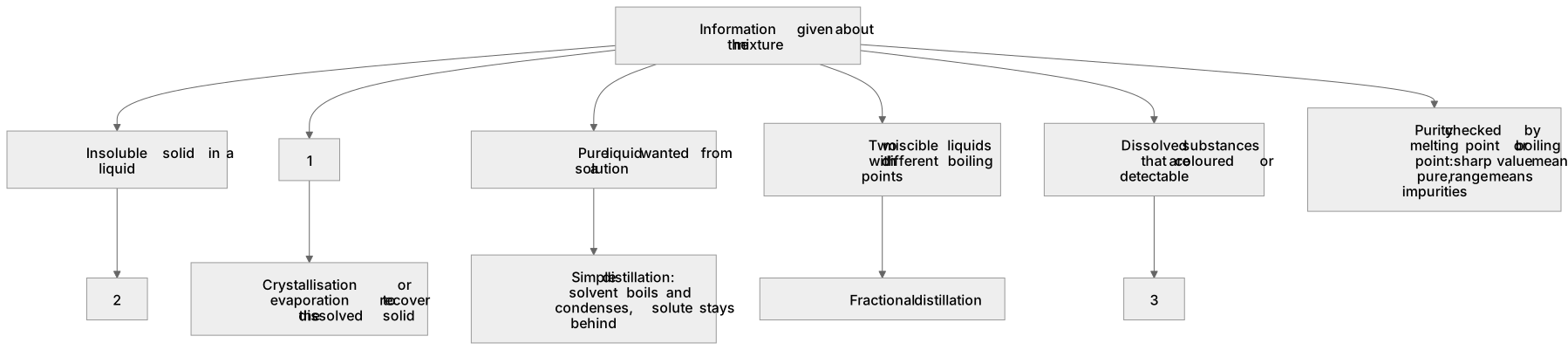
1Box 1
2Box 2
3Box 3
There is more to this lesson
The full lesson goes on to check your understanding and help you earn the marks. Create a free account to carry on, with your progress saved.
A week of Premium from your first lesson · Then the free plan continues · No card, no charge
Test your understanding of Mixtures: suggest suitable separation and purification techniques for mixtures when given appropriate information.
Active recall beats re-reading. Take an instant quiz now to test what you’ve learned and lock it into long-term memory.
A week of Premium from your first lesson · Then the free plan continues · No card, no charge