AQA · GCSE · Combined Science
Course version: 8464 · Version from Sept 2018
Students should understand that the measurement of amounts in moles can…
Full specification wording
Moles (HT only): Students should understand that the measurement of amounts in moles can apply to atoms, molecules, ions, electrons, formulae and equations, for example that in one mole of carbon (C) the number of atoms is the same as the number of molecules in one mole of carbon dioxide (CO₂).
The mole is the unit for amount of substance and applies to any specified particle or formula unit.
Checked against the AQA 8464 specification (opens in a new tab) on .
- Point 5 of 6
- 4 key terms
Study notes
From the checked teaching notes for this specification point.
The idea
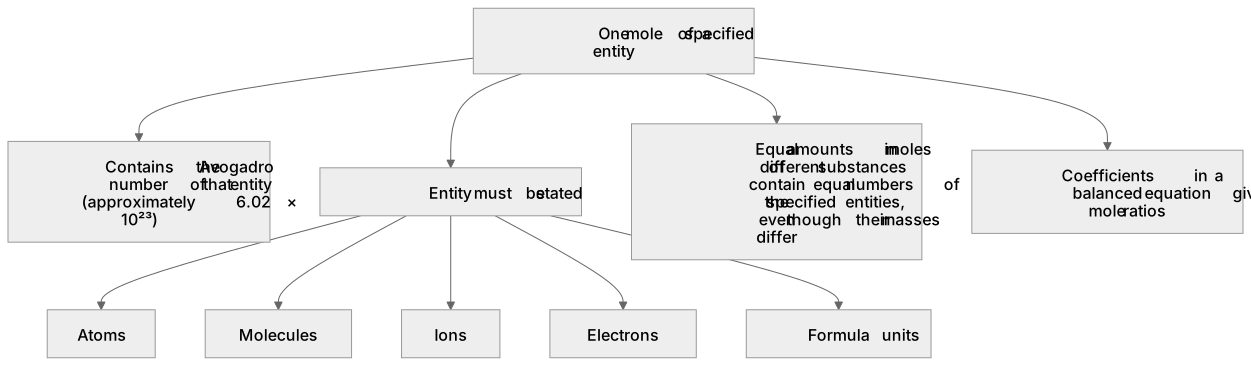
The mole is the unit for amount of substance and applies to any specified particle or formula unit. One mole always contains the Avogadro number of entities, approximately 6.02 × 10²³. The entity must be stated: atoms in C, molecules in CO₂, ions in NaCl, electrons in a charge, or formula units in an equation. For example, 12 g of carbon contains 6.02 × 10²³ C atoms, while 44 g of carbon dioxide contains 6.02 × 10²³ CO₂ molecules, each made of one C atom and two O atoms. Coefficients in a balanced equation give mole ratios, so 2H₂ + O₂ → 2H₂O means two moles of hydrogen molecules react with one mole of oxygen molecules to form two moles of water molecules. This is Higher Tier only content.
What earns the marks
- State that one mole of any specified entity contains the Avogadro number of that entity, approximately 6.02 × 10²³.
- Identify the entity being counted: atoms, molecules, ions, electrons, formula units or particles as specified by the question.
- Apply the mole to a formula unit by using the chemical formula to determine the number of each type of atom or ion present in one mole of the substance.
- Use coefficients in a balanced equation to establish mole ratios between reactants and products.
- Explain that equal amounts in moles of different substances contain equal numbers of the specified entities, even though their masses differ.
- Calculate the number of entities by multiplying the amount in moles by the Avogadro constant when required.
Common mistakes and how to put them right
Treating one mole of a compound as one mole of each element within it.
Put it right by using the formula to find the number of atoms or ions per formula unit, for example one mole of CO₂ contains two moles of oxygen atoms.
Confusing the mass of one mole with the number of entities.
Put it right by separating relative formula mass in grams from the Avogadro number of entities.
Omitting the entity when stating a mole amount.
Put it right by naming what is counted, such as moles of electrons or moles of water molecules.
Exam tips
- Underline the entity in the question, such as atoms, molecules or ions, and ensure your answer refers to that same entity.
- When using an equation, write the mole ratio beneath the balanced equation before doing any calculation.
- As this topic is Higher Tier only, expect questions to test your understanding of the difference between moles of molecules and moles of atoms within those molecules.
Try the lesson
The start of the Moles (HT only): Students should understand that the measurement of amounts in moles can apply to atoms, molecules, ions, electrons, formulae and equations, for example that in one mole of carbon (C) the number of atoms is the same as the number of molecules in one mole of carbon dioxide (CO₂). lesson, made from checked teaching notes for this specification point.
Have a go first
A sample contains one mole of helium atoms and a separate sample contains one mole of methane molecules, CH₄. Which statement about the numbers of particles in the two samples is correct?
Listen
The mole is the unit for amount of substance and applies to any specified particle or formula unit. One mole always contains the Avogadro number of entities, approximately 6.02 × 10²³. The entity must be stated: atoms in C, molecules in CO₂, ions in NaCl, electrons in a charge, or formula units in an equation. For example, 12 g of carbon contains 6.02 × 10²³ C atoms, while 44 g of carbon dioxide contains 6.02 × 10²³ CO₂ molecules, each made of one C atom and two O atoms. Coefficients in a balanced equation give mole ratios, so 2H₂ + O₂ → 2H₂O means two moles of hydrogen molecules react with one mole of oxygen molecules to form two moles of water molecules. This is Higher Tier only content. A strong answer earns marks for these points. State that one mole of any specified entity contains the Avogadro number of that entity, approximately 6.02 × 10²³. Identify the entity being counted: atoms, molecules, ions, electrons, formula units or particles as specified by the question. Apply the mole to a formula unit by using the chemical formula to determine the number of each type of atom or ion present in one mole of the substance. Use coefficients in a balanced equation to establish mole ratios between reactants and products. A common slip: Treating one mole of a compound as one mole of each element within it. Instead, using the formula to find the number of atoms or ions per formula unit, for example one mole of CO₂ contains two moles of oxygen atoms. Exam tip: Underline the entity in the question, such as atoms, molecules or ions, and ensure your answer refers to that same entity.
See it
Key words
Say what each word means before you turn the card.
mole
Try answering aloud or in your head before turning the card.
Avogadro constant
Try answering aloud or in your head before turning the card.
entity
Try answering aloud or in your head before turning the card.
mole ratios
Try answering aloud or in your head before turning the card.
See every definition
- mole
- The unit for amount of substance that applies to any specified particle or formula unit.
- Avogadro constant
- The number of entities per mole, approximately 6.02 × 10²³.
- entity
- The specified particle being counted, such as atoms, molecules, ions, electrons or formula units.
- mole ratios
- The ratios given by coefficients in a balanced equation between reactants and products.
Label the diagram
Some boxes have lost their names. Pick the right name for each number.
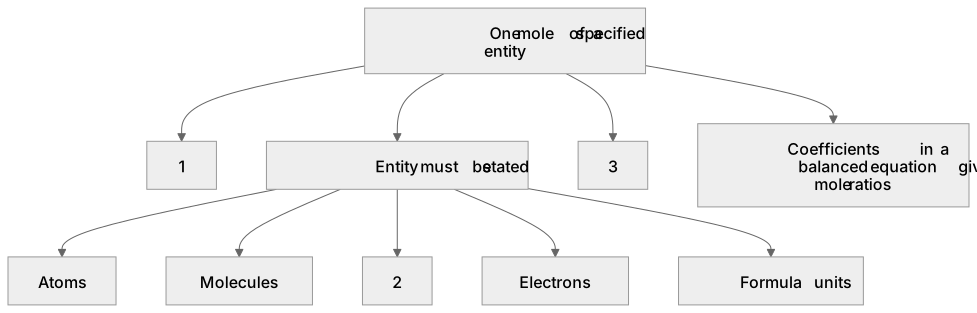
1Box 1
2Box 2
3Box 3
There is more to this lesson
The full lesson goes on to check your understanding and help you earn the marks. Create a free account to carry on, with your progress saved.
A week of Premium from your first lesson · Then the free plan continues · No card, no charge
Test your understanding of Moles (HT only): Students should understand that the measurement of amounts in moles can apply to atoms, molecules, ions, electrons, formulae and equations, for example that in one mole of carbon (C) the number of atoms is the same as the number of molecules in one mole of carbon dioxide (CO₂).
Active recall beats re-reading. Take an instant quiz now to test what you’ve learned and lock it into long-term memory.
A week of Premium from your first lesson · Then the free plan continues · No card, no charge