AQA · GCSE · Combined Science
Course version: 8464 · Version from Sept 2018
Momentum is a property of moving objects: mass, m, in kilograms, kg
In momentum calculations (assessed at Higher Tier only), mass m must be measured in kilograms, kg.
Checked against the AQA 8464 specification (opens in a new tab) on .
- Point 5 of 6
Study notes
From the checked teaching notes for this specification point.
The idea
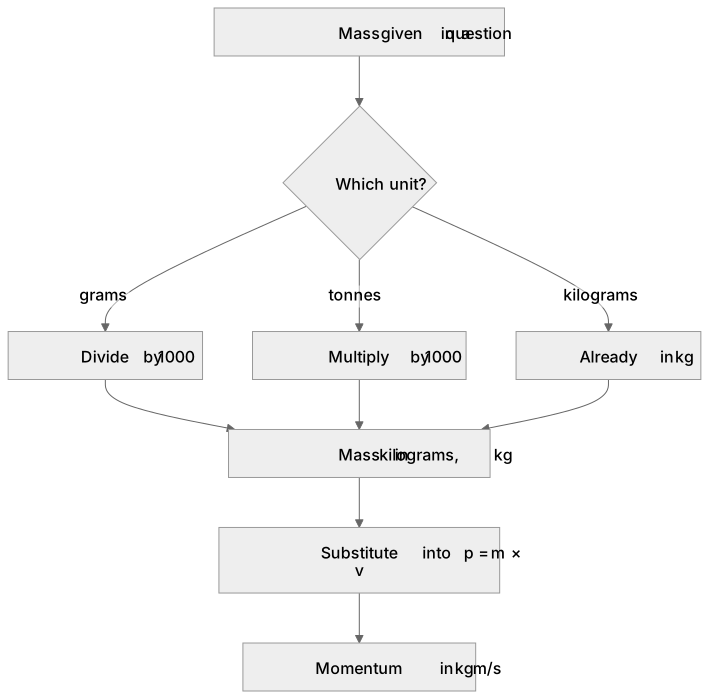
In momentum calculations (assessed at Higher Tier only), mass m must be measured in kilograms, kg. The kilogram is the SI base unit of mass, so it is the unit used in p = m × v. If a mass is given in grams, convert it by dividing by 1000; for example, 2500 g = 2.5 kg. If a mass is given in tonnes, multiply by 1000; for example, 0.4 tonnes = 400 kg. Using the wrong unit changes the numerical value of momentum and its unit, so unit consistency is essential. Mass is a scalar quantity, so it has magnitude but no direction, unlike velocity. Therefore, the direction of an object's momentum is determined entirely by its velocity, while the mass simply scales the magnitude of that momentum.
What earns the marks
- States that mass is measured in kilograms, kg, in momentum calculations.
- Converts grams to kilograms by dividing by 1000, and tonnes to kilograms by multiplying by 1000.
- Recognises that mass is a scalar quantity and does not require a direction.
- Substitutes mass in kg into p = m × v to obtain momentum in kg m/s.
Common mistakes and how to put them right
Forgetting to convert grams to kilograms.
Put it right: Divide the mass in grams by 1000 before using p = m × v.
Mixing kilograms and grams in the same calculation.
Put it right: Convert all masses to kilograms first.
Treating mass as a vector and giving it a direction.
Put it right: Treat mass as a scalar and only give velocity or momentum a direction.
Exam tips
- Underline the mass value and its unit in the question, then convert to kg if it is not already in kg.
- Write the conversion explicitly, for example 2500 g ÷ 1000 = 2.5 kg, so the examiner can see your method.
Try the lesson
The start of the Momentum is a property of moving objects: mass, m, in kilograms, kg lesson, made from checked teaching notes for this specification point.
Have a go first
A student is calculating the momentum of a moving cyclist. Which of the following is the correct standard unit for mass used in the momentum equation?
Listen
In momentum calculations (assessed at Higher Tier only), mass m must be measured in kilograms, kg. The kilogram is the SI base unit of mass, so it is the unit used in p = m × v. If a mass is given in grams, convert it by dividing by 1000; for example, 2500 g = 2.5 kg. If a mass is given in tonnes, multiply by 1000; for example, 0.4 tonnes = 400 kg. Using the wrong unit changes the numerical value of momentum and its unit, so unit consistency is essential. Mass is a scalar quantity, so it has magnitude but no direction, unlike velocity. Therefore, the direction of an object's momentum is determined entirely by its velocity, while the mass simply scales the magnitude of that momentum. A strong answer earns marks for these points. States that mass is measured in kilograms, kg, in momentum calculations. Converts grams to kilograms by dividing by 1000, and tonnes to kilograms by multiplying by 1000. Recognises that mass is a scalar quantity and does not require a direction. Substitutes mass in kg into p = m × v to obtain momentum in kg m/s. A common slip: Forgetting to convert grams to kilograms. Instead, divide the mass in grams by 1000 before using p = m × v. Exam tip: Underline the mass value and its unit in the question, then convert to kg if it is not already in kg.
See it
There is more to this lesson
The full lesson goes on to check your understanding and help you earn the marks. Create a free account to carry on, with your progress saved.
A week of Premium from your first lesson · Then the free plan continues · No card, no charge
Test your understanding of Momentum is a property of moving objects: mass, m, in kilograms, kg
Active recall beats re-reading. Take an instant quiz now to test what you’ve learned and lock it into long-term memory.
A week of Premium from your first lesson · Then the free plan continues · No card, no charge