AQA · GCSE · Combined Science
Course version: 8464 · Version from Sept 2018
The object is moving, the object continues to move at the same speed and…
Full specification wording
Newton's First Law: the object is moving, the object continues to move at the same speed and in the same direction. So the object continues to move at the same velocity.
Newton's First Law states that if the resultant force on an object is zero, its velocity does not change.
Checked against the AQA 8464 specification (opens in a new tab) on .
- Point 4 of 8
- 2 key terms
Study notes
From the checked teaching notes for this specification point.
The idea
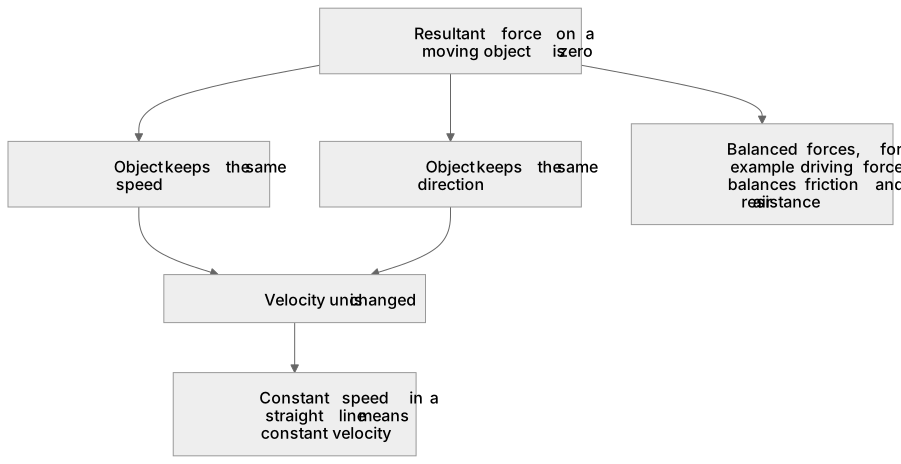
Newton's First Law states that if the resultant force on an object is zero, its velocity does not change. This statement covers a moving object: it keeps the same speed and the same direction, so its velocity is unchanged. Velocity is a vector, so a change in direction is a change in velocity even if speed is constant. For example, a spacecraft drifting far from any planet has negligible resultant force and continues in a straight line at constant speed. A car moving at a steady speed along a straight road also has zero resultant force: the driving force balances friction and air resistance, and weight balances the normal contact force. A student should identify balanced forces and conclude that speed and direction stay the same.
What earns the marks
- States that a moving object with zero resultant force keeps the same speed.
- States that the object keeps the same direction of motion.
- Explains that constant speed in a straight line means constant velocity.
- Applies the idea to a named example, such as a car at steady speed on a straight road.
- Identifies the balanced forces acting on the moving object, for example driving force and resistive forces.
Common mistakes and how to put them right
Saying a moving object needs a constant resultant force to keep moving.
Put it right: A zero resultant force keeps the velocity constant.
Treating speed and velocity as the same.
Put it right: Velocity includes direction, so a change of direction changes velocity even at constant speed.
Forgetting to mention direction and only stating constant speed.
Put it right: State both constant speed and constant direction.
Exam tips
- Write 'same speed and same direction' together to show velocity is unchanged.
- Use a straight-line example so the direction is clearly constant.
- Link your answer to the resultant force being zero before describing the motion.
Try the lesson
The start of the Newton's First Law: the object is moving, the object continues to move at the same speed and in the same direction. So the object continues to move at the same velocity. lesson, made from checked teaching notes for this specification point.
Have a go first
A puck slides across a smooth ice rink. The resultant force acting on the puck is zero. What happens to the puck?
Listen
Newton's First Law states that if the resultant force on an object is zero, its velocity does not change. This statement covers a moving object: it keeps the same speed and the same direction, so its velocity is unchanged. Velocity is a vector, so a change in direction is a change in velocity even if speed is constant. For example, a spacecraft drifting far from any planet has negligible resultant force and continues in a straight line at constant speed. A car moving at a steady speed along a straight road also has zero resultant force: the driving force balances friction and air resistance, and weight balances the normal contact force. A student should identify balanced forces and conclude that speed and direction stay the same. A strong answer earns marks for these points. States that a moving object with zero resultant force keeps the same speed. States that the object keeps the same direction of motion. Explains that constant speed in a straight line means constant velocity. Applies the idea to a named example, such as a car at steady speed on a straight road. A common slip: Saying a moving object needs a constant resultant force to keep moving. Instead, a zero resultant force keeps the velocity constant. Exam tip: Write 'same speed and same direction' together to show velocity is unchanged.
See it
Key words
Say what each word means before you turn the card.
Velocity as a vector
Try answering aloud or in your head before turning the card.
Newton's First Law
Try answering aloud or in your head before turning the card.
See every definition
- Velocity as a vector
- Velocity includes direction, so a change in direction is a change in velocity even if speed is constant.
- Newton's First Law
- If the resultant force on an object is zero, its velocity does not change.
Label the diagram
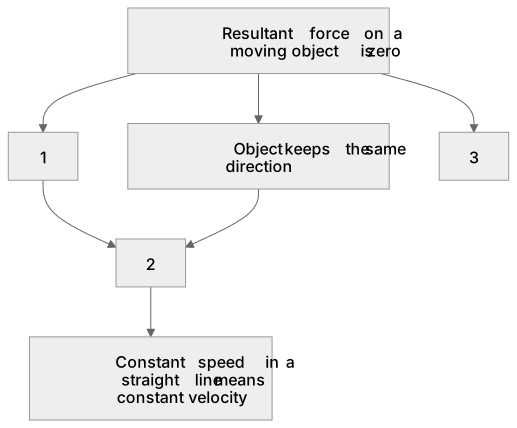
Some boxes have lost their names. Pick the right name for each number.
1Box 1
2Box 2
3Box 3
There is more to this lesson
The full lesson goes on to check your understanding and help you earn the marks. Create a free account to carry on, with your progress saved.
A week of Premium from your first lesson · Then the free plan continues · No card, no charge
Test your understanding of Newton's First Law: the object is moving, the object continues to move at the same speed and in the same direction. So the object continues to move at the same velocity.
Active recall beats re-reading. Take an instant quiz now to test what you’ve learned and lock it into long-term memory.
A week of Premium from your first lesson · Then the free plan continues · No card, no charge