AQA · GCSE · Combined Science
Course version: 8464 · Version from Sept 2018
Newton's Second Law: force, F, in newtons, N
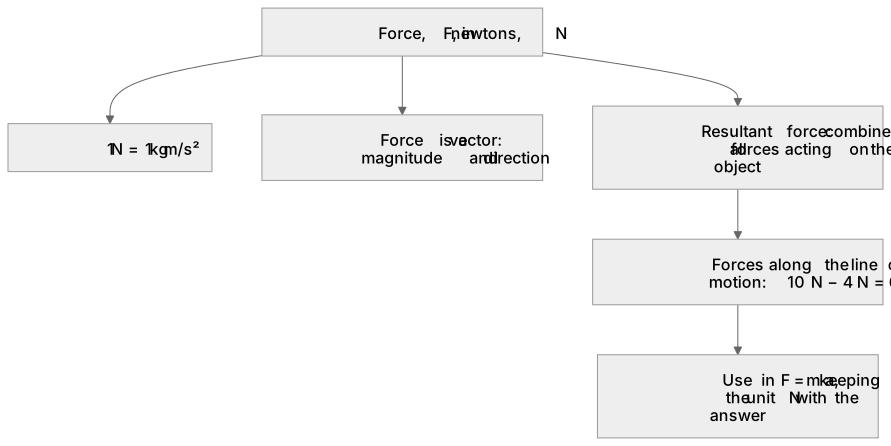
In F = m a, the symbol F stands for force measured in newtons, N. One newton is the force that gives a 1 kg mass an acceleration of 1 m/s², so 1 N = 1 kg m/s².
Checked against the AQA 8464 specification (opens in a new tab) on .
- Point 6 of 13
- 4 key terms
Study notes
From the checked teaching notes for this specification point.
The idea
In F = m a, the symbol F stands for force measured in newtons, N. One newton is the force that gives a 1 kg mass an acceleration of 1 m/s², so 1 N = 1 kg m/s². Force is a vector, so its direction matters: a resultant force along the line of motion changes speed, while a force at an angle can change direction. In calculations, F usually means the resultant force, found by combining all forces acting on the object. For example, if a 3 kg box is pushed with 10 N and friction is 4 N, the resultant force is 10 N − 4 N = 6 N, giving an acceleration of 2 m/s². Always record force in newtons and state its direction where relevant.
What earns the marks
- Identify F as force and state that it is measured in newtons, N.
- Explain that the newton is the SI unit of force and that 1 N = 1 kg m/s².
- Recognise that force is a vector quantity, so both magnitude and direction are needed to describe it fully.
- Distinguish the resultant force from individual applied forces by combining forces along the line of motion.
- Use force values correctly in F = m a, keeping the unit N with the answer.
Common mistakes and how to put them right
Writing the unit as N m or N/m.
Put it right: Force is measured in newtons, N, and the unit is written after the number.
Treating force as a scalar and ignoring direction.
Put it right: State the direction of the resultant force or acceleration when the question requires it.
Confusing mass with force.
Put it right: Mass is in kilograms and measures the amount of matter, while force is in newtons and is a push or pull.
Exam tips
- Write the unit N after every force value in your working and final answer.
- When several forces act, draw a simple free-body diagram and label the direction of each force before calculating the resultant.
- If a question asks for the resultant force, show the addition or subtraction of the individual forces, not just the final value.
Try the lesson
The start of the Newton's Second Law: force, F, in newtons, N lesson, made from checked teaching notes for this specification point.
Have a go first
Which of the following is the correct standard unit for measuring resultant force?
Listen
In F = m a, the symbol F stands for force measured in newtons, N. One newton is the force that gives a 1 kg mass an acceleration of 1 m/s², so 1 N = 1 kg m/s². Force is a vector, so its direction matters: a resultant force along the line of motion changes speed, while a force at an angle can change direction. In calculations, F usually means the resultant force, found by combining all forces acting on the object. For example, if a 3 kg box is pushed with 10 N and friction is 4 N, the resultant force is 10 N − 4 N = 6 N, giving an acceleration of 2 m/s². Always record force in newtons and state its direction where relevant. A strong answer earns marks for these points. Identify F as force and state that it is measured in newtons, N. Explain that the newton is the SI unit of force and that 1 N = 1 kg m/s². Recognise that force is a vector quantity, so both magnitude and direction are needed to describe it fully. Distinguish the resultant force from individual applied forces by combining forces along the line of motion. Exam tip: Write the unit N after every force value in your working and final answer.
See it
Key words
Say what each word means before you turn the card.
Force
Try answering aloud or in your head before turning the card.
Newton
Try answering aloud or in your head before turning the card.
Vector
Try answering aloud or in your head before turning the card.
Resultant force
Try answering aloud or in your head before turning the card.
See every definition
- Force
- A vector quantity measured in newtons, N, where one newton gives a 1 kg mass an acceleration of 1 m/s².
- Newton
- The unit of force, equal to 1 kg m/s², written after the number.
- Vector
- A quantity for which direction matters, so both magnitude and direction are needed to describe it fully.
- Resultant force
- The single force found by combining all forces acting on the object along the line of motion.
Label the diagram
Some boxes have lost their names. Pick the right name for each number.
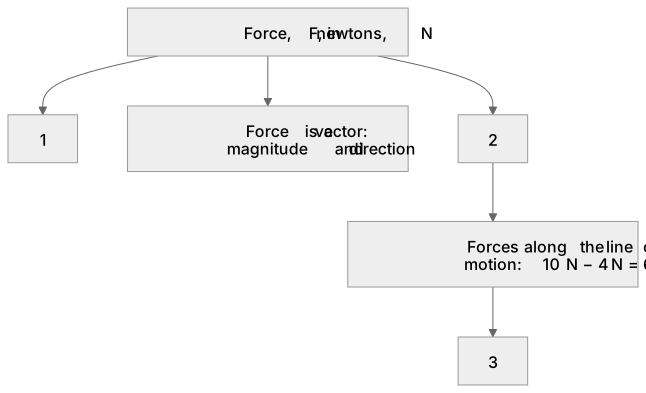
1Box 1
2Box 2
3Box 3
There is more to this lesson
The full lesson goes on to check your understanding and help you earn the marks. Create a free account to carry on, with your progress saved.
A week of Premium from your first lesson · Then the free plan continues · No card, no charge
Test your understanding of Newton's Second Law: force, F, in newtons, N
Active recall beats re-reading. Take an instant quiz now to test what you’ve learned and lock it into long-term memory.
A week of Premium from your first lesson · Then the free plan continues · No card, no charge