AQA · GCSE · Combined Science
Course version: 8464 · Version from Sept 2018
Newton's Third Law: Newton’s Third Law:
Newton’s Third Law describes what happens whenever two objects interact: the two objects push or pull on each other, and the two forces are equal in size and opposite in direction.
Checked against the AQA 8464 specification (opens in a new tab) on .
- Point 1 of 3
Study notes
From the checked teaching notes for this specification point.
The idea
Newton’s Third Law describes what happens whenever two objects interact: the two objects push or pull on each other, and the two forces are equal in size and opposite in direction. The two forces act on different objects, so they never cancel out on a single free-body diagram. A useful method is to name the pair clearly: “force of A on B” and “force of B on A”. For example, a swimmer pushes water backwards with her hands; the water pushes the swimmer forwards with an equal-sized force. Similarly, a book resting on a table pushes down on the table, and the table pushes up on the book. The law applies to contact forces such as friction and normal contact force, and to non-contact forces such as gravity and magnetic force.
What earns the marks
- State that an interaction involves two objects, each exerting a force on the other.
- State that the two forces are equal in magnitude.
- State that the two forces act in opposite directions.
- Identify the forces as a pair acting on different objects, for example force of A on B and force of B on A.
- Apply the law to a named example, such as a swimmer pushing water backwards while the water pushes the swimmer forwards.
- Recognise that the two forces do not cancel because they act on different objects.
Common mistakes and how to put them right
Saying the forces cancel out.
Put it right by stressing that the two forces act on different objects, so they cannot cancel on one object.
Describing a pair of forces on the same object, such as weight and normal contact force on a book.
Put it right by identifying the two interacting objects and naming each force with its object pair.
Assuming the forces are equal only when the objects are stationary.
Put it right by applying the law to moving objects, such as a car tyre pushing the road backwards while the road pushes the car forwards.
Exam tips
- Name both objects in the interaction before stating the two forces, for example “the Earth pulls the Moon” and “the Moon pulls the Earth”.
- Use the wording “equal in magnitude and opposite in direction” rather than “the same force” to show the forces are separate.
- When explaining motion, check whether the forces act on the same object; if they act on different objects, do not treat them as a balanced pair.
Try the lesson
The start of the Newton's Third Law: Newton’s Third Law: lesson, made from checked teaching notes for this specification point.
Have a go first
A book rests on a table. The book pushes down on the table with a force of 12 N. According to Newton’s Third Law, what is the size of the force the table exerts on the book?
Listen
Newton’s Third Law describes what happens whenever two objects interact: the two objects push or pull on each other, and the two forces are equal in size and opposite in direction. The two forces act on different objects, so they never cancel out on a single free-body diagram. A useful method is to name the pair clearly: “force of A on B” and “force of B on A”. For example, a swimmer pushes water backwards with her hands; the water pushes the swimmer forwards with an equal-sized force. Similarly, a book resting on a table pushes down on the table, and the table pushes up on the book. The law applies to contact forces such as friction and normal contact force, and to non-contact forces such as gravity and magnetic force. A strong answer earns marks for these points. State that an interaction involves two objects, each exerting a force on the other. State that the two forces are equal in magnitude. State that the two forces act in opposite directions. Identify the forces as a pair acting on different objects, for example force of A on B and force of B on A. A common slip: Saying the forces cancel out. Instead, stressing that the two forces act on different objects, so they cannot cancel on one object. Exam tip: Name both objects in the interaction before stating the two forces, for example “the Earth pulls the Moon” and “the Moon pulls the Earth”.
See it
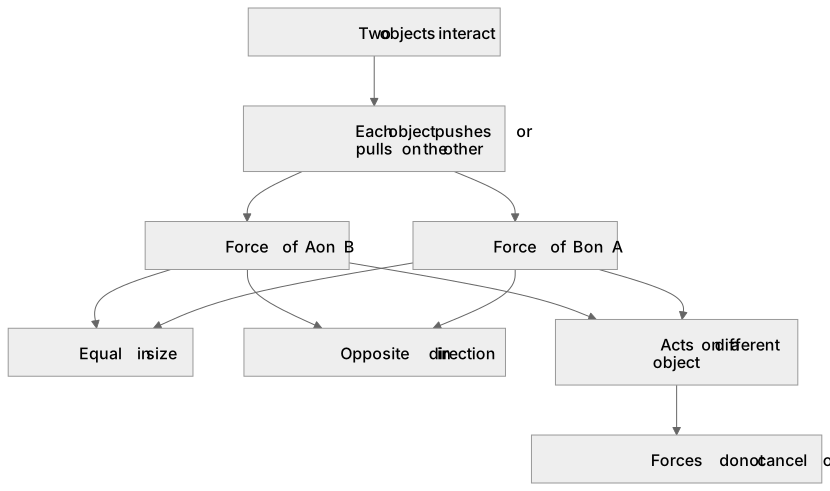
Label the diagram
Some boxes have lost their names. Pick the right name for each number.
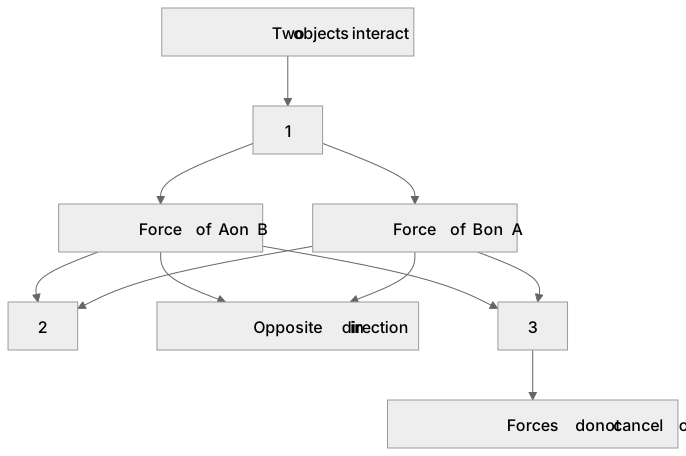
1Box 1
2Box 2
3Box 3
There is more to this lesson
The full lesson goes on to check your understanding and help you earn the marks. Create a free account to carry on, with your progress saved.
A week of Premium from your first lesson · Then the free plan continues · No card, no charge
Test your understanding of Newton's Third Law: Newton’s Third Law:
Active recall beats re-reading. Take an instant quiz now to test what you’ve learned and lock it into long-term memory.
A week of Premium from your first lesson · Then the free plan continues · No card, no charge