AQA · GCSE · Combined Science
Course version: 8464 · Version from Sept 2018
Explain how the motion of the molecules in a gas is related to both its…
Full specification wording
Particle motion in gases: explain how the motion of the molecules in a gas is related to both its temperature and its pressure
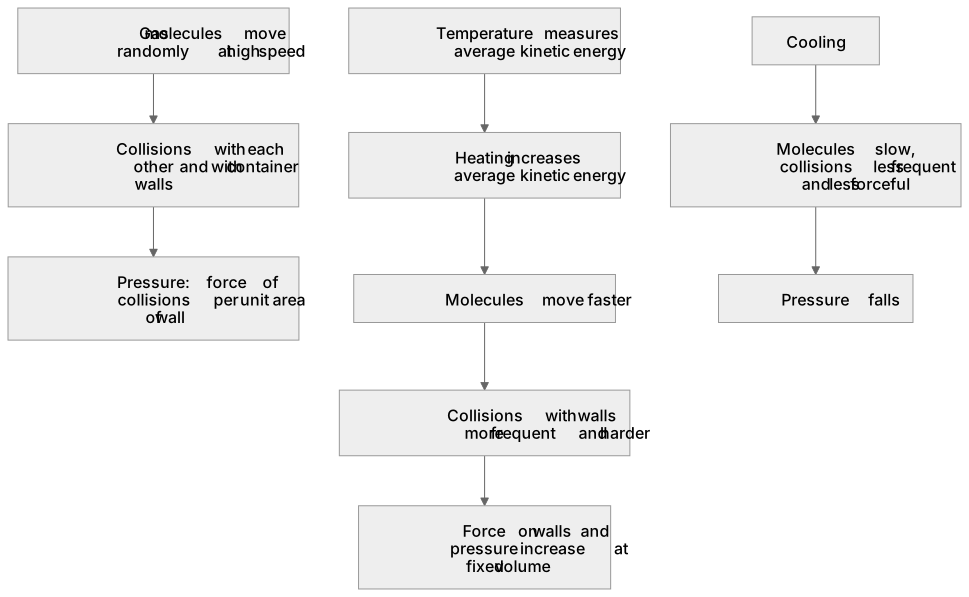
Gas molecules move randomly at high speed, colliding with each other and with the container walls.
Checked against the AQA 8464 specification (opens in a new tab) on .
- Point 3 of 4
- 3 key terms
Study notes
From the checked teaching notes for this specification point.
The idea
Gas molecules move randomly at high speed, colliding with each other and with the container walls. Temperature measures the average kinetic energy of these molecules: heating a gas increases that average kinetic energy, so the molecules move faster. Pressure arises from the total force of molecular collisions on each unit area of the container wall. Faster molecules hit the walls more often and harder, so raising the temperature at fixed volume raises the pressure. For example, heating a sealed rigid can of gas makes its molecules faster, increasing the collision rate and force on the walls, so the pressure rises. Cooling reverses this: molecules slow, collisions become less frequent and less forceful, and pressure falls.
What earns the marks
- Gas molecules move randomly and rapidly, colliding with each other and with the walls of the container.
- Temperature is a measure of the average kinetic energy of the gas molecules, so a higher temperature means a higher average speed.
- Pressure is caused by the force of molecular collisions acting on the container walls per unit area.
- At constant volume, increasing temperature increases the average kinetic energy and speed of the molecules.
- Faster molecules collide with the walls more frequently and with greater change of momentum, so the force on the walls and the pressure increase.
- A complete explanation links temperature to average kinetic energy, then to collision rate and force, then to pressure.
Common mistakes and how to put them right
Saying that molecules expand or get bigger when heated.
Put it right by stating that the molecules themselves do not change size; their average speed and kinetic energy increase.
Claiming that pressure is caused by molecules pushing each other rather than hitting the walls.
Put it right by explaining that pressure comes from collisions with the container walls per unit area.
Confusing temperature with total kinetic energy.
Put it right by stating that temperature relates to the average kinetic energy of the molecules, not the total.
Exam tips
- Use the chain temperature → average kinetic energy → average speed → collision rate and force on walls → pressure.
- Refer explicitly to collisions with the walls per unit area, because that is what pressure measures.
- Use comparative language such as faster, more frequent and greater force rather than simply saying the molecules move more.
Try the lesson
The start of the Particle motion in gases: explain how the motion of the molecules in a gas is related to both its temperature and its pressure lesson, made from checked teaching notes for this specification point.
Have a go first
A sealed gas cylinder is warmed up. What happens to the average speed of the gas molecules inside it?
Listen
Gas molecules move randomly at high speed, colliding with each other and with the container walls. Temperature measures the average kinetic energy of these molecules: heating a gas increases that average kinetic energy, so the molecules move faster. Pressure arises from the total force of molecular collisions on each unit area of the container wall. Faster molecules hit the walls more often and harder, so raising the temperature at fixed volume raises the pressure. For example, heating a sealed rigid can of gas makes its molecules faster, increasing the collision rate and force on the walls, so the pressure rises. Cooling reverses this: molecules slow, collisions become less frequent and less forceful, and pressure falls. A strong answer earns marks for these points. Gas molecules move randomly and rapidly, colliding with each other and with the walls of the container. Temperature is a measure of the average kinetic energy of the gas molecules, so a higher temperature means a higher average speed. Pressure is caused by the force of molecular collisions acting on the container walls per unit area. At constant volume, increasing temperature increases the average kinetic energy and speed of the molecules. A common slip: Saying that molecules expand or get bigger when heated. Instead, stating that the molecules themselves do not change size; their average speed and kinetic energy increase. Exam tip: Use the chain temperature → average kinetic energy → average speed → collision rate and force on walls → pressure.
See it
Key words
Say what each word means before you turn the card.
Temperature
Try answering aloud or in your head before turning the card.
Pressure
Try answering aloud or in your head before turning the card.
Kinetic particle model of gases
Try answering aloud or in your head before turning the card.
See every definition
- Temperature
- A measure of the average kinetic energy of the gas molecules, so a higher temperature means a higher average speed.
- Pressure
- Caused by the force of molecular collisions acting on the container walls per unit area.
- Kinetic particle model of gases
- Gas molecules move randomly and rapidly, colliding with each other and with the walls of the container.
Label the diagram
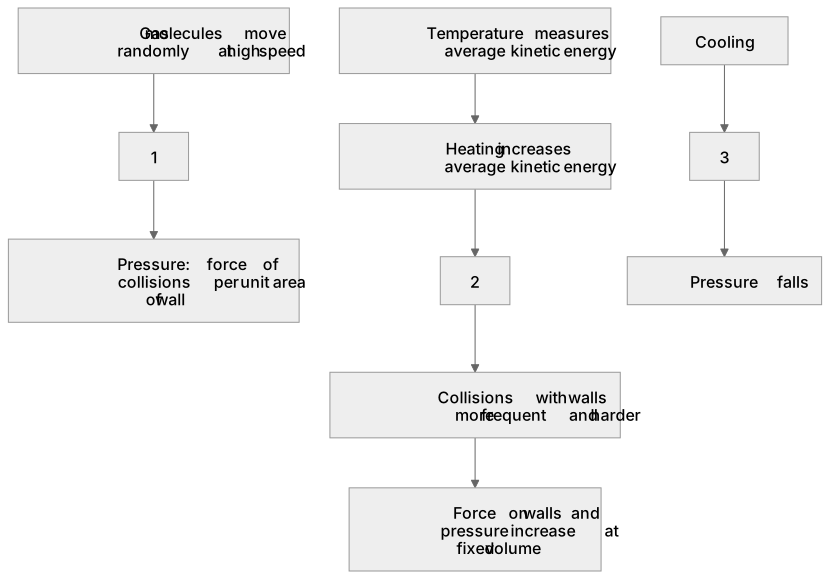
Some boxes have lost their names. Pick the right name for each number.
1Box 1
2Box 2
3Box 3
There is more to this lesson
The full lesson goes on to check your understanding and help you earn the marks. Create a free account to carry on, with your progress saved.
A week of Premium from your first lesson · Then the free plan continues · No card, no charge
Test your understanding of Particle motion in gases: explain how the motion of the molecules in a gas is related to both its temperature and its pressure
Active recall beats re-reading. Take an instant quiz now to test what you’ve learned and lock it into long-term memory.
A week of Premium from your first lesson · Then the free plan continues · No card, no charge