AQA · GCSE · Combined Science
Course version: 8464 · Version from Sept 2018
Required practical activity 21: investigate how the amount of infrared…
Full specification wording
Properties of electromagnetic waves 1: Required practical activity 21: investigate how the amount of infrared radiation absorbed or radiated by a surface depends on the nature of that surface.
Infrared is a region of the electromagnetic spectrum beyond red visible light.
Checked against the AQA 8464 specification (opens in a new tab) on .
- Point 5 of 5
- 4 key terms
Study notes
From the checked teaching notes for this specification point.
The idea
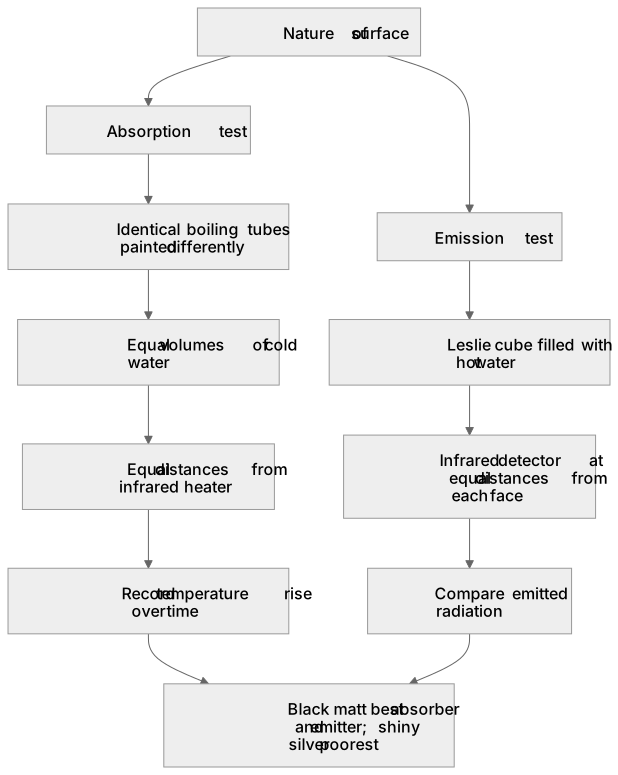
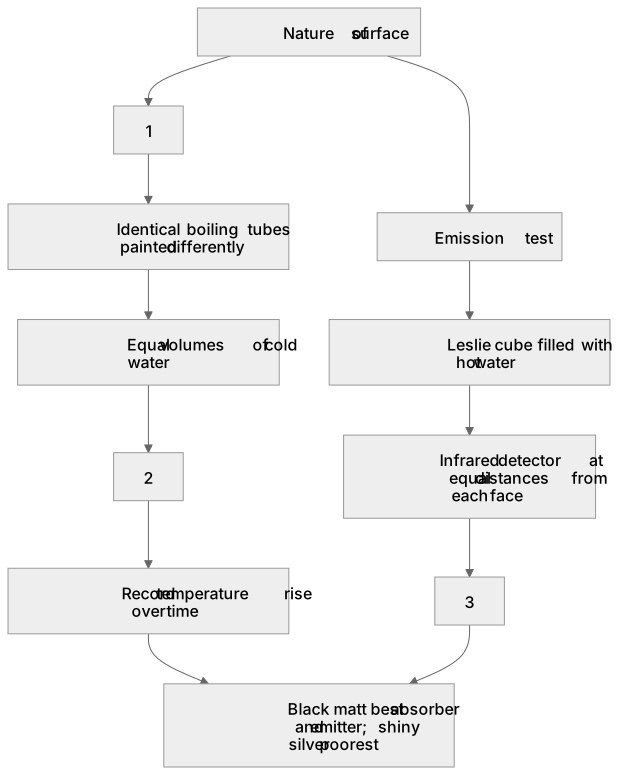
Infrared is a region of the electromagnetic spectrum beyond red visible light. All objects emit infrared; the amount radiated or absorbed depends on surface colour and texture. In this practical, you compare surfaces like black matt, white matt and shiny silver. For absorption, place identical boiling tubes painted differently, filled with equal volumes of cold water, at equal distances from an infrared heater. Record the temperature rise over time. For emission (radiation), fill a Leslie cube with hot water and use an infrared detector at equal distances from each face to measure emitted radiation. Control variables include starting temperature, volume, distance, and time. Black matt surfaces are the best absorbers and emitters; shiny silver surfaces are the poorest. This explains why solar panels are black and survival blankets are shiny.
What earns the marks
- Identifies independent variable as surface nature (colour and texture) and dependent variable as amount of infrared absorbed or radiated, measured by temperature change or detector reading.
- Describes a valid method for absorption: identical containers with different surface coatings, equal volumes of cold water, placed at equal distances from an infrared heater, measuring temperature rise over time.
- Describes a valid method for emission: a Leslie cube or differently coated containers filled with hot water, using an infrared detector or thermometer to compare emitted radiation or cooling rates.
- States control variables: starting temperature, volume of water, distance from heater/detector, and time interval.
- Explains that black matt surfaces are the best absorbers and emitters of infrared, while shiny silver surfaces are the poorest.
- Uses data to compare rates of temperature change or detector readings and links the pattern to the nature of the surface.
- Evaluates the method, identifying sources of error such as heat loss to surroundings or inconsistent coating thickness, and suggests improvements.
Common mistakes and how to put them right
Confusing the methods for absorption and emission.
Put it right: Measuring the cooling of hot water tests emission; to test absorption, you must measure the heating of cold water using an external infrared source.
Thinking shiny surfaces absorb infrared well because they reflect light.
Put it right: Shiny silver surfaces reflect infrared too, so they absorb and emit less than black matt surfaces.
Placing the infrared detector or heater at different distances from each surface.
Put it right: Hold the detector or heater at the exact same distance, because infrared intensity decreases with distance.
Recording only the final temperature rather than a series of readings.
Put it right: Take regular readings so you can compare rates of cooling or heating, not just end points.
Exam tips
- When describing the method, clearly distinguish between testing absorption (heating cold water with an IR lamp) and testing emission (cooling hot water or using a Leslie cube).
- Name the independent, dependent and at least two control variables explicitly; this is often where marks are earned.
- Use comparative language such as 'black matt surface heated fastest' or 'shiny surface gave the lowest detector reading' rather than vague statements.
Try the lesson
The start of the Properties of electromagnetic waves 1: Required practical activity 21: investigate how the amount of infrared radiation absorbed or radiated by a surface depends on the nature of that surface. lesson, made from checked teaching notes for this specification point.
Have a go first
In the required practical on infrared radiation, a student fills two identical metal cans with hot water. One can is painted matt black and the other is painted shiny silver. Which can cools down faster?
Listen
Infrared is a region of the electromagnetic spectrum beyond red visible light. All objects emit infrared; the amount radiated or absorbed depends on surface colour and texture. In this practical, you compare surfaces like black matt, white matt and shiny silver. For absorption, place identical boiling tubes painted differently, filled with equal volumes of cold water, at equal distances from an infrared heater. Record the temperature rise over time. For emission (radiation), fill a Leslie cube with hot water and use an infrared detector at equal distances from each face to measure emitted radiation. Control variables include starting temperature, volume, distance, and time. Black matt surfaces are the best absorbers and emitters; shiny silver surfaces are the poorest. This explains why solar panels are black and survival blankets are shiny. A strong answer earns marks for these points. Identifies independent variable as surface nature (colour and texture) and dependent variable as amount of infrared absorbed or radiated, measured by temperature change or detector reading. Describes a valid method for absorption: identical containers with different surface coatings, equal volumes of cold water, placed at equal distances from an infrared heater, measuring temperature rise over time. Describes a valid method for emission: a Leslie cube or differently coated containers filled with hot water, using an infrared detector or thermometer to compare emitted radiation or cooling rates. States control variables: starting temperature, volume of water, distance from heater/detector, and time interval. A common slip: confusing the methods for absorption and emission. Instead, measuring the cooling of hot water tests emission; to test absorption, you must measure the heating of cold water using an external infrared source. Exam tip: When describing the method, clearly distinguish between testing absorption (heating cold water with an IR lamp) and testing emission (cooling hot water or using a Leslie cube).
See it
Key words
Say what each word means before you turn the card.
Infrared radiation
Try answering aloud or in your head before turning the card.
Absorption
Try answering aloud or in your head before turning the card.
Emission
Try answering aloud or in your head before turning the card.
Control variables
Try answering aloud or in your head before turning the card.
See every definition
- Infrared radiation
- A region of the electromagnetic spectrum beyond red visible light, which all objects emit, and the amount radiated or absorbed depends on surface colour and texture.
- Absorption
- Tested by measuring the heating of cold water using an external infrared source, with black matt surfaces being the best absorbers and shiny silver surfaces the poorest.
- Emission
- Tested by measuring the cooling of hot water or using a Leslie cube, with black matt surfaces being the best emitters and shiny silver surfaces the poorest.
- Control variables
- Include starting temperature, volume of water, distance from heater or detector, and time interval, held the same to make the test fair.
Label the diagram
Some boxes have lost their names. Pick the right name for each number.
1Box 1
2Box 2
3Box 3
There is more to this lesson
The full lesson goes on to check your understanding and help you earn the marks. Create a free account to carry on, with your progress saved.
A week of Premium from your first lesson · Then the free plan continues · No card, no charge
Test your understanding of Properties of electromagnetic waves 1: Required practical activity 21: investigate how the amount of infrared radiation absorbed or radiated by a surface depends on the nature of that surface.
Active recall beats re-reading. Take an instant quiz now to test what you’ve learned and lock it into long-term memory.
A week of Premium from your first lesson · Then the free plan continues · No card, no charge