AQA · GCSE · Combined Science
Course version: 8464 · Version from Sept 2018
When melted or dissolved in water, ionic compounds conduct electricity…
Full specification wording
Properties of ionic compounds: When melted or dissolved in water, ionic compounds conduct electricity because the ions are free to move and so charge can flow.
Ionic compounds form giant lattices of alternating positive and negative ions held by strong electrostatic attraction.
Checked against the AQA 8464 specification (opens in a new tab) on .
- Point 3 of 3
- 3 key terms
Study notes
From the checked teaching notes for this specification point.
The idea
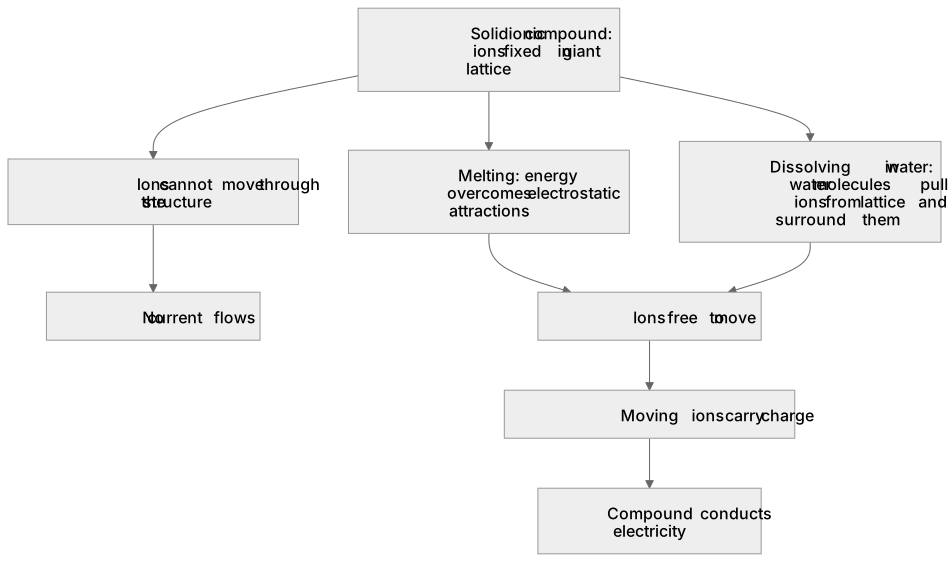
Ionic compounds form giant lattices of alternating positive and negative ions held by strong electrostatic attraction. In the solid state these ions vibrate about fixed positions, so although each ion carries charge, no ion can travel through the lattice and no current flows. Melting supplies enough energy to overcome the attractions, releasing the ions so they can slide past one another. Dissolving in water has a similar effect: water molecules pull ions away from the lattice and surround them, forming a solution in which the ions are mobile. In both cases the charged particles themselves move, so charge can flow and the compound conducts electricity.
For example: Solid sodium chloride does not light a bulb, but molten sodium chloride and sodium chloride solution both conduct because Na⁺ and Cl⁻ ions are free to move.
What earns the marks
- Solid ionic compounds do not conduct because their ions are held in fixed positions in the giant lattice and cannot move through the structure.
- Melting provides energy to overcome the strong electrostatic attractions between oppositely charged ions, so the ions become free to move.
- When an ionic compound dissolves, water molecules separate the ions from the lattice and surround them, so the ions are free to move in solution.
- Conduction occurs because the moving ions carry charge through the liquid or solution, completing the circuit.
- The charge carriers in an ionic compound are the ions themselves, not electrons as in a metal.
Common mistakes and how to put them right
Saying that solid ionic compounds conduct because ions are charged.
Put it right: Charge alone is not enough; the ions must be free to move, and in a solid lattice they are not.
Stating that electrons flow through molten or dissolved ionic compounds.
Put it right: The mobile charge carriers are ions, so the current is carried by moving positive and negative ions.
Claiming that melting destroys the ions or that dissolving breaks ions into atoms.
Put it right: The ions remain intact; melting and dissolving only free them from the lattice so they can move.
Exam tips
- Link the state of the substance to the mobility of its ions in every explanation: solid means fixed ions, molten or aqueous means mobile ions.
- Use the phrase free to move and so charge can flow when explaining conduction, and name the charge carriers as ions.
- Compare a solid sample with the same compound when molten or dissolved to show that the difference is ion mobility, not a change in the ions themselves.
Try the lesson
The start of the Properties of ionic compounds: When melted or dissolved in water, ionic compounds conduct electricity because the ions are free to move and so charge can flow. lesson, made from checked teaching notes for this specification point.
Have a go first
Solid sodium chloride does not conduct electricity, but molten sodium chloride does. What is the reason for this difference?
Listen
Ionic compounds form giant lattices of alternating positive and negative ions held by strong electrostatic attraction. In the solid state these ions vibrate about fixed positions, so although each ion carries charge, no ion can travel through the lattice and no current flows. Melting supplies enough energy to overcome the attractions, releasing the ions so they can slide past one another. Dissolving in water has a similar effect: water molecules pull ions away from the lattice and surround them, forming a solution in which the ions are mobile. In both cases the charged particles themselves move, so charge can flow and the compound conducts electricity. For example, solid sodium chloride does not light a bulb, but molten sodium chloride and sodium chloride solution both conduct because Na⁺ and Cl⁻ ions are free to move. A strong answer earns marks for these points. Solid ionic compounds do not conduct because their ions are held in fixed positions in the giant lattice and cannot move through the structure. Melting provides energy to overcome the strong electrostatic attractions between oppositely charged ions, so the ions become free to move. When an ionic compound dissolves, water molecules separate the ions from the lattice and surround them, so the ions are free to move in solution. Conduction occurs because the moving ions carry charge through the liquid or solution, completing the circuit. A common slip: Saying that solid ionic compounds conduct because ions are charged. Instead, charge alone is not enough; the ions must be free to move, and in a solid lattice they are not. Exam tip: Link the state of the substance to the mobility of its ions in every explanation: solid means fixed ions, molten or aqueous means mobile ions.
See it
Key words
Say what each word means before you turn the card.
Electrical conduction by mobile charged particles
Try answering aloud or in your head before turning the card.
Structure and bonding
Try answering aloud or in your head before turning the card.
Relationship between structure and properties
Try answering aloud or in your head before turning the card.
See every definition
- Electrical conduction by mobile charged particles
- Charge can flow when charged particles are free to move, as the ions are when an ionic compound is melted or dissolved in water.
- Structure and bonding
- Ionic compounds form giant lattices of alternating positive and negative ions held by strong electrostatic attraction, and in the solid state these ions vibrate about fixed positions.
- Relationship between structure and properties
- Solid ionic compounds do not conduct because their ions are held in fixed positions in the giant lattice and cannot move through the structure.
Label the diagram
Some boxes have lost their names. Pick the right name for each number.
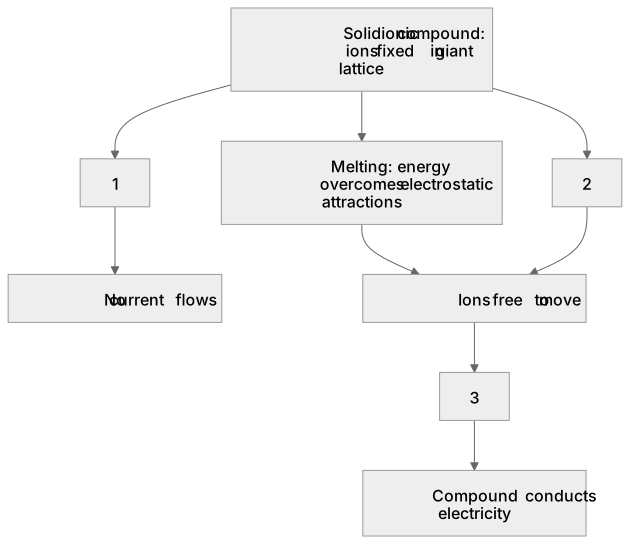
1Box 1
2Box 2
3Box 3
There is more to this lesson
The full lesson goes on to check your understanding and help you earn the marks. Create a free account to carry on, with your progress saved.
A week of Premium from your first lesson · Then the free plan continues · No card, no charge
Test your understanding of Properties of ionic compounds: When melted or dissolved in water, ionic compounds conduct electricity because the ions are free to move and so charge can flow.
Active recall beats re-reading. Take an instant quiz now to test what you’ve learned and lock it into long-term memory.
A week of Premium from your first lesson · Then the free plan continues · No card, no charge