AQA · GCSE · Combined Science
Course version: 8464 · Version from Sept 2018
Metals have giant structures of atoms with strong metallic bonding. This…
Full specification wording
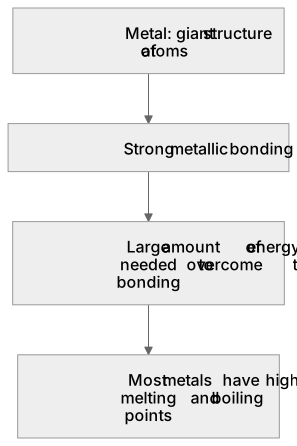
Properties of metals and alloys: Metals have giant structures of atoms with strong metallic bonding. This means that most metals have high melting and boiling points.
Metals are giant structures in which positive metal ions are arranged in a regular lattice and are surrounded by a sea of delocalised electrons.
Checked against the AQA 8464 specification (opens in a new tab) on .
- Point 1 of 3
Study notes
From the checked teaching notes for this specification point.
The idea
Metals are giant structures in which positive metal ions are arranged in a regular lattice and are surrounded by a sea of delocalised electrons. The electrostatic attraction between the positive ions and the shared delocalised electrons is metallic bonding, and it acts in all directions throughout the structure. Because this bonding is strong and extends across the whole giant lattice, a large amount of energy is needed to overcome it, so most metals have high melting and boiling points.
For example: Magnesium melts at about 650 °C and iron at about 1538 °C. Melting point trends can be linked to the strength of metallic bonding: metals with more delocalised electrons per atom and smaller ions often have stronger bonding and higher melting points.
What earns the marks
- Describe a metal as a giant lattice of positive ions with delocalised electrons throughout the structure.
- Explain metallic bonding as the strong electrostatic attraction between positive metal ions and delocalised electrons.
- Link the strength and extent of metallic bonding to the large energy needed to melt or boil the metal.
- State that most metals therefore have high melting and boiling points, and use a named example such as iron or magnesium.
- Compare metals with simple molecular substances, where weak intermolecular forces mean low melting and boiling points.
- Recognise that the same delocalised electrons explain why metals conduct electricity and heat.
Common mistakes and how to put them right
Saying metallic bonding is between atoms only.
Put it right: Describe positive metal ions in a lattice with delocalised electrons, and the attraction between them.
Claiming all metals have equally high melting points.
Put it right: Most are high, but the strength of metallic bonding varies, so values differ, for example mercury is liquid at room temperature.
Confusing delocalised electrons with shared pairs in covalent bonds.
Put it right: In metallic bonding the electrons are delocalised across the whole giant structure, not shared between two specific atoms.
Exam tips
- Always name the two charged or electron parts involved in metallic bonding, then state that the attraction is strong and acts throughout the giant structure.
- When explaining a high melting point, refer to energy needed to overcome the strong metallic bonds, not to breaking individual atoms.
- Use a specific metal and its approximate melting point as evidence, and keep the link between bonding strength and energy explicit.
Try the lesson
The start of the Properties of metals and alloys: Metals have giant structures of atoms with strong metallic bonding. This means that most metals have high melting and boiling points. lesson, made from checked teaching notes for this specification point.
Have a go first
Most metals have high melting points. Which statement explains this?
Listen
Metals are giant structures in which positive metal ions are arranged in a regular lattice and are surrounded by a sea of delocalised electrons. The electrostatic attraction between the positive ions and the shared delocalised electrons is metallic bonding, and it acts in all directions throughout the structure. Because this bonding is strong and extends across the whole giant lattice, a large amount of energy is needed to overcome it, so most metals have high melting and boiling points. For example, magnesium melts at about 650 °C and iron at about 1538 °C. Melting point trends can be linked to the strength of metallic bonding: metals with more delocalised electrons per atom and smaller ions often have stronger bonding and higher melting points. A strong answer earns marks for these points. Describe a metal as a giant lattice of positive ions with delocalised electrons throughout the structure. Explain metallic bonding as the strong electrostatic attraction between positive metal ions and delocalised electrons. Link the strength and extent of metallic bonding to the large energy needed to melt or boil the metal. State that most metals therefore have high melting and boiling points, and use a named example such as iron or magnesium. A common slip: Saying metallic bonding is between atoms only. Instead, describe positive metal ions in a lattice with delocalised electrons, and the attraction between them. Exam tip: Always name the two charged or electron parts involved in metallic bonding, then state that the attraction is strong and acts throughout the giant structure.
See it
Put it in order
Put these steps in the order they happen.
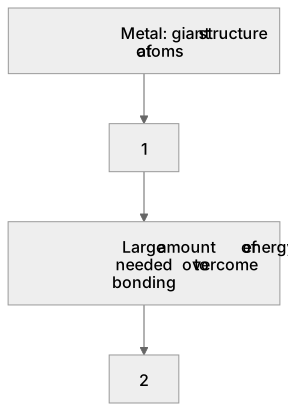
- 1. Large amount of energy needed to overcome the bonding
- 2. Most metals have high melting and boiling points
- 3. Strong metallic bonding
- 4. Metal: giant structure of atoms
Label the diagram
Some boxes have lost their names. Pick the right name for each number.
1Box 1
2Box 2
There is more to this lesson
The full lesson goes on to check your understanding and help you earn the marks. Create a free account to carry on, with your progress saved.
A week of Premium from your first lesson · Then the free plan continues · No card, no charge
Test your understanding of Properties of metals and alloys: Metals have giant structures of atoms with strong metallic bonding. This means that most metals have high melting and boiling points.
Active recall beats re-reading. Take an instant quiz now to test what you’ve learned and lock it into long-term memory.
A week of Premium from your first lesson · Then the free plan continues · No card, no charge