AQA · GCSE · Combined Science
Course version: 8464 · Version from Sept 2018
Students should be able to explain why alloys are harder than pure metals…
Full specification wording
Properties of metals and alloys: Students should be able to explain why alloys are harder than pure metals in terms of distortion of the layers of atoms in the structure of a pure metal.
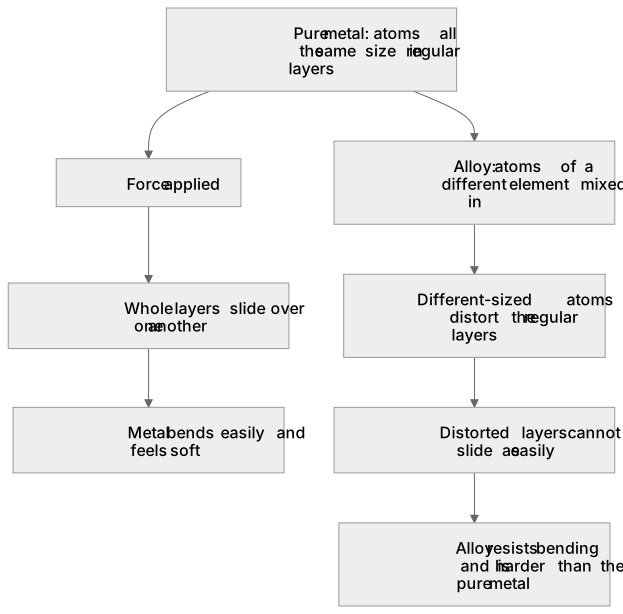
In a pure metal, all atoms are the same size and sit in regular layers.
Checked against the AQA 8464 specification (opens in a new tab) on .
- Point 3 of 3
Study notes
From the checked teaching notes for this specification point.
The idea
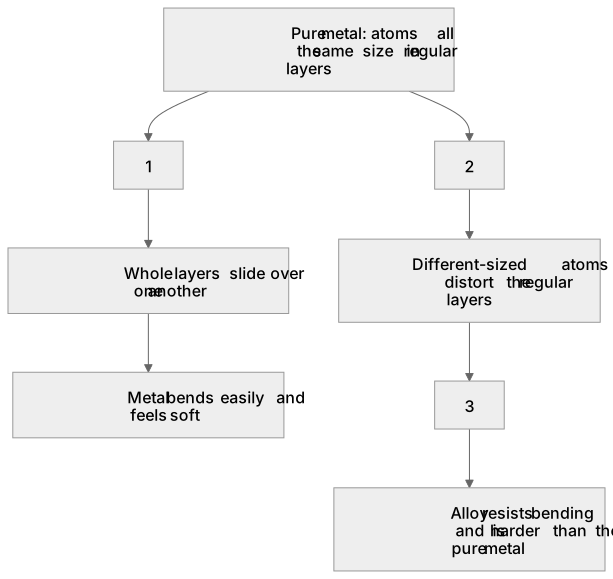
In a pure metal, all atoms are the same size and sit in regular layers. When a force is applied, whole layers can slide over one another, so the metal bends easily and feels soft. In an alloy, atoms of a different element are mixed in. These atoms have a different size from the metal atoms, so they distort the regular layers. The distorted layers cannot slide over one another as easily, so the alloy resists bending and is harder than the pure metal.
For example: Adding carbon atoms to iron distorts the iron layers and produces steel, which is harder than pure iron and suitable for tools and structures.
What earns the marks
- Pure metals have atoms of the same size arranged in regular layers.
- In a pure metal, layers can slide over one another when a force is applied.
- An alloy contains atoms of a different element mixed into the metal structure.
- The different-sized atoms distort the regular layers of the pure metal.
- Distorted layers cannot slide over one another as easily.
- Less easy sliding means the alloy is harder than the pure metal.
- A named example, such as carbon in iron to make steel, can support the explanation.
Common mistakes and how to put them right
Saying that alloy atoms make the layers stronger by forming stronger bonds.
Put it right by explaining that the different-sized atoms distort the layers and stop them sliding.
Describing alloy atoms as fitting neatly into the layers without changing them.
Put it right by stating that the different-sized atoms distort the regular arrangement.
Explaining hardness only by saying the alloy is denser.
Put it right by linking hardness to the disruption of layer sliding.
Exam tips
- Start by describing the regular layers in the pure metal before introducing the alloy atoms.
- Use the word 'distort' when explaining how different-sized atoms affect the layers.
- Finish by linking the distorted layers to reduced sliding and increased hardness.
Try the lesson
The start of the Properties of metals and alloys: Students should be able to explain why alloys are harder than pure metals in terms of distortion of the layers of atoms in the structure of a pure metal. lesson, made from checked teaching notes for this specification point.
Have a go first
Pure copper is made of layers of identical copper atoms. When a small amount of tin is added to make bronze, the tin atoms are a different size. What happens to the layers of copper atoms?
Listen
In a pure metal, all atoms are the same size and sit in regular layers. When a force is applied, whole layers can slide over one another, so the metal bends easily and feels soft. In an alloy, atoms of a different element are mixed in. These atoms have a different size from the metal atoms, so they distort the regular layers. The distorted layers cannot slide over one another as easily, so the alloy resists bending and is harder than the pure metal. For example, adding carbon atoms to iron distorts the iron layers and produces steel, which is harder than pure iron and suitable for tools and structures. A strong answer earns marks for these points. Pure metals have atoms of the same size arranged in regular layers. In a pure metal, layers can slide over one another when a force is applied. An alloy contains atoms of a different element mixed into the metal structure. The different-sized atoms distort the regular layers of the pure metal. A common slip: Saying that alloy atoms make the layers stronger by forming stronger bonds. Instead, explaining that the different-sized atoms distort the layers and stop them sliding. Exam tip: Start by describing the regular layers in the pure metal before introducing the alloy atoms.
See it
Label the diagram
Some boxes have lost their names. Pick the right name for each number.
1Box 1
2Box 2
3Box 3
There is more to this lesson
The full lesson goes on to check your understanding and help you earn the marks. Create a free account to carry on, with your progress saved.
A week of Premium from your first lesson · Then the free plan continues · No card, no charge
Test your understanding of Properties of metals and alloys: Students should be able to explain why alloys are harder than pure metals in terms of distortion of the layers of atoms in the structure of a pure metal.
Active recall beats re-reading. Take an instant quiz now to test what you’ve learned and lock it into long-term memory.
A week of Premium from your first lesson · Then the free plan continues · No card, no charge