AQA · GCSE · Combined Science
Course version: 8464 · Version from Sept 2018
Describe a method to measure the speed of sound waves in air
Full specification wording
Properties of waves: describe a method to measure the speed of sound waves in air
To measure the speed of sound in air, use a direct distance-and-time method.
Checked against the AQA 8464 specification (opens in a new tab) on .
- Point 16 of 18
- 4 key terms
Study notes
From the checked teaching notes for this specification point.
The idea
To measure the speed of sound in air, use a direct distance-and-time method. Two students stand a measured distance apart, for example 100 m, in an open space. One student holds two wooden blocks and claps them together sharply; the other student starts a stopwatch when they see the blocks meet and stops it when they hear the clap. Because light travels much faster than sound, seeing the blocks gives a near-instant start signal. Repeat the timing several times and calculate a mean time. Then use speed = distance ÷ time. For 100 m and a mean time of about 0.29 s, the speed is roughly 340 m/s. The method measures the time for sound to travel the measured distance through air, so the calculated value is the speed of sound in air.
What earns the marks
- State a measured distance between the source of the sound and the observer, for example 100 m, measured with a tape measure or trundle wheel.
- Describe a clear sound source, such as two wooden blocks clapped together or a starting pistol, and a timing method that starts when the sound is made and stops when it is heard.
- Explain that the observer starts timing on seeing the source act and stops on hearing the sound, because light travels much faster than sound.
- Repeat the measurement several times and calculate a mean time to reduce the effect of random errors in reaction time.
- Calculate speed using speed = distance ÷ time, and state that the result is the speed of sound in air, approximately 340 m/s.
Common mistakes and how to put them right
Starting the stopwatch when the sound is heard rather than when the source is seen, which measures almost zero time.
Put it right: Start on the visual signal and stop on the sound.
Using a very short distance such as 1 m, so the time is too small to measure with a stopwatch.
Put it right: Use a large distance, for example 100 m or more.
Forgetting to repeat and average the timings, leaving reaction-time errors uncorrected.
Put it right: Take several readings and calculate a mean.
Exam tips
- Name the measuring instruments, such as a tape measure for distance and a stopwatch for time, and state the distance used.
- Explain the role of the visual signal in starting the timer, linking it to the much greater speed of light compared with sound.
- Show the calculation clearly with the equation speed = distance ÷ time and include the unit m/s.
Try the lesson
The start of the Properties of waves: describe a method to measure the speed of sound waves in air lesson, made from checked teaching notes for this specification point.
Have a go first
Two students measure the speed of sound in air. One student bangs two wooden blocks together. The other student uses a stopwatch to measure the time taken for the sound to reach them. What other piece of equipment is essential for this method?
Listen
To measure the speed of sound in air, use a direct distance-and-time method. Two students stand a measured distance apart, for example 100 m, in an open space. One student holds two wooden blocks and claps them together sharply; the other student starts a stopwatch when they see the blocks meet and stops it when they hear the clap. Because light travels much faster than sound, seeing the blocks gives a near-instant start signal. Repeat the timing several times and calculate a mean time. Then use speed = distance ÷ time. For 100 m and a mean time of about 0.29 s, the speed is roughly 340 m/s. The method measures the time for sound to travel the measured distance through air, so the calculated value is the speed of sound in air. A strong answer earns marks for these points. State a measured distance between the source of the sound and the observer, for example 100 m, measured with a tape measure or trundle wheel. Describe a clear sound source, such as two wooden blocks clapped together or a starting pistol, and a timing method that starts when the sound is made and stops when it is heard. Explain that the observer starts timing on seeing the source act and stops on hearing the sound, because light travels much faster than sound. Repeat the measurement several times and calculate a mean time to reduce the effect of random errors in reaction time. A common slip: Starting the stopwatch when the sound is heard rather than when the source is seen, which measures almost zero time. Instead, start on the visual signal and stop on the sound. Exam tip: Name the measuring instruments, such as a tape measure for distance and a stopwatch for time, and state the distance used.
See it
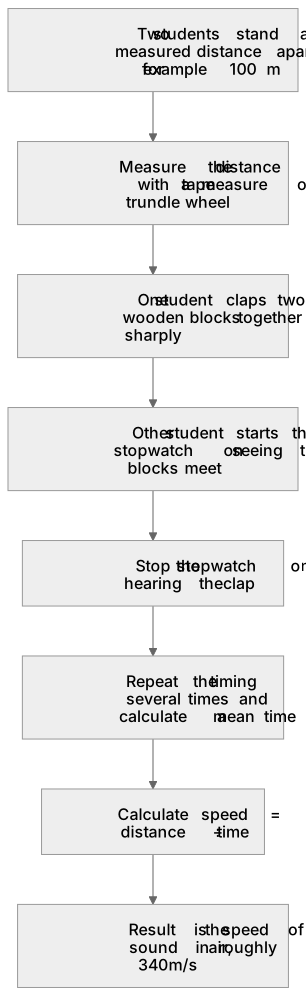
Put it in order
Put these steps in the order they happen.
- 1. Stop the stopwatch on hearing the clap
- 2. Result is the speed of sound in air, roughly 340 m/s
- 3. Repeat the timing several times and calculate a mean time
- 4. Two students stand a measured distance apart, for example 100 m
- 5. Measure the distance with a tape measure or trundle wheel
- 6. Calculate speed = distance ÷ time
- 7. One student claps two wooden blocks together sharply
- 8. Other student starts the stopwatch on seeing the blocks meet
Key words
Say what each word means before you turn the card.
Speed
Try answering aloud or in your head before turning the card.
Direct timing method
Try answering aloud or in your head before turning the card.
Reducing random error
Try answering aloud or in your head before turning the card.
Speed of light and speed of sound
Try answering aloud or in your head before turning the card.
See every definition
- Speed
- Distance travelled per unit time, calculated using speed = distance ÷ time.
- Direct timing method
- A method that measures the time for sound to travel a measured distance through air, so the calculated value is the speed of sound in air.
- Reducing random error
- Repeating the timing several times and calculating a mean time to reduce the effect of random errors in reaction time.
- Speed of light and speed of sound
- Light travels much faster than sound, so seeing the blocks gives a near-instant start signal for the stopwatch.
Label the diagram
Some boxes have lost their names. Pick the right name for each number.
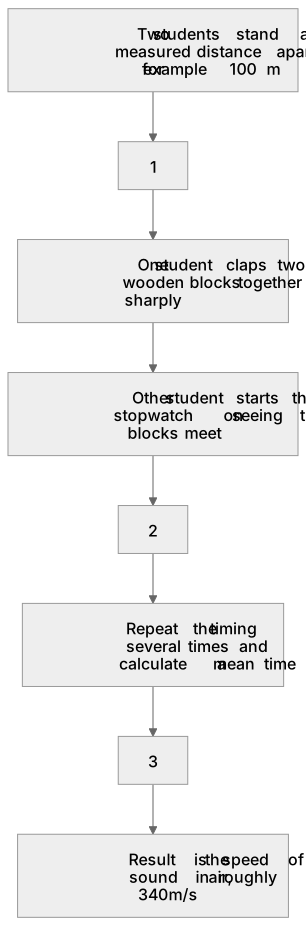
1Box 1
2Box 2
3Box 3
There is more to this lesson
The full lesson goes on to check your understanding and help you earn the marks. Create a free account to carry on, with your progress saved.
A week of Premium from your first lesson · Then the free plan continues · No card, no charge
Test your understanding of Properties of waves: describe a method to measure the speed of sound waves in air
Active recall beats re-reading. Take an instant quiz now to test what you’ve learned and lock it into long-term memory.
A week of Premium from your first lesson · Then the free plan continues · No card, no charge