AQA · GCSE · Combined Science
Course version: 8464 · Version from Sept 2018
The amplitude of a wave is the maximum displacement of a point on a wave…
Full specification wording
Properties of waves: The amplitude of a wave is the maximum displacement of a point on a wave away from its undisturbed position.
Amplitude measures how far a point on a wave moves from its undisturbed position.
Checked against the AQA 8464 specification (opens in a new tab) on .
- Point 2 of 18
- 4 key terms
Study notes
From the checked teaching notes for this specification point.
The idea
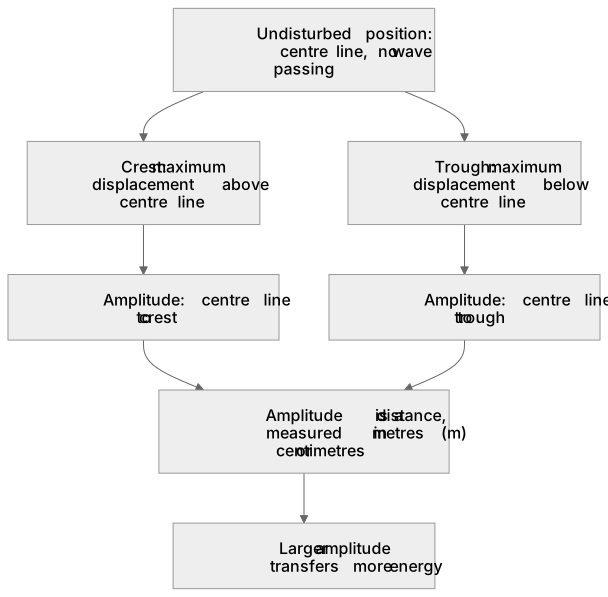
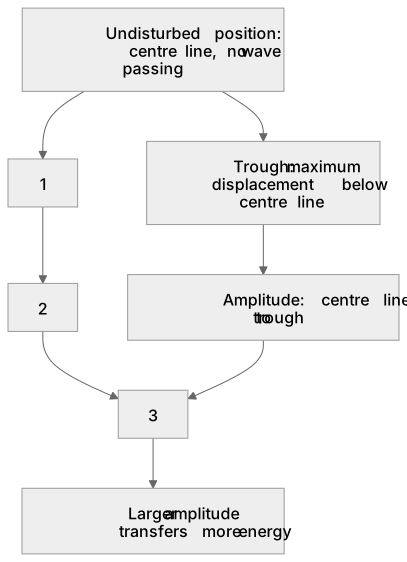
Amplitude measures how far a point on a wave moves from its undisturbed position. The undisturbed position is the level the medium would sit at with no wave passing, often shown as the centre line on a graph. Amplitude is the maximum displacement from that line, so it is measured from the centre line to a crest or from the centre line to a trough, not from crest to trough. Amplitude is a distance, so its unit is the metre (m); larger amplitudes carry more energy. For example, on a displacement–distance graph with a centre line at 0 cm, a crest at +3 cm and a trough at −3 cm has amplitude 3 cm. The peak-to-trough distance of 6 cm is twice the amplitude.
What earns the marks
- Amplitude is the maximum displacement of a point on a wave from its undisturbed position.
- The undisturbed position is the position of the medium when no wave passes, often drawn as the centre line.
- Amplitude is measured from the undisturbed position to a crest or to a trough, not from crest to trough.
- Amplitude is a distance, so it is measured in metres (m) or suitable subunits such as centimetres.
- A wave with a larger amplitude transfers more energy than one with a smaller amplitude.
- On a displacement–distance graph, amplitude is read from the vertical axis as the height of a crest or the depth of a trough above or below the centre line.
Common mistakes and how to put them right
Measuring amplitude from crest to trough.
Put it right: This gives twice the amplitude; amplitude is measured from the undisturbed position to a crest or trough.
Using the wrong unit for amplitude.
Put it right: Amplitude is a displacement, so the unit is metres, not hertz or seconds.
Assuming amplitude affects wavelength.
Put it right: Changing amplitude does not change wavelength; amplitude describes displacement from the undisturbed position.
Exam tips
- Identify the undisturbed position first, often the centre line at zero on a graph, then measure vertically to a crest or trough.
- Give amplitude with a unit, such as 3 cm or 0.03 m, and do not confuse it with the peak-to-trough distance.
- If a question asks for amplitude from a graph, check whether the vertical scale is in cm or m before writing the answer.
Try the lesson
The start of the Properties of waves: The amplitude of a wave is the maximum displacement of a point on a wave away from its undisturbed position. lesson, made from checked teaching notes for this specification point.
Have a go first
A wave on a rope has an undisturbed position at 0 cm. A point on the wave reaches a maximum displacement of 8 cm above the undisturbed position. What is the amplitude of this wave?
Listen
Amplitude measures how far a point on a wave moves from its undisturbed position. The undisturbed position is the level the medium would sit at with no wave passing, often shown as the centre line on a graph. Amplitude is the maximum displacement from that line, so it is measured from the centre line to a crest or from the centre line to a trough, not from crest to trough. Amplitude is a distance, so its unit is the metre (m); larger amplitudes carry more energy. For example, on a displacement–distance graph with a centre line at 0 cm, a crest at +3 cm and a trough at −3 cm has amplitude 3 cm. The peak-to-trough distance of 6 cm is twice the amplitude. A strong answer earns marks for these points. Amplitude is the maximum displacement of a point on a wave from its undisturbed position. The undisturbed position is the position of the medium when no wave passes, often drawn as the centre line. Amplitude is measured from the undisturbed position to a crest or to a trough, not from crest to trough. Amplitude is a distance, so it is measured in metres (m) or suitable subunits such as centimetres. Exam tip: Identify the undisturbed position first, often the centre line at zero on a graph, then measure vertically to a crest or trough.
See it
Key words
Say what each word means before you turn the card.
Amplitude
Try answering aloud or in your head before turning the card.
Undisturbed position
Try answering aloud or in your head before turning the card.
Displacement–distance graph
Try answering aloud or in your head before turning the card.
Energy transfer and amplitude
Try answering aloud or in your head before turning the card.
See every definition
- Amplitude
- The maximum displacement of a point on a wave away from its undisturbed position, measured from the centre line to a crest or to a trough.
- Undisturbed position
- The position of the medium when no wave passes, often drawn as the centre line on a graph.
- Displacement–distance graph
- A graph on which amplitude is read from the vertical axis as the height of a crest or the depth of a trough above or below the centre line.
- Energy transfer and amplitude
- A wave with a larger amplitude transfers more energy than one with a smaller amplitude.
Label the diagram
Some boxes have lost their names. Pick the right name for each number.
1Box 1
2Box 2
3Box 3
There is more to this lesson
The full lesson goes on to check your understanding and help you earn the marks. Create a free account to carry on, with your progress saved.
A week of Premium from your first lesson · Then the free plan continues · No card, no charge
Test your understanding of Properties of waves: The amplitude of a wave is the maximum displacement of a point on a wave away from its undisturbed position.
Active recall beats re-reading. Take an instant quiz now to test what you’ve learned and lock it into long-term memory.
A week of Premium from your first lesson · Then the free plan continues · No card, no charge