AQA · GCSE · Combined Science
Course version: 8464 · Version from Sept 2018
The wave speed is the speed at which the energy is transferred (or the…
Full specification wording
Properties of waves: The wave speed is the speed at which the energy is transferred (or the wave moves) through the medium.
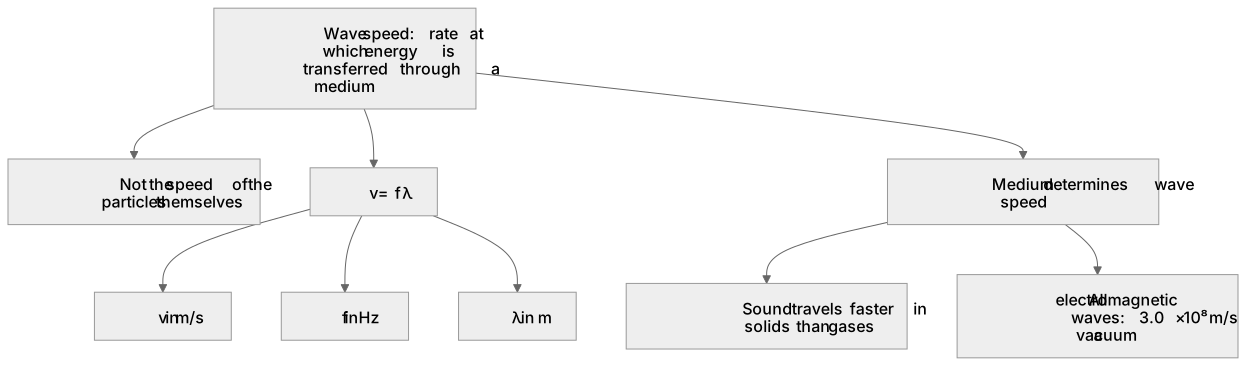
Wave speed describes how quickly energy travels through a medium, not how fast individual particles move.
Checked against the AQA 8464 specification (opens in a new tab) on .
- Point 9 of 18
- 4 key terms
Study notes
From the checked teaching notes for this specification point.
The idea
Wave speed describes how quickly energy travels through a medium, not how fast individual particles move. In a transverse wave, particles oscillate about fixed positions while the disturbance passes; in a longitudinal wave, particles vibrate along the direction of travel. For example, a sound wave in air has a speed of about 340 m/s, meaning energy reaches a listener 340 m away in roughly one second, even though air molecules only jiggle a few millimetres. Wave speed is calculated using v = f λ, where v is speed in m/s, f is frequency in Hz and λ is wavelength in m. The medium determines the speed: sound travels faster in solids than gases, while all electromagnetic waves travel at 3.0 × 10⁸ m/s in a vacuum.
What earns the marks
- State that wave speed is the rate at which energy is transferred through a medium, not the speed of the particles themselves.
- Distinguish between the motion of the wave (energy transfer) and the oscillation of particles about fixed positions.
- Use v = f λ correctly, substituting frequency in Hz and wavelength in m to give speed in m/s.
- Explain that the medium determines wave speed, for example sound is faster in solids than in gases.
- Apply the idea to a context, such as calculating the speed of a water wave from frequency and wavelength measurements.
Common mistakes and how to put them right
Confusing wave speed with particle speed.
Put it right by stating that energy, not matter, is transferred.
Using wavelength in cm with frequency in Hz without converting to m.
Put it right by converting all lengths to metres before calculating.
Thinking that increasing frequency always increases wave speed in the same medium.
Put it right by noting that in a given medium speed is fixed, so frequency and wavelength are inversely proportional.
Exam tips
- Underline the phrase 'energy is transferred' in the statement and use it in your definition to show precise understanding.
- When calculating, write the equation, substitute values with units, then give the answer with the correct unit, for example 12 m/s.
- For explain questions, link the medium to the speed, for example 'sound travels faster in steel than in air because particles are closer together'.
Try the lesson
The start of the Properties of waves: The wave speed is the speed at which the energy is transferred (or the wave moves) through the medium. lesson, made from checked teaching notes for this specification point.
Have a go first
A water wave travels across a pond. What does the wave speed of the water wave describe?
Listen
Wave speed describes how quickly energy travels through a medium, not how fast individual particles move. In a transverse wave, particles oscillate about fixed positions while the disturbance passes; in a longitudinal wave, particles vibrate along the direction of travel. For example, a sound wave in air has a speed of about 340 m/s, meaning energy reaches a listener 340 m away in roughly one second, even though air molecules only jiggle a few millimetres. Wave speed is calculated using v = f λ, where v is speed in m/s, f is frequency in Hz and λ is wavelength in m. The medium determines the speed: sound travels faster in solids than gases, while all electromagnetic waves travel at 3.0 × 10⁸ m/s in a vacuum. A strong answer earns marks for these points. State that wave speed is the rate at which energy is transferred through a medium, not the speed of the particles themselves. Distinguish between the motion of the wave (energy transfer) and the oscillation of particles about fixed positions. Use v = f λ correctly, substituting frequency in Hz and wavelength in m to give speed in m/s. Explain that the medium determines wave speed, for example sound is faster in solids than in gases. A common slip: Confusing wave speed with particle speed: particles in a transverse wave move up and down, not along the wave. Instead, stating that energy, not matter, is transferred. Exam tip: Underline the phrase 'energy is transferred' in the statement and use it in your definition to show precise understanding.
See it
Key words
Say what each word means before you turn the card.
Wave speed
Try answering aloud or in your head before turning the card.
Particle oscillation versus wave motion
Try answering aloud or in your head before turning the card.
The wave equation v = f λ
Try answering aloud or in your head before turning the card.
Medium-dependent wave speed
Try answering aloud or in your head before turning the card.
See every definition
- Wave speed
- The speed at which the energy is transferred (or the wave moves) through the medium.
- Particle oscillation versus wave motion
- Particles oscillate about fixed positions while the disturbance passes, so energy, not matter, is transferred.
- The wave equation v = f λ
- Wave speed is calculated using v = f λ, where v is speed in m/s, f is frequency in Hz and λ is wavelength in m.
- Medium-dependent wave speed
- The medium determines the speed, for example sound travels faster in solids than gases.
Label the diagram
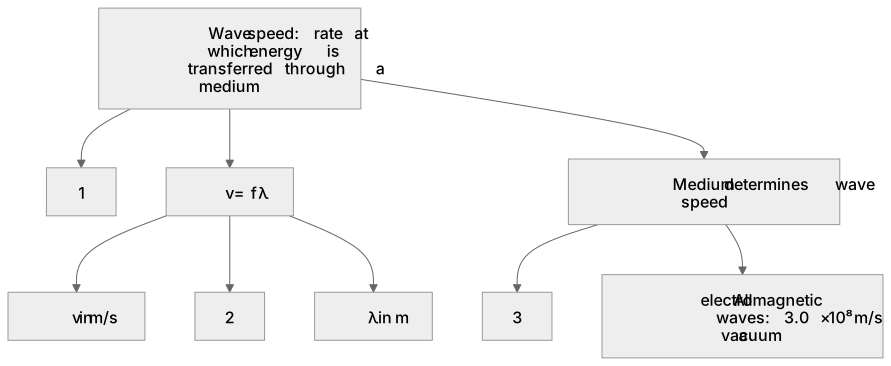
Some boxes have lost their names. Pick the right name for each number.
1Box 1
2Box 2
3Box 3
There is more to this lesson
The full lesson goes on to check your understanding and help you earn the marks. Create a free account to carry on, with your progress saved.
A week of Premium from your first lesson · Then the free plan continues · No card, no charge
Test your understanding of Properties of waves: The wave speed is the speed at which the energy is transferred (or the wave moves) through the medium.
Active recall beats re-reading. Take an instant quiz now to test what you’ve learned and lock it into long-term memory.
A week of Premium from your first lesson · Then the free plan continues · No card, no charge