AQA · GCSE · Combined Science
Course version: 8464 · Version from Sept 2018
Suitable precautions must be taken to protect against any hazard that the…
Full specification wording
Radioactive contamination: Suitable precautions must be taken to protect against any hazard that the radioactive source used in the process of irradiation may present.
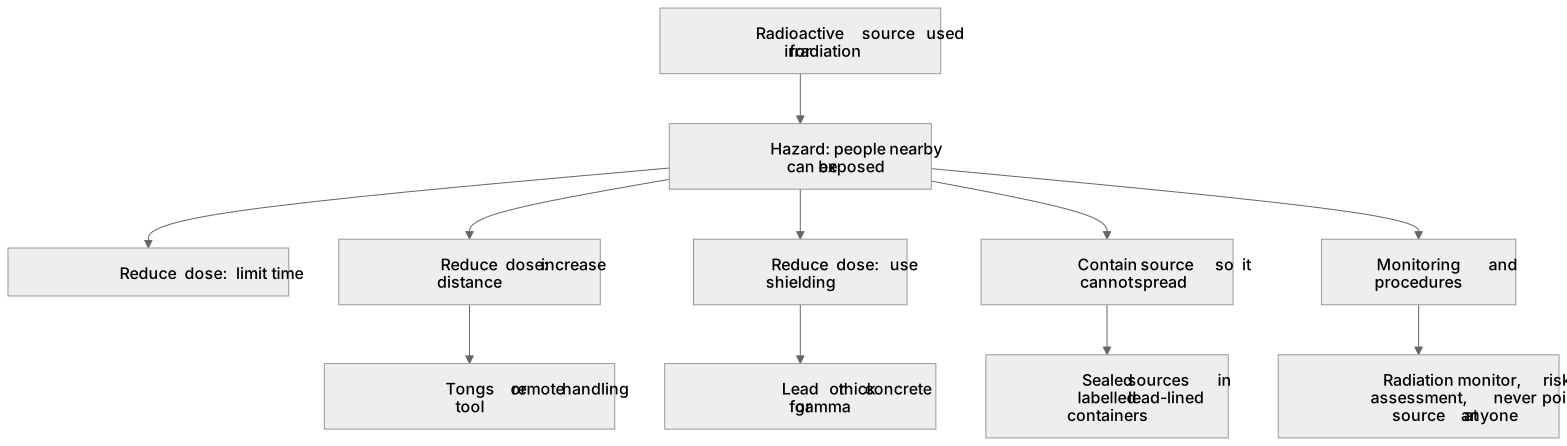
When a radioactive source is used to irradiate something, the source stays outside the target, but people nearby can still be exposed.
Checked against the AQA 8464 specification (opens in a new tab) on .
- Point 4 of 5
- 3 key terms
Study notes
From the checked teaching notes for this specification point.
The idea
When a radioactive source is used to irradiate something, the source stays outside the target, but people nearby can still be exposed. Precautions reduce the dose received by using time, distance and shielding, and by containing the source so it cannot spread. Keep exposure time as short as possible, handle the source with tongs or in a remote handling tool to increase distance, and place appropriate shielding such as lead or thick concrete around gamma emitters. Store sources in labelled lead-lined containers, never point a source at anyone, and check equipment before and after use.
For example: A school demonstration with a sealed gamma source uses long tongs, a shielded store and a radiation monitor to confirm safe dose rates.
What earns the marks
- Identifies that the main aim is to reduce the radiation dose received by people, by limiting time, increasing distance and using shielding.
- Describes distance precautions such as handling sources with tongs or remote handling tools and keeping the source away from the body.
- Describes shielding precautions matched to the radiation, for example lead or thick concrete for gamma and appropriate containers for beta sources.
- Describes containment and storage precautions such as sealed sources, labelled lead-lined containers and secure storage when not in use.
- Explains monitoring and procedural controls, such as using a radiation monitor, following a risk assessment and never pointing a source at anyone.
- Links each precaution to the hazard it reduces, for example shielding reduces external irradiation while sealed containment prevents contamination.
Common mistakes and how to put them right
Thinking that any material blocks any radiation equally.
Put it right: Alpha is stopped by paper or air, beta by thin metal or plastic, and gamma needs dense shielding such as lead or thick concrete.
Believing distance does not matter once shielding is used.
Put it right: Dose rate falls sharply with distance, so tongs and remote handling remain important even with shielding.
Confusing precautions against irradiation with precautions against contamination.
Put it right: Irradiation is reduced by time, distance and shielding, while contamination is prevented by containment, sealing and hygiene.
Exam tips
- Answer with named precautions and link each one to the hazard it reduces, rather than listing safety words.
- Match the shielding to the radiation type and state why that material is suitable.
- Include both equipment controls, such as tongs and monitors, and procedural controls, such as risk assessment and limited exposure time.
Try the lesson
The start of the Radioactive contamination: Suitable precautions must be taken to protect against any hazard that the radioactive source used in the process of irradiation may present. lesson, made from checked teaching notes for this specification point.
Have a go first
A sealed radioactive source is used to irradiate a sample of food. Which precaution best protects the worker from the hazard of the source?
Listen
When a radioactive source is used to irradiate something, the source stays outside the target, but people nearby can still be exposed. Precautions reduce the dose received by using time, distance and shielding, and by containing the source so it cannot spread. Keep exposure time as short as possible, handle the source with tongs or in a remote handling tool to increase distance, and place appropriate shielding such as lead or thick concrete around gamma emitters. Store sources in labelled lead-lined containers, never point a source at anyone, and check equipment before and after use. For example, a school demonstration with a sealed gamma source uses long tongs, a shielded store and a radiation monitor to confirm safe dose rates. A strong answer earns marks for these points. Identifies that the main aim is to reduce the radiation dose received by people, by limiting time, increasing distance and using shielding. Describes distance precautions such as handling sources with tongs or remote handling tools and keeping the source away from the body. Describes shielding precautions matched to the radiation, for example lead or thick concrete for gamma and appropriate containers for beta sources. Describes containment and storage precautions such as sealed sources, labelled lead-lined containers and secure storage when not in use. A common slip: Thinking that any material blocks any radiation equally. Instead, alpha is stopped by paper or air, beta by thin metal or plastic, and gamma needs dense shielding such as lead or thick concrete. Exam tip: Answer with named precautions and link each one to the hazard it reduces, rather than listing safety words.
See it
Key words
Say what each word means before you turn the card.
Time, distance and shielding
Try answering aloud or in your head before turning the card.
Sealed sources and containment
Try answering aloud or in your head before turning the card.
Risk assessment and monitoring
Try answering aloud or in your head before turning the card.
See every definition
- Time, distance and shielding
- Precautions that reduce the dose received by keeping exposure time as short as possible, increasing distance and placing appropriate shielding around the source.
- Sealed sources and containment
- Storing sources in labelled lead-lined containers and containing the source so it cannot spread.
- Risk assessment and monitoring
- Using a radiation monitor and following a risk assessment to confirm safe dose rates and reduce the dose received by people.
Label the diagram
Some boxes have lost their names. Pick the right name for each number.
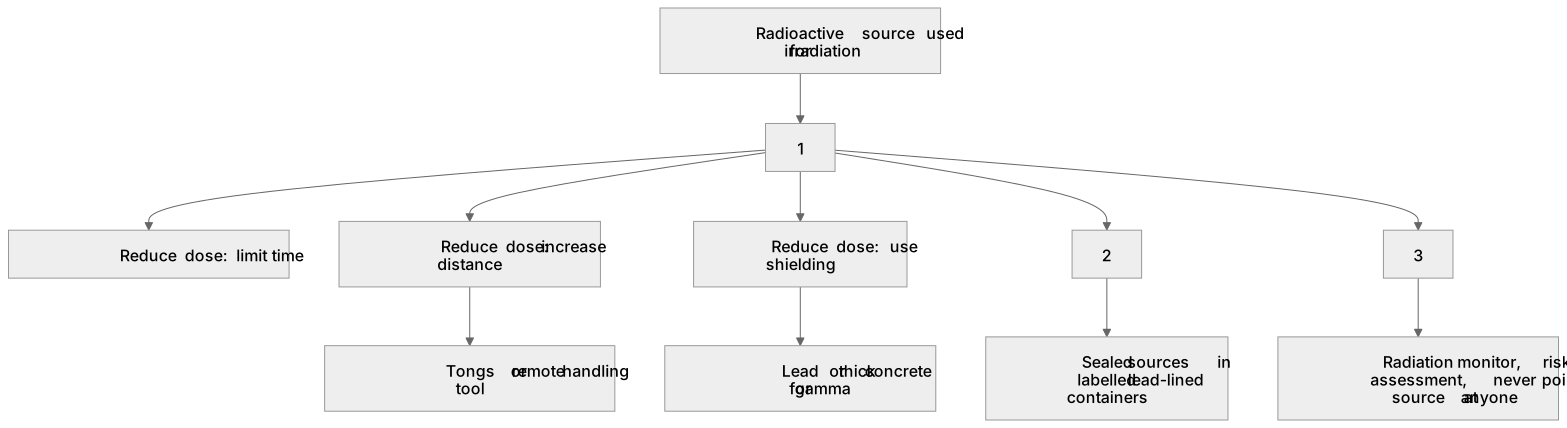
1Box 1
2Box 2
3Box 3
There is more to this lesson
The full lesson goes on to check your understanding and help you earn the marks. Create a free account to carry on, with your progress saved.
A week of Premium from your first lesson · Then the free plan continues · No card, no charge
Test your understanding of Radioactive contamination: Suitable precautions must be taken to protect against any hazard that the radioactive source used in the process of irradiation may present.
Active recall beats re-reading. Take an instant quiz now to test what you’ve learned and lock it into long-term memory.
A week of Premium from your first lesson · Then the free plan continues · No card, no charge