AQA · GCSE · Combined Science
Course version: 8464 · Version from Sept 2018
A vector quantity may be represented by an arrow. The length of the arrow…
Full specification wording
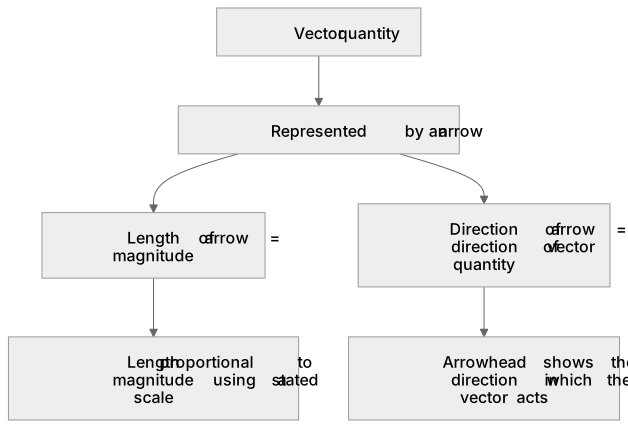
Scalar and vector quantities: A vector quantity may be represented by an arrow. The length of the arrow represents the magnitude, and the direction of the arrow the direction of the vector quantity.
A vector quantity has both magnitude and direction, unlike a scalar which has magnitude only.
Checked against the AQA 8464 specification (opens in a new tab) on .
- Point 3 of 3
Study notes
From the checked teaching notes for this specification point.
The idea
A vector quantity has both magnitude and direction, unlike a scalar which has magnitude only. To represent a vector, draw a straight arrow: its length is proportional to the magnitude, using a stated scale, and its orientation shows the direction. For example, a 20 N force acting horizontally to the right could be drawn as a 4 cm arrow using the scale 1 cm = 5 N. Changing the scale changes the drawn length but not the physical vector. When several vectors act, each is drawn tip-to-tail at the correct angle, allowing a resultant to be found. Always state the scale and use a ruler and protractor so the drawing is accurate.
What earns the marks
- State that a vector has both magnitude and direction, whereas a scalar has magnitude only.
- Explain that the arrow's length is proportional to the magnitude and must be drawn using a stated scale.
- Explain that the arrow's direction, including its orientation and sense, represents the direction of the vector quantity.
- Use a ruler and protractor to draw a vector accurately, and label the scale and the quantity represented.
- Interpret a given arrow diagram by reading its length against the scale and its direction from a stated reference line.
Common mistakes and how to put them right
Treating length alone as the vector.
Put it right: The arrow must also show direction, so always include an arrowhead and orientation.
Forgetting to state or apply a scale.
Put it right: Without a scale, the drawn length cannot be converted to a magnitude.
Drawing the arrowhead at the wrong end or reversing the sense.
Put it right: The arrowhead shows the direction in which the vector acts.
Exam tips
- Write the scale next to the diagram, for example 1 cm = 5 N, before drawing any arrow.
- Measure length from the tail to the tip of the arrowhead, not to the middle of the arrowhead.
- When comparing vectors, refer to both magnitude and direction rather than length alone.
Try the lesson
The start of the Scalar and vector quantities: A vector quantity may be represented by an arrow. The length of the arrow represents the magnitude, and the direction of the arrow the direction of the vector quantity. lesson, made from checked teaching notes for this specification point.
Have a go first
A pupil draws an arrow to represent a force. What does the length of the arrow show?
Listen
A vector quantity has both magnitude and direction, unlike a scalar which has magnitude only. To represent a vector, draw a straight arrow: its length is proportional to the magnitude, using a stated scale, and its orientation shows the direction. For example, a 20 N force acting horizontally to the right could be drawn as a 4 cm arrow using the scale 1 cm = 5 N. Changing the scale changes the drawn length but not the physical vector. When several vectors act, each is drawn tip-to-tail at the correct angle, allowing a resultant to be found. Always state the scale and use a ruler and protractor so the drawing is accurate. A strong answer earns marks for these points. State that a vector has both magnitude and direction, whereas a scalar has magnitude only. Explain that the arrow's length is proportional to the magnitude and must be drawn using a stated scale. Explain that the arrow's direction, including its orientation and sense, represents the direction of the vector quantity. Use a ruler and protractor to draw a vector accurately, and label the scale and the quantity represented. Exam tip: Write the scale next to the diagram, for example 1 cm = 5 N, before drawing any arrow.
See it
Label the diagram
Some boxes have lost their names. Pick the right name for each number.
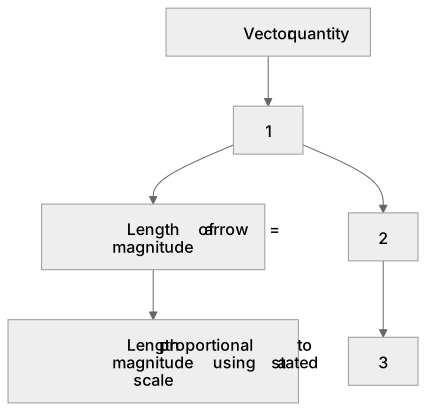
1Box 1
2Box 2
3Box 3
There is more to this lesson
The full lesson goes on to check your understanding and help you earn the marks. Create a free account to carry on, with your progress saved.
A week of Premium from your first lesson · Then the free plan continues · No card, no charge
Test your understanding of Scalar and vector quantities: A vector quantity may be represented by an arrow. The length of the arrow represents the magnitude, and the direction of the arrow the direction of the vector quantity.
Active recall beats re-reading. Take an instant quiz now to test what you’ve learned and lock it into long-term memory.
A week of Premium from your first lesson · Then the free plan continues · No card, no charge