AQA · GCSE · Combined Science
Course version: 8464 · Version from Sept 2018
Scalar and vector quantities: Scalar quantities have magnitude only.
A scalar is fully described by a size alone, called its magnitude, together with its unit.
Checked against the AQA 8464 specification (opens in a new tab) on .
- Point 1 of 3
- 3 key terms
Study notes
From the checked teaching notes for this specification point.
The idea
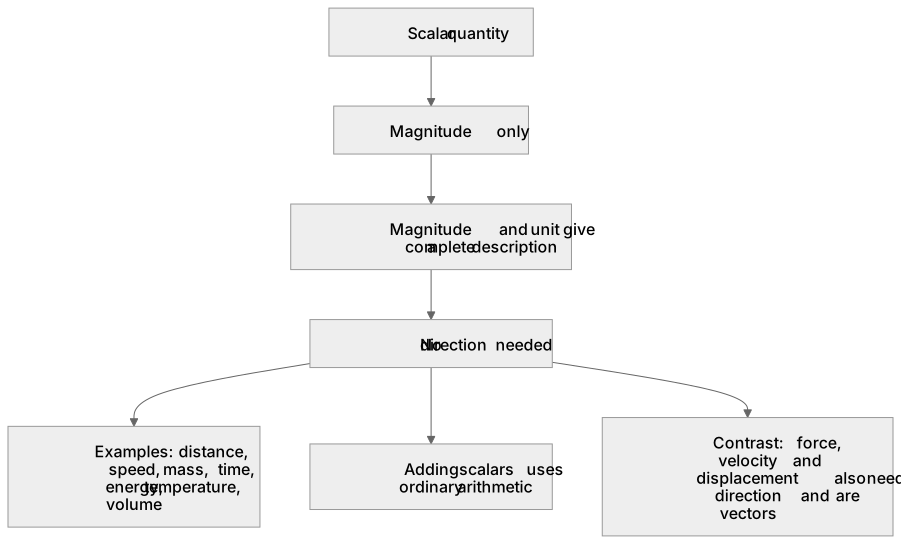
A scalar is fully described by a size alone, called its magnitude, together with its unit. Magnitude means how much of the quantity there is, so a scalar carries no information about direction. For example, a distance of 5 m tells you how far something moved but not which way; a mass of 2 kg, a time of 30 s, a temperature of 20 °C and a speed of 12 m/s are all scalars. When you add scalars you simply combine their sizes using normal arithmetic, because no direction is involved. Recognising scalars matters because some quantities, such as force, velocity and displacement, also need a direction and are therefore vectors. In an exam you may be asked to identify a scalar from a list or explain why a stated quantity is scalar: the key is that magnitude alone gives a complete description.
What earns the marks
- A scalar quantity is completely specified by its magnitude and its unit, with no direction needed.
- Magnitude means the size or amount of the quantity, such as 5 m, 2 kg or 30 s.
- Examples of scalars include distance, speed, mass, time, energy, temperature and volume.
- Adding scalars uses ordinary arithmetic because direction plays no part in the sum.
- A quantity is scalar only if stating its size alone gives a complete description of it.
Common mistakes and how to put them right
Treating distance as a vector.
Put it right: Distance is a scalar because it records how far was travelled, whereas displacement is the vector that includes direction.
Confusing speed with velocity.
Put it right: Speed is scalar, but velocity is a vector because it includes direction as well as magnitude.
Giving a direction when describing a scalar, for example saying 'a mass of 2 kg downwards'.
Put it right: Adding a direction is wrong because a scalar has magnitude only.
Exam tips
- When asked to identify a scalar, check whether the quantity would still be fully described without any direction; if yes, it is scalar.
- Quote the unit with the magnitude, for example 12 m/s, because a number without a unit is incomplete.
- If asked to explain, use the phrase 'magnitude only' and contrast it briefly with a vector that also needs direction.
Try the lesson
The start of the Scalar and vector quantities: Scalar quantities have magnitude only. lesson, made from checked teaching notes for this specification point.
Have a go first
Which of these is a scalar quantity, having magnitude only?
Listen
A scalar is fully described by a size alone, called its magnitude, together with its unit. Magnitude means how much of the quantity there is, so a scalar carries no information about direction. For example, a distance of 5 m tells you how far something moved but not which way; a mass of 2 kg, a time of 30 s, a temperature of 20 °C and a speed of 12 m/s are all scalars. When you add scalars you simply combine their sizes using normal arithmetic, because no direction is involved. Recognising scalars matters because some quantities, such as force, velocity and displacement, also need a direction and are therefore vectors. In an exam you may be asked to identify a scalar from a list or explain why a stated quantity is scalar: the key is that magnitude alone gives a complete description. A strong answer earns marks for these points. A scalar quantity is completely specified by its magnitude and its unit, with no direction needed. Magnitude means the size or amount of the quantity, such as 5 m, 2 kg or 30 s. Examples of scalars include distance, speed, mass, time, energy, temperature and volume. Adding scalars uses ordinary arithmetic because direction plays no part in the sum. Exam tip: When asked to identify a scalar, check whether the quantity would still be fully described without any direction; if yes, it is scalar.
See it
Key words
Say what each word means before you turn the card.
Scalar quantity
Try answering aloud or in your head before turning the card.
Magnitude
Try answering aloud or in your head before turning the card.
Vector
Try answering aloud or in your head before turning the card.
See every definition
- Scalar quantity
- A quantity completely specified by its magnitude and its unit, with no direction needed.
- Magnitude
- The size or amount of the quantity, such as 5 m, 2 kg or 30 s.
- Vector
- A quantity that also needs a direction, such as force, velocity and displacement.
Label the diagram
Some boxes have lost their names. Pick the right name for each number.
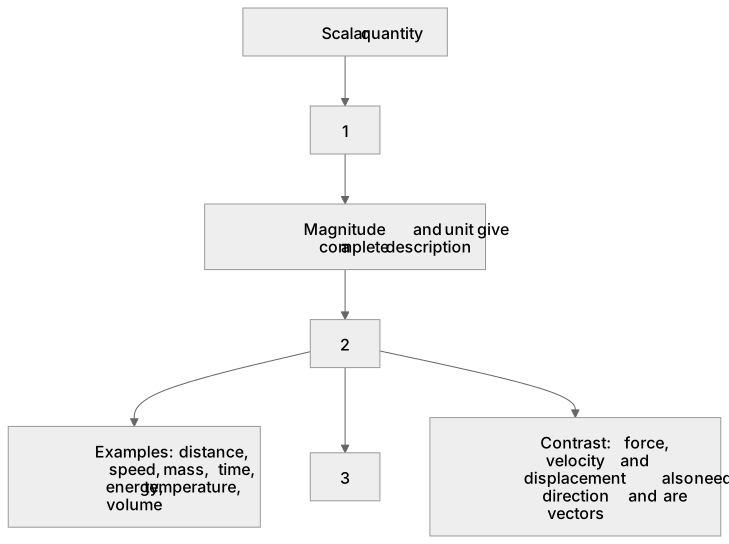
1Box 1
2Box 2
3Box 3
There is more to this lesson
The full lesson goes on to check your understanding and help you earn the marks. Create a free account to carry on, with your progress saved.
A week of Premium from your first lesson · Then the free plan continues · No card, no charge
Test your understanding of Scalar and vector quantities: Scalar quantities have magnitude only.
Active recall beats re-reading. Take an instant quiz now to test what you’ve learned and lock it into long-term memory.
A week of Premium from your first lesson · Then the free plan continues · No card, no charge