AQA · GCSE · Combined Science
Course version: 8464 · Version from Sept 2018
Students should be able to calculate average speed for non-uniform motion.
Full specification wording
Speed: Students should be able to calculate average speed for non-uniform motion.
Non-uniform motion means speed changes during a journey, so a single instantaneous speed does not describe the whole trip.
Checked against the AQA 8464 specification (opens in a new tab) on .
- Point 18 of 18
- 4 key terms
Study notes
From the checked teaching notes for this specification point.
The idea
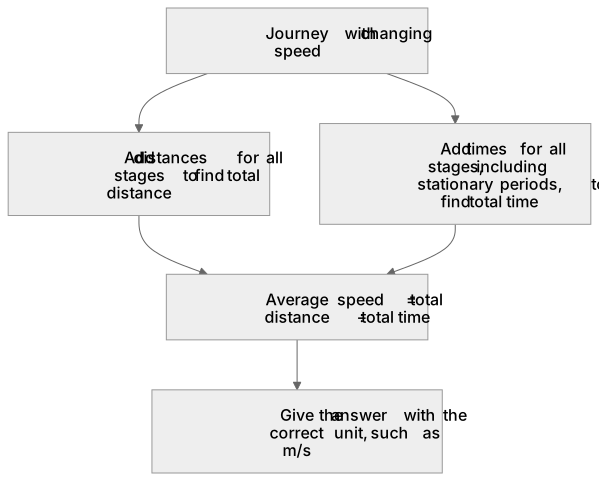
Non-uniform motion means speed changes during a journey, so a single instantaneous speed does not describe the whole trip. Average speed is the total distance travelled divided by the total time taken: average speed = total distance ÷ total time. For example, a cyclist covers 300 m in 20 s, stops for 10 s, then covers 200 m in 15 s. Total distance = 500 m and total time = 45 s, so average speed = 500 ÷ 45 = 11.1 m/s (to 3 significant figures). Use the whole journey, not one stage, and do not average the separate speeds unless the times are equal. Give the unit m/s, or convert to km/h by multiplying by 3.6 if needed.
What earns the marks
- State that average speed = total distance ÷ total time and apply it to a journey with changing speed.
- Add distances for all stages of a journey to find the total distance before dividing.
- Add times for all stages, including any stationary periods, to find the total time before dividing.
- Substitute values into average speed = total distance ÷ total time and give the answer with the correct unit, such as m/s.
- Interpret a distance–time graph for non-uniform motion by using the overall change in distance divided by the overall time.
Common mistakes and how to put them right
Averaging the separate speeds of each stage instead of dividing total distance by total time.
Put it right by using the whole-journey values.
Omitting a stationary period from the total time.
Put it right by including all time intervals, even when distance does not change.
Using the distance of only one stage with the total time.
Put it right by summing every distance covered during the journey.
Exam tips
- Write down total distance and total time as separate steps before dividing, so method marks are clear.
- Check that distance and time units are consistent, converting km to m or minutes to seconds where necessary.
- Round the final answer sensibly, for example to 2 or 3 significant figures, and always include the unit.
Try the lesson
The start of the Speed: Students should be able to calculate average speed for non-uniform motion. lesson, made from checked teaching notes for this specification point.
Have a go first
A cyclist travels 40 m in 10 s, and then travels a further 60 m in 10 s. What is the average speed for the whole journey?
Listen
Non-uniform motion means speed changes during a journey, so a single instantaneous speed does not describe the whole trip. Average speed is the total distance travelled divided by the total time taken: average speed = total distance ÷ total time. For example, a cyclist covers 300 m in 20 s, stops for 10 s, then covers 200 m in 15 s. Total distance = 500 m and total time = 45 s, so average speed = 500 ÷ 45 = 11.1 m/s (to 3 significant figures). Use the whole journey, not one stage, and do not average the separate speeds unless the times are equal. Give the unit m/s, or convert to km/h by multiplying by 3.6 if needed. A strong answer earns marks for these points. State that average speed = total distance ÷ total time and apply it to a journey with changing speed. Add distances for all stages of a journey to find the total distance before dividing. Add times for all stages, including any stationary periods, to find the total time before dividing. Substitute values into average speed = total distance ÷ total time and give the answer with the correct unit, such as m/s. A common slip: Averaging the separate speeds of each stage instead of dividing total distance by total time. Instead, using the whole-journey values. Exam tip: Write down total distance and total time as separate steps before dividing, so method marks are clear.
See it
Key words
Say what each word means before you turn the card.
Average speed for changing motion
Try answering aloud or in your head before turning the card.
Total distance and total time
Try answering aloud or in your head before turning the card.
Unit consistency in calculations
Try answering aloud or in your head before turning the card.
Interpreting distance–time graphs
Try answering aloud or in your head before turning the card.
See every definition
- Average speed for changing motion
- The total distance travelled divided by the total time taken, used when speed changes during a journey.
- Total distance and total time
- The distances for all stages of a journey added together, and the times for all stages including any stationary periods added together.
- Unit consistency in calculations
- Checking that distance and time units are consistent, converting km to m or minutes to seconds where necessary.
- Interpreting distance–time graphs
- Using the overall change in distance divided by the overall time to find average speed for non-uniform motion.
Label the diagram
Some boxes have lost their names. Pick the right name for each number.
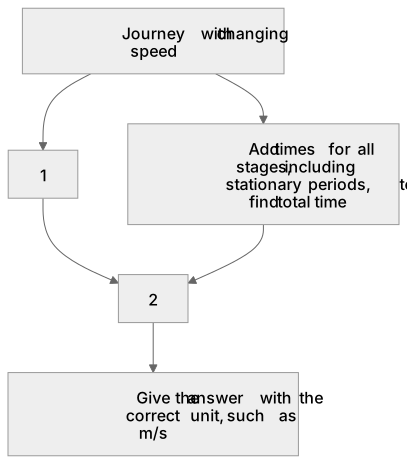
1Box 1
2Box 2
There is more to this lesson
The full lesson goes on to check your understanding and help you earn the marks. Create a free account to carry on, with your progress saved.
A week of Premium from your first lesson · Then the free plan continues · No card, no charge
Test your understanding of Speed: Students should be able to calculate average speed for non-uniform motion.
Active recall beats re-reading. Take an instant quiz now to test what you’ve learned and lock it into long-term memory.
A week of Premium from your first lesson · Then the free plan continues · No card, no charge