AQA · GCSE · Combined Science
Course version: 8464 · Version from Sept 2018
Students should be able to make measurements of distance and time and then…
Full specification wording
Speed: Students should be able to make measurements of distance and time and then calculate speeds of objects.
Speed describes how much distance an object covers each second, so measuring speed means measuring two quantities: distance and time.
Checked against the AQA 8464 specification (opens in a new tab) on .
- Point 11 of 18
Study notes
From the checked teaching notes for this specification point.
The idea
Speed describes how much distance an object covers each second, so measuring speed means measuring two quantities: distance and time. Choose a straight, clear section of the object's path and mark a start line and a finish line. Measure the distance between them with a metre rule or tape measure, in metres, and record the time the object takes to travel that distance using a stopwatch or light gate, in seconds. Repeat the timing several times and take a mean to reduce random error. Then divide distance by time: speed = distance ÷ time. For example, a trolley travelling 1.50 m in 2.5 s has a speed of 1.50 m ÷ 2.5 s = 0.60 m/s. Always give the unit, and check that the value is sensible for the object.
What earns the marks
- Selects a measurable straight section of the path and identifies a clear start point and finish point for timing.
- Measures the distance between the two points with a metre rule or tape measure and records it in metres, converting from cm or km where needed.
- Measures the time taken to travel that distance with a stopwatch or light gate and records it in seconds.
- Repeats the measurement and calculates a mean time to reduce the effect of random error.
- Calculates speed using speed = distance ÷ time and states the unit, such as m/s.
- Comments on whether the result is reasonable, for example comparing with expected speeds or identifying obvious timing error.
Common mistakes and how to put them right
Timing the whole journey instead of the measured section.
Put it right: The distance and time must refer to the same start and finish points, otherwise the calculated speed is wrong.
Forgetting to convert centimetres to metres before dividing.
Put it right: 150 cm must be written as 1.50 m, not 150 m.
Using a single timing without repeats.
Put it right: One reaction-time error can distort the result, so repeat and average the times.
Exam tips
- Write the equation, substitute the measured values with units, then give the answer with the correct unit.
- If asked to improve the experiment, suggest light gates or video timing to remove human reaction time.
- Check the arithmetic by estimating: 1.5 m in about 2.5 s should be roughly 0.6 m/s, not 6 m/s or 0.06 m/s.
Try the lesson
The start of the Speed: Students should be able to make measurements of distance and time and then calculate speeds of objects. lesson, made from checked teaching notes for this specification point.
Have a go first
A student measures that a toy car travels a distance of 20 m in a time of 4 s. Calculate the speed of the toy car.
Listen
Speed describes how much distance an object covers each second, so measuring speed means measuring two quantities: distance and time. Choose a straight, clear section of the object's path and mark a start line and a finish line. Measure the distance between them with a metre rule or tape measure, in metres, and record the time the object takes to travel that distance using a stopwatch or light gate, in seconds. Repeat the timing several times and take a mean to reduce random error. Then divide distance by time: speed = distance ÷ time. For example, a trolley travelling 1.50 m in 2.5 s has a speed of 1.50 m ÷ 2.5 s = 0.60 m/s. Always give the unit, and check that the value is sensible for the object. A strong answer earns marks for these points. Selects a measurable straight section of the path and identifies a clear start point and finish point for timing. Measures the distance between the two points with a metre rule or tape measure and records it in metres, converting from cm or km where needed. Measures the time taken to travel that distance with a stopwatch or light gate and records it in seconds. Repeats the measurement and calculates a mean time to reduce the effect of random error. Exam tip: Write the equation, substitute the measured values with units, then give the answer with the correct unit.
See it
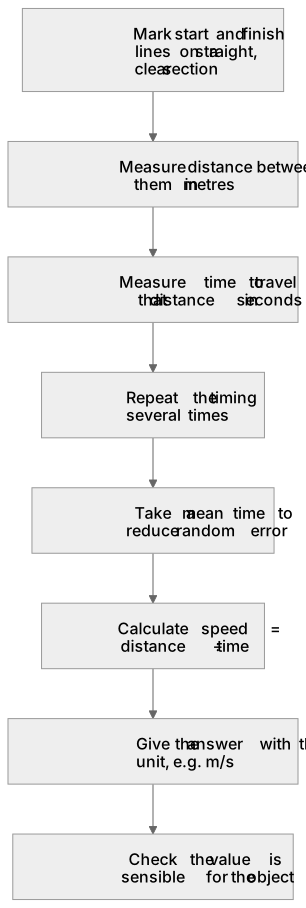
Put it in order
Put these steps in the order they happen.
- 1. Take a mean time to reduce random error
- 2. Check the value is sensible for the object
- 3. Calculate speed = distance ÷ time
- 4. Mark start and finish lines on a straight, clear section
- 5. Measure distance between them in metres
- 6. Give the answer with the unit, e.g. m/s
- 7. Measure time to travel that distance in seconds
- 8. Repeat the timing several times
Label the diagram
Some boxes have lost their names. Pick the right name for each number.
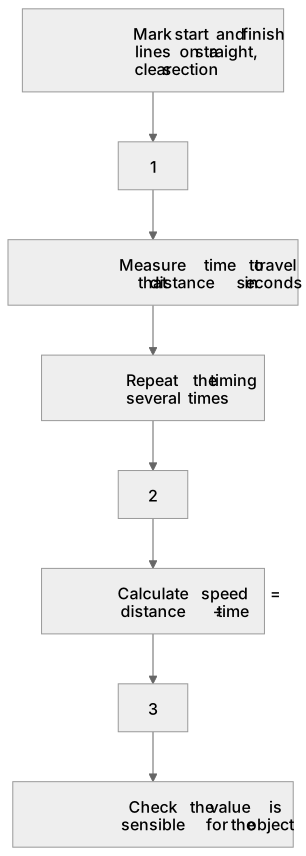
1Box 1
2Box 2
3Box 3
There is more to this lesson
The full lesson goes on to check your understanding and help you earn the marks. Create a free account to carry on, with your progress saved.
A week of Premium from your first lesson · Then the free plan continues · No card, no charge
Test your understanding of Speed: Students should be able to make measurements of distance and time and then calculate speeds of objects.
Active recall beats re-reading. Take an instant quiz now to test what you’ve learned and lock it into long-term memory.
A week of Premium from your first lesson · Then the free plan continues · No card, no charge