AQA · GCSE · Combined Science
Course version: 8464 · Version from Sept 2018
The specific heat capacity of a substance is the amount of energy required…
Full specification wording
Temperature changes in a system and specific heat capacity: The specific heat capacity of a substance is the amount of energy required to raise the temperature of one kilogram of the substance by one degree Celsius.
Specific heat capacity measures how much energy one kilogram of a material absorbs to warm by one degree Celsius.
Checked against the AQA 8464 specification (opens in a new tab) on .
- Point 10 of 10
- 4 key terms
Study notes
From the checked teaching notes for this specification point.
The idea
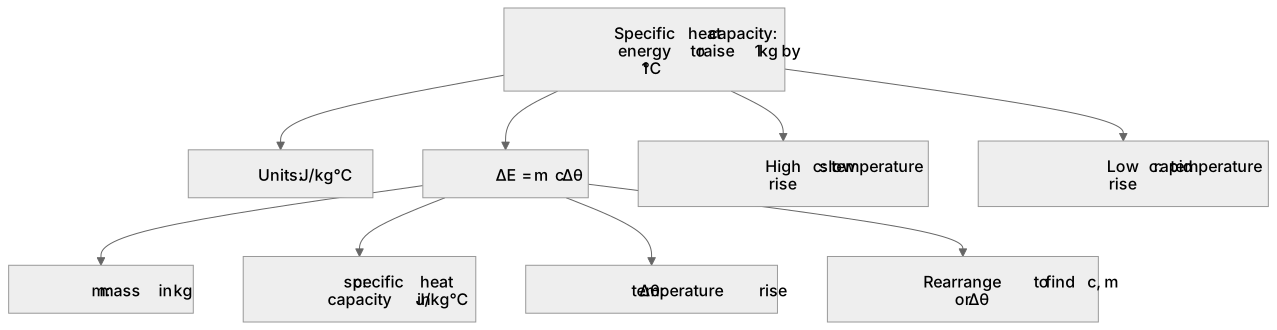
Specific heat capacity measures how much energy one kilogram of a material absorbs to warm by one degree Celsius. A low value, such as copper at about 385 J/kg°C, means it heats quickly; water's high value of 4200 J/kg°C means it warms slowly. To find energy, use ΔE = m c Δθ, where m is mass in kg, c is specific heat capacity in J/kg°C and Δθ is the temperature rise. For example, heating 2 kg of water by 10 °C needs 2 × 4200 × 10 = 84 000 J. Rearranged, c = ΔE ÷ (m Δθ). The definition fixes both the mass and the temperature rise, so the value is a property of the substance, not of the sample size.
What earns the marks
- State that specific heat capacity is the energy needed per kilogram per degree Celsius, with units J/kg°C.
- Use ΔE = m c Δθ correctly, converting grams to kilograms and kJ to J before substituting.
- Rearrange the equation to find c, m or Δθ when the other quantities are known.
- Interpret a high specific heat capacity as a slow temperature rise for a given energy input, and a low value as a rapid rise.
- Compare materials quantitatively, for example explaining why water is used in heating systems because it stores more energy per degree.
- Read data from a table of specific heat capacities and select the appropriate value for a calculation.
Common mistakes and how to put them right
Using mass in grams instead of kilograms.
Put it right: Divide grams by 1000 before substituting into ΔE = m c Δθ.
Confusing specific heat capacity with specific latent heat.
Put it right: Specific heat capacity involves a temperature change, while latent heat involves a change of state at constant temperature.
Using the final temperature instead of the temperature change for Δθ.
Put it right by subtracting the initial temperature from the final temperature to find the change.
Exam tips
- Write the equation, substitute numbers with units, then calculate; this earns method credit even if the arithmetic slips.
- Check whether the question gives a temperature change or a final temperature; subtract the starting temperature to find Δθ.
- For 'explain' questions, link the size of c to the observed temperature change rather than just quoting the number.
Try the lesson
The start of the Temperature changes in a system and specific heat capacity: The specific heat capacity of a substance is the amount of energy required to raise the temperature of one kilogram of the substance by one degree Celsius. lesson, made from checked teaching notes for this specification point.
Have a go first
Which statement gives the definition of the specific heat capacity of a substance?
Listen
Specific heat capacity measures how much energy one kilogram of a material absorbs to warm by one degree Celsius. A low value, such as copper at about 385 J/kg°C, means it heats quickly; water's high value of 4200 J/kg°C means it warms slowly. To find energy, use ΔE = m c Δθ, where m is mass in kg, c is specific heat capacity in J/kg°C and Δθ is the temperature rise. For example, heating 2 kg of water by 10 °C needs 2 × 4200 × 10 = 84 000 J. Rearranged, c = ΔE ÷ (m Δθ). The definition fixes both the mass and the temperature rise, so the value is a property of the substance, not of the sample size. A strong answer earns marks for these points. State that specific heat capacity is the energy needed per kilogram per degree Celsius, with units J/kg°C. Use ΔE = m c Δθ correctly, converting grams to kilograms and kJ to J before substituting. Rearrange the equation to find c, m or Δθ when the other quantities are known. Interpret a high specific heat capacity as a slow temperature rise for a given energy input, and a low value as a rapid rise. A common slip: Using the final temperature instead of the temperature change for Δθ. Instead, subtracting the initial temperature from the final temperature to find the change. Exam tip: Write the equation, substitute numbers with units, then calculate; this earns method credit even if the arithmetic slips.
See it
Key words
Say what each word means before you turn the card.
Specific heat capacity
Try answering aloud or in your head before turning the card.
ΔE = m c Δθ
Try answering aloud or in your head before turning the card.
Temperature change
Try answering aloud or in your head before turning the card.
J/kg°C
Try answering aloud or in your head before turning the card.
See every definition
- Specific heat capacity
- The amount of energy required to raise the temperature of one kilogram of a substance by one degree Celsius.
- ΔE = m c Δθ
- The equation used to find energy, where m is mass in kg, c is specific heat capacity in J/kg°C and Δθ is the temperature rise.
- Temperature change
- The temperature rise found by subtracting the initial temperature from the final temperature.
- J/kg°C
- The units of specific heat capacity.
Label the diagram
Some boxes have lost their names. Pick the right name for each number.
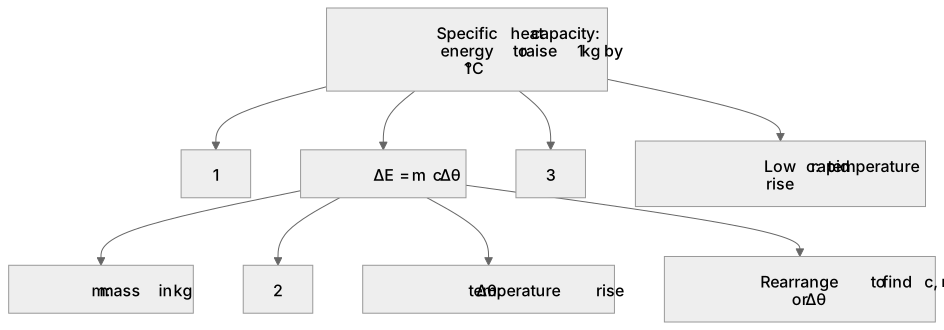
1Box 1
2Box 2
3Box 3
There is more to this lesson
The full lesson goes on to check your understanding and help you earn the marks. Create a free account to carry on, with your progress saved.
A week of Premium from your first lesson · Then the free plan continues · No card, no charge
Test your understanding of Temperature changes in a system and specific heat capacity: The specific heat capacity of a substance is the amount of energy required to raise the temperature of one kilogram of the substance by one degree Celsius.
Active recall beats re-reading. Take an instant quiz now to test what you’ve learned and lock it into long-term memory.
A week of Premium from your first lesson · Then the free plan continues · No card, no charge