AQA · GCSE · Combined Science
Course version: 8464 · Version from Sept 2018
Before the discovery of the electron, atoms were thought to be tiny…
Full specification wording
The development of the model of the atom (common content with chemistry): Before the discovery of the electron, atoms were thought to be tiny spheres that could not be divided.
This statement describes the earliest scientific model of the atom, often linked to John Dalton in the early 1800s.
Checked against the AQA 8464 specification (opens in a new tab) on .
- Point 2 of 10
- 4 key terms
Study notes
From the checked teaching notes for this specification point.
The idea
This statement describes the earliest scientific model of the atom, often linked to John Dalton in the early 1800s. Atoms were imagined as solid, indivisible spheres, rather like tiny billiard balls. The word atom comes from the Greek word atomos, meaning uncuttable, because there was no evidence that anything smaller existed. This model explained simple ideas such as elements combining in fixed ratios, but it could not explain electricity or radioactivity. The discovery of the electron by J. J. Thomson in 1897 showed that atoms contain smaller, negatively charged particles, so the solid-sphere model had to be replaced. When answering, describe the model and explain why new evidence caused it to change.
What earns the marks
- State that atoms were modelled as tiny solid spheres.
- Explain that the spheres were thought to be indivisible, meaning they could not be split into smaller parts.
- Link the model to the absence of evidence for smaller particles before the electron was discovered.
- Explain that the model was later replaced because the discovery of the electron showed atoms contain smaller charged particles.
- Use the term indivisible correctly rather than saying atoms were simply small.
Common mistakes and how to put them right
Saying atoms were thought to be made of protons and neutrons.
Put it right by stating that these particles were not known at the time and the model contained no smaller particles.
Confusing indivisible with invisible.
Put it right by explaining that indivisible means cannot be divided, not cannot be seen.
Claiming the solid-sphere model is still accepted.
Put it right by stating it was replaced after the electron was discovered.
Exam tips
- Name the model clearly as the solid-sphere or indivisible-sphere model.
- Use the phrase could not be divided to match the statement precisely.
- Explain the role of new evidence in causing a scientific model to change.
Try the lesson
The start of the The development of the model of the atom (common content with chemistry): Before the discovery of the electron, atoms were thought to be tiny spheres that could not be divided. lesson, made from checked teaching notes for this specification point.
Have a go first
In the early 1800s, John Dalton described atoms as solid spheres. What did Dalton's model say about whether an atom can be split into smaller parts?
Listen
This statement describes the earliest scientific model of the atom, often linked to John Dalton in the early 1800s. Atoms were imagined as solid, indivisible spheres, rather like tiny billiard balls. The word atom comes from the Greek word atomos, meaning uncuttable, because there was no evidence that anything smaller existed. This model explained simple ideas such as elements combining in fixed ratios, but it could not explain electricity or radioactivity. The discovery of the electron by J. J. Thomson in 1897 showed that atoms contain smaller, negatively charged particles, so the solid-sphere model had to be replaced. When answering, describe the model and explain why new evidence caused it to change. A strong answer earns marks for these points. State that atoms were modelled as tiny solid spheres. Explain that the spheres were thought to be indivisible, meaning they could not be split into smaller parts. Link the model to the absence of evidence for smaller particles before the electron was discovered. Explain that the model was later replaced because the discovery of the electron showed atoms contain smaller charged particles. A common slip: Saying atoms were thought to be made of protons and neutrons. Instead, stating that these particles were not known at the time and the model contained no smaller particles. Exam tip: Name the model clearly as the solid-sphere or indivisible-sphere model.
See it
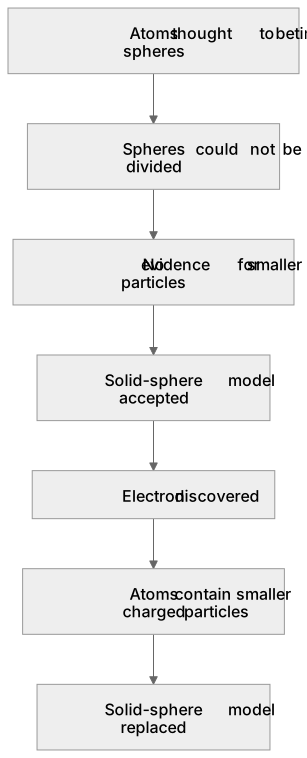
Put it in order
Put these steps in the order they happen.
- 1. Solid-sphere model replaced
- 2. Atoms contain smaller charged particles
- 3. No evidence for smaller particles
- 4. Electron discovered
- 5. Atoms thought to be tiny spheres
- 6. Spheres could not be divided
- 7. Solid-sphere model accepted
Key words
Say what each word means before you turn the card.
Indivisible
Try answering aloud or in your head before turning the card.
Solid-sphere model
Try answering aloud or in your head before turning the card.
Electron
Try answering aloud or in your head before turning the card.
New evidence
Try answering aloud or in your head before turning the card.
See every definition
- Indivisible
- Describes atoms that could not be divided into smaller parts, as they were thought to be before the electron was discovered.
- Solid-sphere model
- The earliest scientific model of the atom, in which atoms were imagined as tiny spheres that could not be divided.
- Electron
- A smaller, negatively charged particle contained within atoms, whose discovery showed that the solid-sphere model had to be replaced.
- New evidence
- Findings such as the discovery of the electron that caused the solid-sphere model of the atom to be replaced.
Label the diagram
Some boxes have lost their names. Pick the right name for each number.
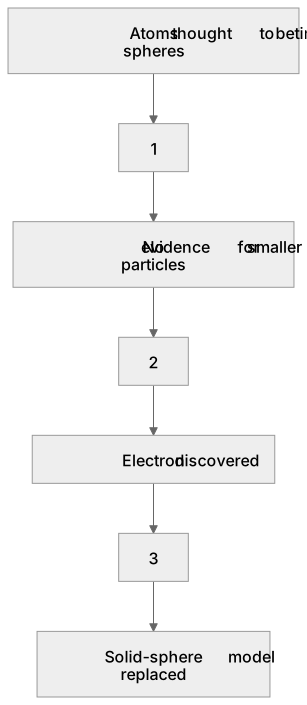
1Box 1
2Box 2
3Box 3
There is more to this lesson
The full lesson goes on to check your understanding and help you earn the marks. Create a free account to carry on, with your progress saved.
A week of Premium from your first lesson · Then the free plan continues · No card, no charge
Test your understanding of The development of the model of the atom (common content with chemistry): Before the discovery of the electron, atoms were thought to be tiny spheres that could not be divided.
Active recall beats re-reading. Take an instant quiz now to test what you’ve learned and lock it into long-term memory.
A week of Premium from your first lesson · Then the free plan continues · No card, no charge