AQA · GCSE · Combined Science
Course version: 8464 · Version from Sept 2018
(HT only) If an object is accelerating, its speed at any particular time…
Full specification wording
The distance–time relationship: (HT only) If an object is accelerating, its speed at any particular time can be determined by drawing a tangent and measuring the gradient of the distance–time graph at that time.
This is a Higher Tier only skill.
Checked against the AQA 8464 specification (opens in a new tab) on .
- Point 3 of 5
- 3 key terms
Study notes
From the checked teaching notes for this specification point.
The idea
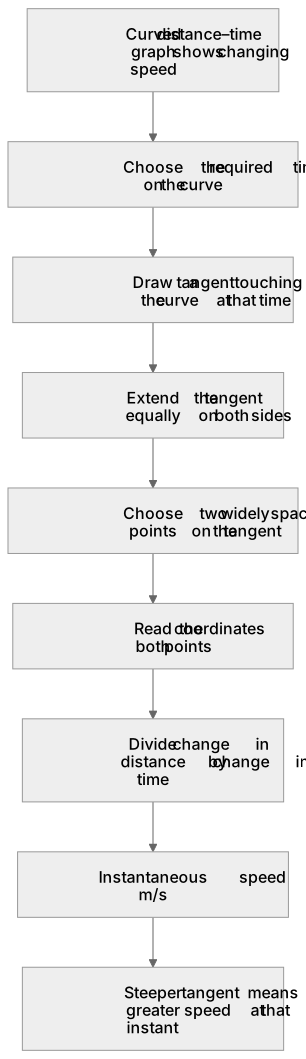
This is a Higher Tier only skill. When an object accelerates, its distance–time graph is curved, so the gradient changes continuously and no single straight-line gradient gives the speed throughout. The speed at one instant equals the gradient of the tangent at that point. Draw a straight line that touches the curve at the chosen time and continues equally on both sides, then choose two well-separated points on that tangent, read their coordinates, and divide the change in distance by the change in time. For example, a tangent at 3 s might pass through 10 m at 1 s and 50 m at 5 s, giving (50 − 10) ÷ (5 − 1) = 40 ÷ 4 = 10 m/s. A steeper tangent means a higher instantaneous speed.
What earns the marks
- Recognise that a curved distance–time graph shows changing speed, so the gradient must be found at a single point rather than between two points on the curve (Higher Tier only).
- Draw a tangent that touches the curve at the required time and extends on both sides, judging it by eye so it matches the curve's direction at that point.
- Choose two widely spaced points on the tangent, read their coordinates, and calculate change in distance divided by change in time to obtain the instantaneous speed.
- State the answer with correct units such as m/s and relate a steeper tangent to a greater speed at that instant.
Common mistakes and how to put them right
Drawing a chord between two points on the curve instead of a tangent.
Put it right by making the line touch the curve at one point only and follow its direction there.
Using the point of contact as one of the two calculation points and reading a single coordinate.
Put it right by selecting two separate points on the tangent and subtracting.
Drawing a tangent that crosses the curve or sits at the wrong angle.
Put it right by checking that the tangent and curve have the same slope at the point of contact.
Exam tips
- Use a ruler and extend the tangent well beyond the curve so two widely separated points can be read accurately.
- Mark the two points on the tangent clearly and show the subtraction and division, since method marks may be available even if the final value is slightly out.
- Sanity-check the value: if the curve is getting steeper, the tangent gradient at a later time should be larger.
Try the lesson
The start of the The distance–time relationship: (HT only) If an object is accelerating, its speed at any particular time can be determined by drawing a tangent and measuring the gradient of the distance–time graph at that time. lesson, made from checked teaching notes for this specification point.
Have a go first
On a distance–time graph for an accelerating object, what does the gradient of a tangent drawn at a particular time give?
Listen
This is a Higher Tier only skill. When an object accelerates, its distance–time graph is curved, so the gradient changes continuously and no single straight-line gradient gives the speed throughout. The speed at one instant equals the gradient of the tangent at that point. Draw a straight line that touches the curve at the chosen time and continues equally on both sides, then choose two well-separated points on that tangent, read their coordinates, and divide the change in distance by the change in time. For example, a tangent at 3 s might pass through 10 m at 1 s and 50 m at 5 s, giving (50 − 10) ÷ (5 − 1) = 40 ÷ 4 = 10 m/s. A steeper tangent means a higher instantaneous speed. A strong answer earns marks for these points. Recognise that a curved distance–time graph shows changing speed, so the gradient must be found at a single point rather than between two points on the curve (Higher Tier only). Draw a tangent that touches the curve at the required time and extends on both sides, judging it by eye so it matches the curve's direction at that point. Choose two widely spaced points on the tangent, read their coordinates, and calculate change in distance divided by change in time to obtain the instantaneous speed. State the answer with correct units such as m/s and relate a steeper tangent to a greater speed at that instant. A common slip: Drawing a chord between two points on the curve instead of a tangent. Instead, making the line touch the curve at one point only and follow its direction there. Exam tip: Use a ruler and extend the tangent well beyond the curve so two widely separated points can be read accurately.
See it
Key words
Say what each word means before you turn the card.
Accelerated motion and curved graphs
Try answering aloud or in your head before turning the card.
Instantaneous speed as a tangent gradient
Try answering aloud or in your head before turning the card.
Practical graph-reading skills
Try answering aloud or in your head before turning the card.
See every definition
- Accelerated motion and curved graphs
- When an object accelerates, its distance–time graph is curved, so the gradient changes continuously and no single straight-line gradient gives the speed throughout.
- Instantaneous speed as a tangent gradient
- The speed at one instant equals the gradient of the tangent at that point, found by dividing the change in distance by the change in time between two well-separated points on the tangent.
- Practical graph-reading skills
- Draw a straight line that touches the curve at the chosen time and continues equally on both sides, then choose two well-separated points on that tangent and read their coordinates.
Label the diagram
Some boxes have lost their names. Pick the right name for each number.
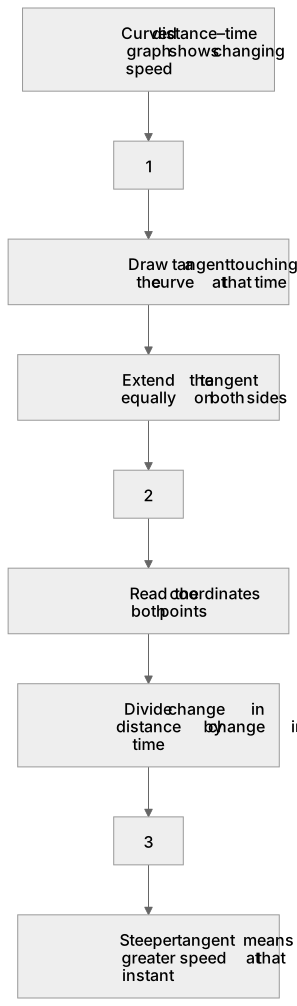
1Box 1
2Box 2
3Box 3
There is more to this lesson
The full lesson goes on to check your understanding and help you earn the marks. Create a free account to carry on, with your progress saved.
A week of Premium from your first lesson · Then the free plan continues · No card, no charge
Test your understanding of The distance–time relationship: (HT only) If an object is accelerating, its speed at any particular time can be determined by drawing a tangent and measuring the gradient of the distance–time graph at that time.
Active recall beats re-reading. Take an instant quiz now to test what you’ve learned and lock it into long-term memory.
A week of Premium from your first lesson · Then the free plan continues · No card, no charge