AQA · GCSE · Combined Science
Course version: 8464 · Version from Sept 2018
Atoms are very small, having a radius of about 1 × 10⁻¹⁰ metres.
Full specification wording
The structure of an atom: Atoms are very small, having a radius of about 1 × 10⁻¹⁰ metres.
Atoms are the smallest particles of an element that retain its chemical identity.
Checked against the AQA 8464 specification (opens in a new tab) on .
- Point 1 of 4
Study notes
From the checked teaching notes for this specification point.
The idea
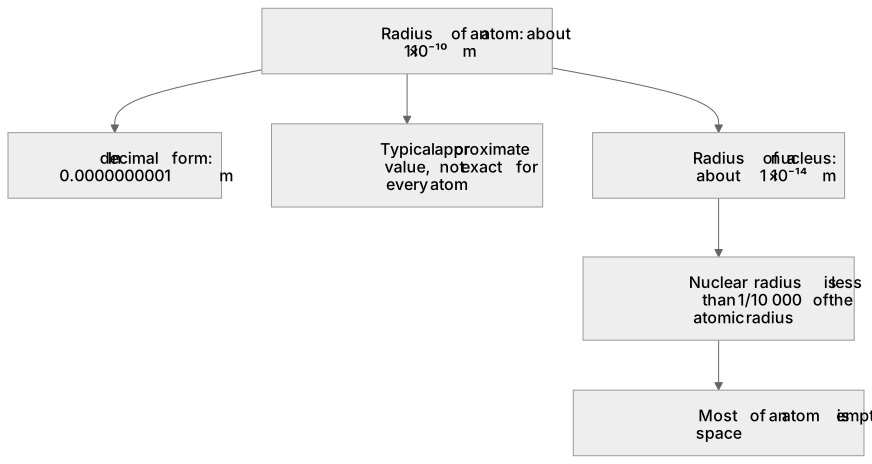
Atoms are the smallest particles of an element that retain its chemical identity. The radius of a typical atom is about 1 × 10⁻¹⁰ m, which is 0.0000000001 m, or one ten-billionth of a metre. This is roughly a million times smaller than the width of a human hair. Because atoms are so small, a single grain of sand contains an enormous number of them. The value is an order-of-magnitude figure: atoms vary slightly in size, but 1 × 10⁻¹⁰ m is a useful benchmark. When comparing atomic size with the nucleus, the radius of the nucleus is less than 1/10 000 of the radius of the atom (about 1 × 10⁻¹⁴ m), so most of an atom is empty space.
What earns the marks
- States that the radius of an atom is about 1 × 10⁻¹⁰ m.
- Recognises that this is a typical or approximate value, not an exact size for every atom.
- Converts 1 × 10⁻¹⁰ m into ordinary decimal form as 0.0000000001 m.
- Explains that atoms are mostly empty space because the radius of the nucleus is less than 1/10 000 of the radius of the atom.
- States that the radius of a nucleus is about 1 × 10⁻¹⁴ m.
Common mistakes and how to put them right
Writing the radius as 1 × 10¹⁰ m instead of 1 × 10⁻¹⁰ m.
Put it right: The negative exponent is essential because atoms are extremely small.
Treating 1 × 10⁻¹⁰ m as the exact radius of every atom.
Put it right: It is a typical value and atoms of different elements vary slightly.
Confusing the atomic radius with the nuclear radius.
Put it right: The radius of the nucleus is less than 1/10 000 of the radius of the atom.
Exam tips
- Learn the value 1 × 10⁻¹⁰ m with its negative exponent and be ready to write it in standard form.
- If asked to compare sizes, convert both values to the same form, such as standard form, before dividing.
- Remember that the nuclear radius is less than 1/10 000 of the atomic radius, which is why the atom is mostly empty space.
Try the lesson
The start of the The structure of an atom: Atoms are very small, having a radius of about 1 × 10⁻¹⁰ metres. lesson, made from checked teaching notes for this specification point.
Have a go first
Which value is closest to the radius of a typical atom?
Listen
Atoms are the smallest particles of an element that retain its chemical identity. The radius of a typical atom is about 1 × 10⁻¹⁰ m, which is 0.0000000001 m, or one ten-billionth of a metre. This is roughly a million times smaller than the width of a human hair. Because atoms are so small, a single grain of sand contains an enormous number of them. The value is an order-of-magnitude figure: atoms vary slightly in size, but 1 × 10⁻¹⁰ m is a useful benchmark. When comparing atomic size with the nucleus, the radius of the nucleus is less than 1/10 000 of the radius of the atom (about 1 × 10⁻¹⁴ m), so most of an atom is empty space. A strong answer earns marks for these points. States that the radius of an atom is about 1 × 10⁻¹⁰ m. Recognises that this is a typical or approximate value, not an exact size for every atom. Converts 1 × 10⁻¹⁰ m into ordinary decimal form as 0.0000000001 m. Explains that atoms are mostly empty space because the radius of the nucleus is less than 1/10 000 of the radius of the atom. Exam tip: Learn the value 1 × 10⁻¹⁰ m with its negative exponent and be ready to write it in standard form.
See it
Label the diagram
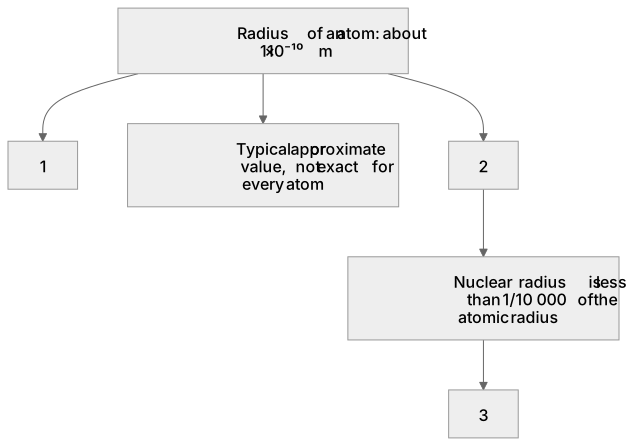
Some boxes have lost their names. Pick the right name for each number.
1Box 1
2Box 2
3Box 3
There is more to this lesson
The full lesson goes on to check your understanding and help you earn the marks. Create a free account to carry on, with your progress saved.
A week of Premium from your first lesson · Then the free plan continues · No card, no charge
Test your understanding of The structure of an atom: Atoms are very small, having a radius of about 1 × 10⁻¹⁰ metres.
Active recall beats re-reading. Take an instant quiz now to test what you’ve learned and lock it into long-term memory.
A week of Premium from your first lesson · Then the free plan continues · No card, no charge