AQA · GCSE · Combined Science
Course version: 8464 · Version from Sept 2018
Students should be able to describe evidence that, for both ripples on a…
Full specification wording
Transverse and longitudinal waves: Students should be able to describe evidence that, for both ripples on a water surface and sound waves in air, it is the wave and not the water or air itself that travels.
A wave transfers energy through a medium while the medium itself stays in place.
Checked against the AQA 8464 specification (opens in a new tab) on .
- Point 5 of 5
- 3 key terms
Study notes
From the checked teaching notes for this specification point.
The idea
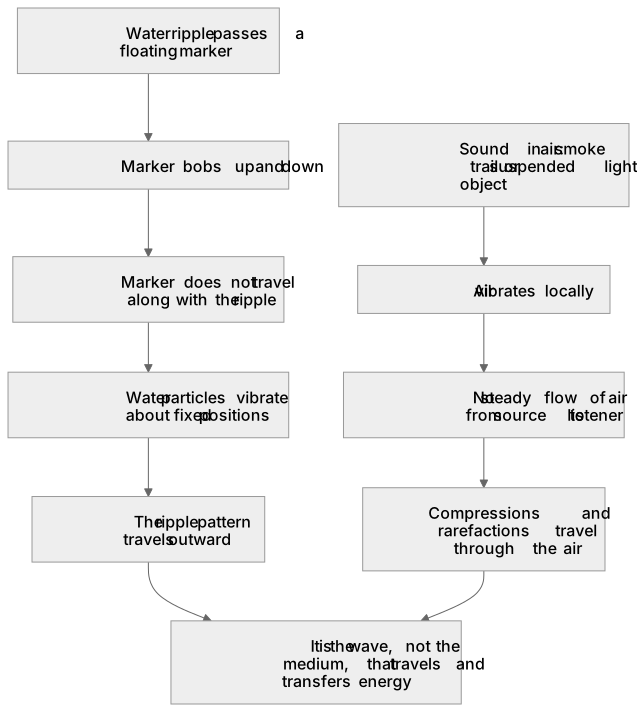
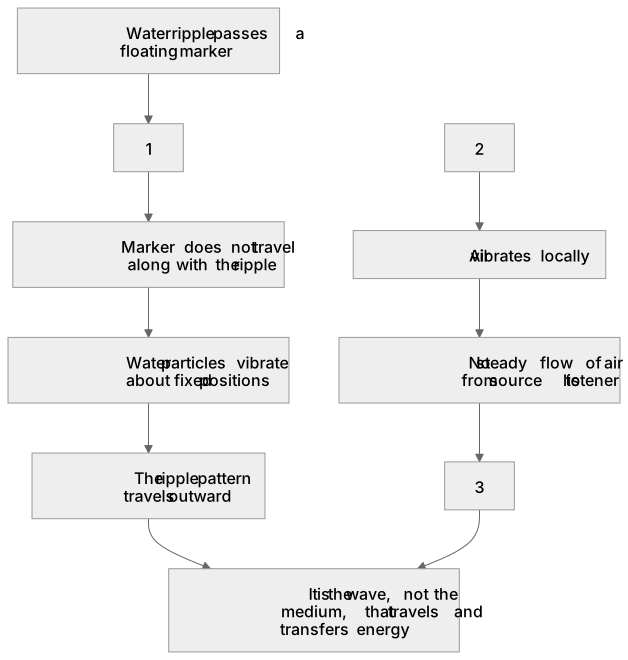
A wave transfers energy through a medium while the medium itself stays in place. For water ripples, a small floating object such as a cork or leaf bobs up and down as a ripple passes but does not move along with the ripple; this shows the water oscillates about a fixed position while the wave pattern travels outward. For sound in air, a smoke trail or a lightweight suspended object in a tube shows local vibration of air but no steady flow of air from the source to the listener; the sound is heard because compressions and rarefactions travel through the air. In both cases the wave, meaning the disturbance and its energy, moves from source to detector, while the particles of water or air only vibrate about equilibrium positions. This distinguishes wave travel from bulk movement of matter.
What earns the marks
- Describes a floating marker on water that moves up and down but does not travel along with the ripple.
- Explains that the water particles oscillate about fixed positions while the ripple pattern moves outward.
- Describes a demonstration with sound, such as a smoke trail or suspended light object, showing air vibrating without a steady flow from source to detector.
- States that in both cases it is the wave or disturbance that travels and transfers energy, not the medium as a whole.
- Links the observation to the idea that particles vibrate about equilibrium positions rather than being carried along.
- Uses the terms transverse and longitudinal correctly when describing the two examples.
Common mistakes and how to put them right
Claiming that water moves outward with the ripple.
Put it right by citing the floating object that only bobs up and down.
Saying that air travels from the source to the ear.
Put it right by explaining that compressions and rarefactions pass through the air while air particles vibrate locally.
Treating the wave as a physical object that is carried along.
Put it right by defining a wave as a disturbance that transfers energy through a medium.
Ignoring the medium entirely and saying no particles are involved.
Put it right by stating that particles vibrate but do not travel with the wave.
Exam tips
- Name the observation and then state what it proves, for example 'the cork stays in place, so the water does not travel with the wave'.
- Use the phrase 'vibrate about fixed positions' to make the distinction between particle motion and wave travel clear.
- For sound, refer to compressions and rarefactions moving through the air rather than air moving as a whole.
- Keep the two examples separate in your answer so each piece of evidence is clearly linked to its wave type.
Try the lesson
The start of the Transverse and longitudinal waves: Students should be able to describe evidence that, for both ripples on a water surface and sound waves in air, it is the wave and not the water or air itself that travels. lesson, made from checked teaching notes for this specification point.
Have a go first
A student drops a stone into a still pond. A floating cork bobs up and down as the ripples pass, but the cork stays in the same place. What does this show about the ripples?
Listen
A wave transfers energy through a medium while the medium itself stays in place. For water ripples, a small floating object such as a cork or leaf bobs up and down as a ripple passes but does not move along with the ripple; this shows the water oscillates about a fixed position while the wave pattern travels outward. For sound in air, a smoke trail or a lightweight suspended object in a tube shows local vibration of air but no steady flow of air from the source to the listener; the sound is heard because compressions and rarefactions travel through the air. In both cases the wave, meaning the disturbance and its energy, moves from source to detector, while the particles of water or air only vibrate about equilibrium positions. This distinguishes wave travel from bulk movement of matter. A strong answer earns marks for these points. Describes a floating marker on water that moves up and down but does not travel along with the ripple. Explains that the water particles oscillate about fixed positions while the ripple pattern moves outward. Describes a demonstration with sound, such as a smoke trail or suspended light object, showing air vibrating without a steady flow from source to detector. States that in both cases it is the wave or disturbance that travels and transfers energy, not the medium as a whole. A common slip: Claiming that water moves outward with the ripple. Instead, citing the floating object that only bobs up and down. Exam tip: Name the observation and then state what it proves, for example 'the cork stays in place, so the water does not travel with the wave'.
See it
Key words
Say what each word means before you turn the card.
Energy transfer by waves
Try answering aloud or in your head before turning the card.
Particle oscillation about equilibrium positions
Try answering aloud or in your head before turning the card.
Experimental evidence and observation
Try answering aloud or in your head before turning the card.
See every definition
- Energy transfer by waves
- The wave, meaning the disturbance and its energy, moves from source to detector while the medium stays in place.
- Particle oscillation about equilibrium positions
- The particles of water or air only vibrate about equilibrium positions rather than being carried along with the wave.
- Experimental evidence and observation
- A floating marker on water moves up and down but does not travel along with the ripple, and a smoke trail or suspended light object shows air vibrating without a steady flow.
Label the diagram
Some boxes have lost their names. Pick the right name for each number.
1Box 1
2Box 2
3Box 3
There is more to this lesson
The full lesson goes on to check your understanding and help you earn the marks. Create a free account to carry on, with your progress saved.
A week of Premium from your first lesson · Then the free plan continues · No card, no charge
Test your understanding of Transverse and longitudinal waves: Students should be able to describe evidence that, for both ripples on a water surface and sound waves in air, it is the wave and not the water or air itself that travels.
Active recall beats re-reading. Take an instant quiz now to test what you’ve learned and lock it into long-term memory.
A week of Premium from your first lesson · Then the free plan continues · No card, no charge