AQA · GCSE · Combined Science
Course version: 8464 · Version from Sept 2018
Our eyes only detect visible light and so detect a limited range of…
Full specification wording
Types of electromagnetic waves: Our eyes only detect visible light and so detect a limited range of electromagnetic waves.
The electromagnetic spectrum is a continuous family of transverse waves that all travel at the same speed in a vacuum, yet differ in wavelength and frequency.
Checked against the AQA 8464 specification (opens in a new tab) on .
- Point 4 of 5
- 2 key terms
Study notes
From the checked teaching notes for this specification point.
The idea
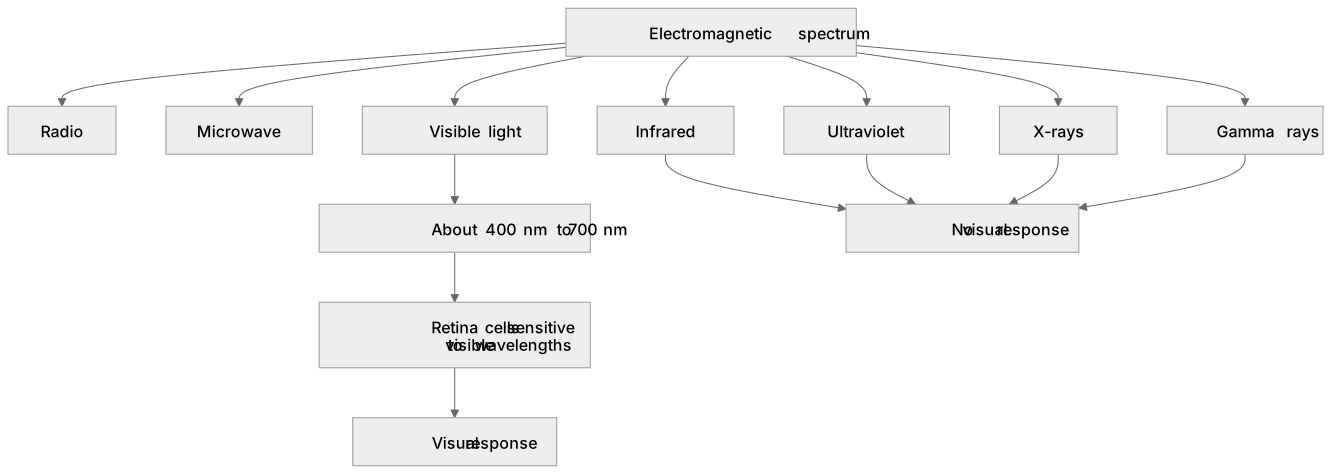
The electromagnetic spectrum is a continuous family of transverse waves that all travel at the same speed in a vacuum, yet differ in wavelength and frequency. Human eyes contain light-sensitive cells that respond only to the narrow band of wavelengths from about 400 nm to 700 nm, which we call visible light. Longer waves such as radio, microwave and infrared, and shorter waves such as ultraviolet, X-rays and gamma rays, carry energy but produce no visual sensation. For example, a television remote emits infrared that a camera may record but the eye cannot see, while an X-ray image forms only on a detector, not on the retina. Because vision samples just one small region of the spectrum, our eyes detect a limited range of electromagnetic waves.
What earns the marks
- State that the electromagnetic spectrum includes radio, microwave, infrared, visible, ultraviolet, X-rays and gamma rays, and that visible light is only one region.
- Identify the approximate wavelength range of visible light as about 400 nm to 700 nm, or the frequency range about 4 × 10¹⁴ Hz to 7.5 × 10¹⁴ Hz.
- Explain that the retina contains cells sensitive to visible wavelengths, so other electromagnetic waves do not cause a visual response.
- Use an example such as infrared from a remote control or ultraviolet from a black lamp being detected by a sensor or camera rather than by the unaided eye.
- Recognise that all electromagnetic waves transfer energy, so undetected waves can still have effects such as heating or ionising.
Common mistakes and how to put them right
Thinking that invisible means no energy is transferred.
Put it right by stating that infrared, ultraviolet and other waves still carry energy and can heat or damage materials.
Believing that the eye can see all colours of the rainbow but no other electromagnetic waves.
Put it right by noting that the rainbow is simply the visible band spread out, not the whole spectrum.
Confusing wavelength order with detection.
Put it right by separating the continuous spectrum order from the narrow visible window that human eyes respond to.
Exam tips
- Link the answer to the structure of the eye: mention the retina and light-sensitive cells when explaining why detection is limited.
- Give a named wave outside the visible range and state what detects it instead of the eye, such as a thermometer for infrared or a photographic film for X-rays.
- Use comparative language such as longer wavelength than red light or shorter wavelength than violet light to place a named wave precisely.
Try the lesson
The start of the Types of electromagnetic waves: Our eyes only detect visible light and so detect a limited range of electromagnetic waves. lesson, made from checked teaching notes for this specification point.
Have a go first
Which part of the electromagnetic spectrum can human eyes detect?
Listen
The electromagnetic spectrum is a continuous family of transverse waves that all travel at the same speed in a vacuum, yet differ in wavelength and frequency. Human eyes contain light-sensitive cells that respond only to the narrow band of wavelengths from about 400 nm to 700 nm, which we call visible light. Longer waves such as radio, microwave and infrared, and shorter waves such as ultraviolet, X-rays and gamma rays, carry energy but produce no visual sensation. For example, a television remote emits infrared that a camera may record but the eye cannot see, while an X-ray image forms only on a detector, not on the retina. Because vision samples just one small region of the spectrum, our eyes detect a limited range of electromagnetic waves. A strong answer earns marks for these points. State that the electromagnetic spectrum includes radio, microwave, infrared, visible, ultraviolet, X-rays and gamma rays, and that visible light is only one region. Identify the approximate wavelength range of visible light as about 400 nm to 700 nm, or the frequency range about 4 × 10¹⁴ Hz to 7.5 × 10¹⁴ Hz. Explain that the retina contains cells sensitive to visible wavelengths, so other electromagnetic waves do not cause a visual response. Use an example such as infrared from a remote control or ultraviolet from a black lamp being detected by a sensor or camera rather than by the unaided eye. A common slip: Thinking that invisible means no energy is transferred. Instead, stating that infrared, ultraviolet and other waves still carry energy and can heat or damage materials. Exam tip: Link the answer to the structure of the eye: mention the retina and light-sensitive cells when explaining why detection is limited.
See it
Key words
Say what each word means before you turn the card.
Visible light
Try answering aloud or in your head before turning the card.
Electromagnetic spectrum
Try answering aloud or in your head before turning the card.
See every definition
- Visible light
- The narrow band of wavelengths from about 400 nm to 700 nm that human eyes respond to.
- Electromagnetic spectrum
- A continuous family of transverse waves that all travel at the same speed in a vacuum, yet differ in wavelength and frequency.
Label the diagram
Some boxes have lost their names. Pick the right name for each number.
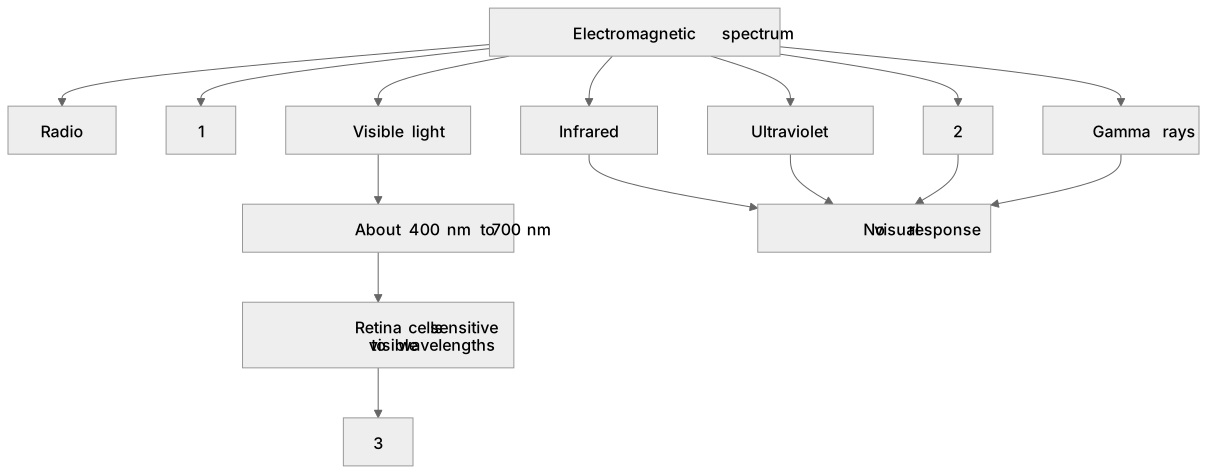
1Box 1
2Box 2
3Box 3
There is more to this lesson
The full lesson goes on to check your understanding and help you earn the marks. Create a free account to carry on, with your progress saved.
A week of Premium from your first lesson · Then the free plan continues · No card, no charge
Test your understanding of Types of electromagnetic waves: Our eyes only detect visible light and so detect a limited range of electromagnetic waves.
Active recall beats re-reading. Take an instant quiz now to test what you’ve learned and lock it into long-term memory.
A week of Premium from your first lesson · Then the free plan continues · No card, no charge