AQA · GCSE · Combined Science
Course version: 8464 · Version from Sept 2018
Work done and energy transfer: moved along the line of action of the force
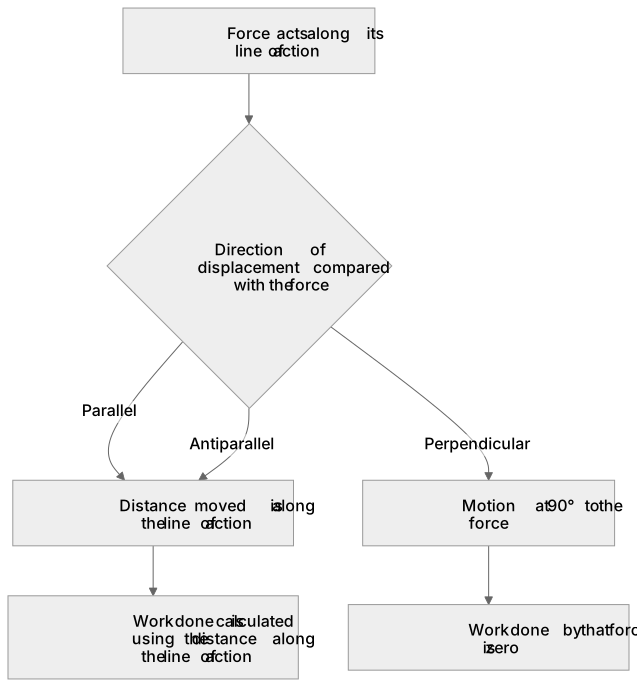
Work is only done when the distance moved is along the line of action of the force.
Checked against the AQA 8464 specification (opens in a new tab) on .
- Point 4 of 13
Study notes
From the checked teaching notes for this specification point.
The idea
Work is only done when the distance moved is along the line of action of the force. The line of action is the straight line through the force in the direction it pushes or pulls. For example, carrying a bag horizontally while gravity acts downwards means gravity does no work on the bag because motion is perpendicular to the force. Pushing a trolley 4 m with a 30 N horizontal force gives W = 30 N × 4 m = 120 J because the motion is along the force line. If the force and motion are at 90°, work done by that force is zero.
What earns the marks
- Define the line of action as the straight line along which a force acts.
- Identify whether the displacement is parallel, antiparallel or perpendicular to the force.
- State that distance moved must be along the line of action of the force when calculating work done.
- Explain that a force does zero work when the motion is perpendicular to its line of action.
- Apply the idea to examples such as lifting a load vertically against weight or pushing horizontally along a floor.
Common mistakes and how to put them right
Assuming any movement means work is done by every force.
Put it right by checking each force against the direction of motion.
Using a distance that is not along the line of action of the force.
Put it right by ensuring the distance used is in the same direction as the force.
Treating a force at right angles to motion as doing work.
Put it right by stating that perpendicular forces transfer no energy.
Exam tips
- Sketch the force arrow and the displacement arrow to check they are in the same direction before calculating.
- If motion is perpendicular to a force, state that the work done by that force is zero rather than trying to calculate a value.
- Always read the question carefully to ensure the distance given is along the line of action of the force.
Try the lesson
The start of the Work done and energy transfer: moved along the line of action of the force lesson, made from checked teaching notes for this specification point.
Have a go first
A pupil pushes a box with a force of 30 N. The box moves 4 m in the same direction as the force. What is the work done on the box?
Listen
Work is only done when the distance moved is along the line of action of the force. The line of action is the straight line through the force in the direction it pushes or pulls. For example, carrying a bag horizontally while gravity acts downwards means gravity does no work on the bag because motion is perpendicular to the force. Pushing a trolley 4 m with a 30 N horizontal force gives W = 30 N × 4 m = 120 J because the motion is along the force line. If the force and motion are at 90°, work done by that force is zero. A strong answer earns marks for these points. Define the line of action as the straight line along which a force acts. Identify whether the displacement is parallel, antiparallel or perpendicular to the force. State that distance moved must be along the line of action of the force when calculating work done. Explain that a force does zero work when the motion is perpendicular to its line of action. A common slip: Assuming any movement means work is done by every force. Instead, checking each force against the direction of motion. Exam tip: Sketch the force arrow and the displacement arrow to check they are in the same direction before calculating.
See it
There is more to this lesson
The full lesson goes on to check your understanding and help you earn the marks. Create a free account to carry on, with your progress saved.
A week of Premium from your first lesson · Then the free plan continues · No card, no charge
Test your understanding of Work done and energy transfer: moved along the line of action of the force
Active recall beats re-reading. Take an instant quiz now to test what you’ve learned and lock it into long-term memory.
A week of Premium from your first lesson · Then the free plan continues · No card, no charge