AQA · GCSE · Combined Science
Course version: 8464 · Version from Sept 2018
Work done and energy transfer: W = F s
This equation defines mechanical work: the energy transferred when a force moves an object along the line of the force.
Checked against the AQA 8464 specification (opens in a new tab) on .
- Point 5 of 13
- 3 key terms
Study notes
From the checked teaching notes for this specification point.
The idea
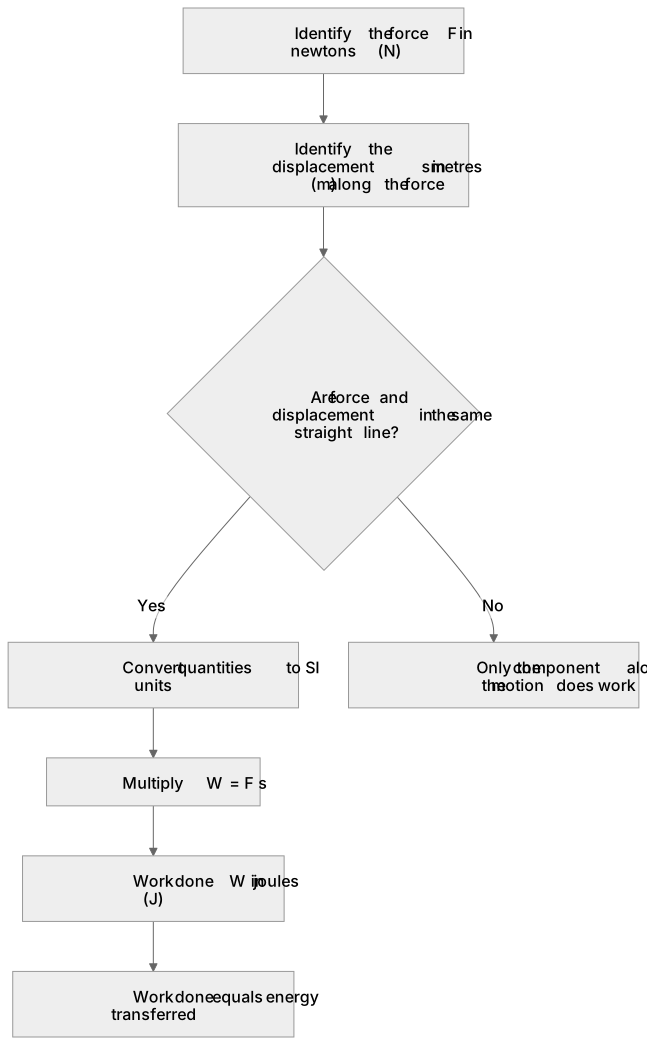
This equation defines mechanical work: the energy transferred when a force moves an object along the line of the force. W is work done in joules (J), F is the force in newtons (N) and s is the distance moved along the force's direction in metres (m). To use it, identify the force and the displacement it causes, ensure both act along the same straight line, then multiply. For example, lifting a 20 N weight 1.5 m vertically transfers W = 20 N × 1.5 m = 30 J. If the force is at an angle to the motion, only the component along the motion does work, so the simple product applies only when force and displacement are parallel. Work done equals energy transferred, so the joule is also the unit of energy.
What earns the marks
- States that W is work done, measured in joules (J), and that one joule equals one newton metre.
- Identifies F as the force in newtons (N) and s as the distance moved in metres (m) along the direction of the force.
- Applies W = F s by multiplying force and displacement only when they are in the same straight line.
- Recognises that work done equals energy transferred, so a 30 J transfer moves 30 J of energy between stores.
- Uses consistent SI units, converting centimetres to metres or kilojoules to joules before substituting.
- Explains that a force at right angles to the motion does no work on the object because there is no displacement along the force.
Common mistakes and how to put them right
Using the total distance travelled rather than the displacement along the force.
Put it right by resolving the motion along the force direction and using only that component.
Forgetting to convert units, for example substituting 50 cm as 50.
Put it right by converting to 0.50 m before multiplying.
Assuming any applied force does work even when the object does not move.
Put it right by checking that s is non-zero along the force direction.
Exam tips
- Write the equation, substitute values with units, then give the answer with the correct unit, usually J.
- Check whether force and displacement are parallel; if not, state that only the component along the motion is used.
- Show the conversion step when lengths are given in cm or mm, as marks often depend on correct SI substitution.
Try the lesson
The start of the Work done and energy transfer: W = F s lesson, made from checked teaching notes for this specification point.
Have a go first
A force of 20 N pushes a box 3 m along a floor in the direction of the force. Using W = F s, what is the work done on the box?
Listen
This equation defines mechanical work: the energy transferred when a force moves an object along the line of the force. W is work done in joules (J), F is the force in newtons (N) and s is the distance moved along the force's direction in metres (m). To use it, identify the force and the displacement it causes, ensure both act along the same straight line, then multiply. For example, lifting a 20 N weight 1.5 m vertically transfers W = 20 N × 1.5 m = 30 J. If the force is at an angle to the motion, only the component along the motion does work, so the simple product applies only when force and displacement are parallel. Work done equals energy transferred, so the joule is also the unit of energy. A strong answer earns marks for these points. States that W is work done, measured in joules (J), and that one joule equals one newton metre. Identifies F as the force in newtons (N) and s as the distance moved in metres (m) along the direction of the force. Applies W = F s by multiplying force and displacement only when they are in the same straight line. Recognises that work done equals energy transferred, so a 30 J transfer moves 30 J of energy between stores. A common slip: Using the total distance travelled rather than the displacement along the force. Instead, resolving the motion along the force direction and using only that component. Exam tip: Write the equation, substitute values with units, then give the answer with the correct unit, usually J.
See it
Key words
Say what each word means before you turn the card.
Work done
Try answering aloud or in your head before turning the card.
Force
Try answering aloud or in your head before turning the card.
Distance moved along the direction of the force
Try answering aloud or in your head before turning the card.
See every definition
- Work done
- The energy transferred when a force moves an object along the line of the force, measured in joules (J).
- Force
- The quantity in newtons (N) that, multiplied by the distance moved along its direction, gives the work done.
- Distance moved along the direction of the force
- The displacement in metres (m) along the force's direction, which is multiplied by the force to give work done.
Label the diagram
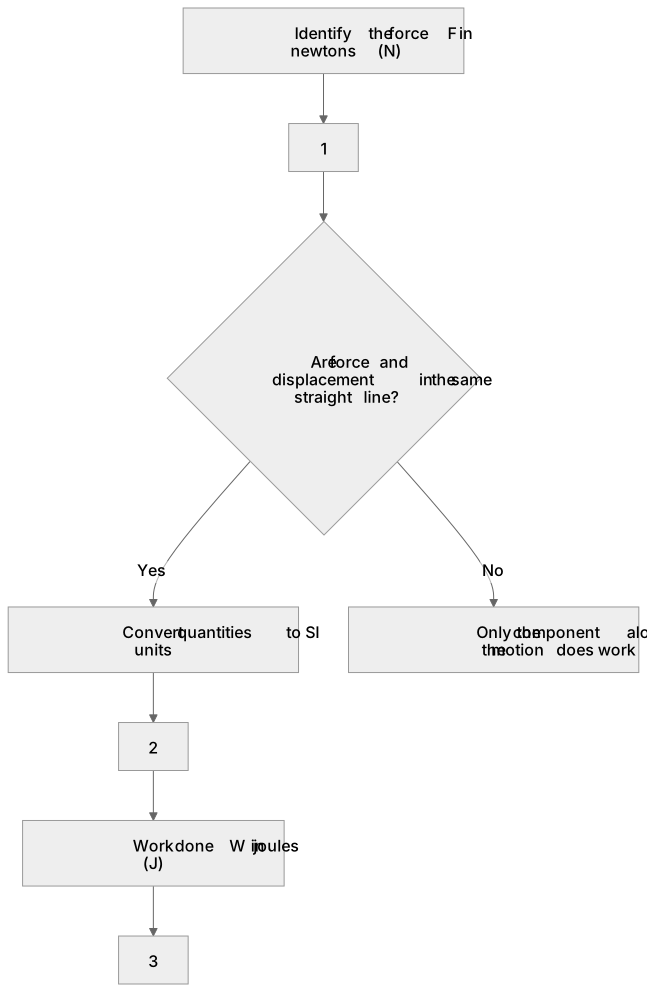
Some boxes have lost their names. Pick the right name for each number.
1Box 1
2Box 2
3Box 3
There is more to this lesson
The full lesson goes on to check your understanding and help you earn the marks. Create a free account to carry on, with your progress saved.
A week of Premium from your first lesson · Then the free plan continues · No card, no charge
Test your understanding of Work done and energy transfer: W = F s
Active recall beats re-reading. Take an instant quiz now to test what you’ve learned and lock it into long-term memory.
A week of Premium from your first lesson · Then the free plan continues · No card, no charge