AQA · GCSE · Combined Science
Course version: 8464 · Version from Sept 2018
Students should be able to convert between newton-metres and joules.
Full specification wording
Work done and energy transfer: Students should be able to convert between newton-metres and joules.
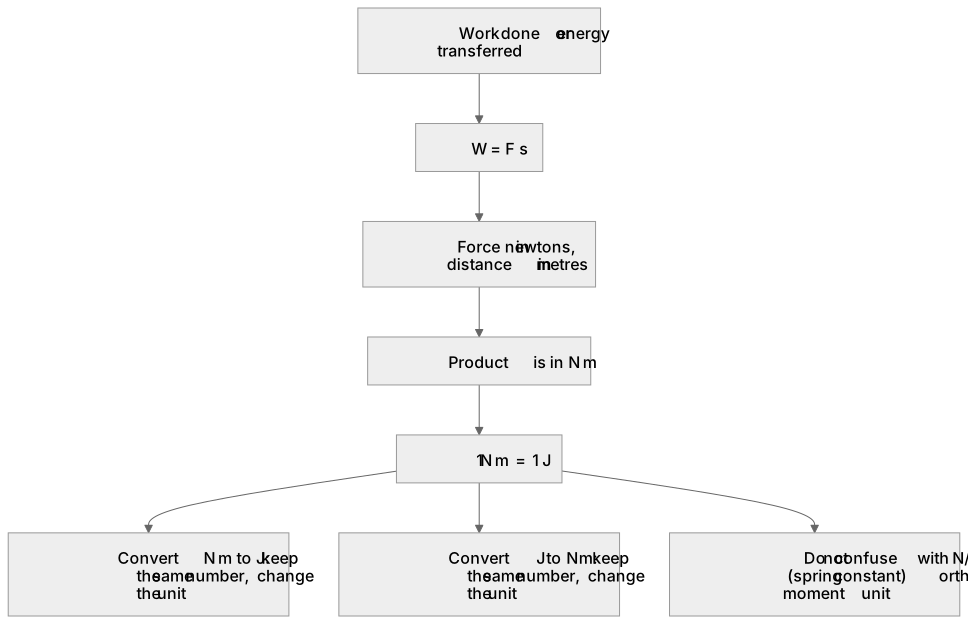
The newton-metre (N m) and the joule (J) are equivalent units for work done and energy transferred: 1 N m = 1 J. This follows from W = F s, where a force of 1 N moving an object 1 m transfers 1 J.…
Checked against the AQA 8464 specification (opens in a new tab) on .
- Point 12 of 13
Study notes
From the checked teaching notes for this specification point.
The idea
The newton-metre (N m) and the joule (J) are equivalent units for work done and energy transferred: 1 N m = 1 J. This follows from W = F s, where a force of 1 N moving an object 1 m transfers 1 J. To convert, treat the units as interchangeable: 25 N m = 25 J, and 0.5 J = 0.5 N m. In calculations, if force is in newtons and distance in metres, the answer is in N m, which you may state as joules. Do not confuse the newton-metre with the newton per metre (N/m), which is a spring constant unit, or with the newton metre as a moment unit; the context of work done or energy transferred tells you it is equivalent to the joule.
What earns the marks
- 1 newton-metre is exactly equal to 1 joule, so the numerical value does not change when converting.
- The equivalence follows from W = F s: 1 N × 1 m = 1 N m = 1 J.
- To convert from N m to J, keep the same number and change the unit to J; to convert from J to N m, keep the same number and change the unit to N m.
- In calculations, if force is in newtons and distance in metres, the product is in N m, which can be quoted as joules.
- The newton-metre as a unit of work done or energy transferred is equivalent to the joule, but the newton metre as a unit of moment is not an energy unit.
Common mistakes and how to put them right
Multiplying or dividing by a conversion factor.
Put it right: N m and J are equivalent, so 40 N m = 40 J with no arithmetic needed.
Confusing N m with N/m.
Put it right: N/m is a unit of spring constant, not work done or energy transferred.
Writing 'Nm' or 'n m' instead of the correct unit symbol 'N m' with a space and capital N.
Exam tips
- When a calculation gives an answer in N m, write the final answer in J to show you know the units are equivalent.
- If a question asks for the unit, write 'J' or 'N m'; both are acceptable for work done or energy transferred.
- Check the context: if the quantity is a moment, keep N m as the unit; if it is work done or energy transferred, convert to J.
Try the lesson
The start of the Work done and energy transfer: Students should be able to convert between newton-metres and joules. lesson, made from checked teaching notes for this specification point.
Have a go first
A force does 45 N m of work on a box. How many joules of energy are transferred to the box?
Listen
The newton-metre (N m) and the joule (J) are equivalent units for work done and energy transferred: 1 N m = 1 J. This follows from W = F s, where a force of 1 N moving an object 1 m transfers 1 J. To convert, treat the units as interchangeable: 25 N m = 25 J, and 0.5 J = 0.5 N m. In calculations, if force is in newtons and distance in metres, the answer is in N m, which you may state as joules. Do not confuse the newton-metre with the newton per metre (N/m), which is a spring constant unit, or with the newton metre as a moment unit; the context of work done or energy transferred tells you it is equivalent to the joule. A strong answer earns marks for these points. 1 newton-metre is exactly equal to 1 joule, so the numerical value does not change when converting. The equivalence follows from W = F s: 1 N × 1 m = 1 N m = 1 J. To convert from N m to J, keep the same number and change the unit to J; to convert from J to N m, keep the same number and change the unit to N m. In calculations, if force is in newtons and distance in metres, the product is in N m, which can be quoted as joules. Exam tip: When a calculation gives an answer in N m, write the final answer in J to show you know the units are equivalent.
See it
Label the diagram
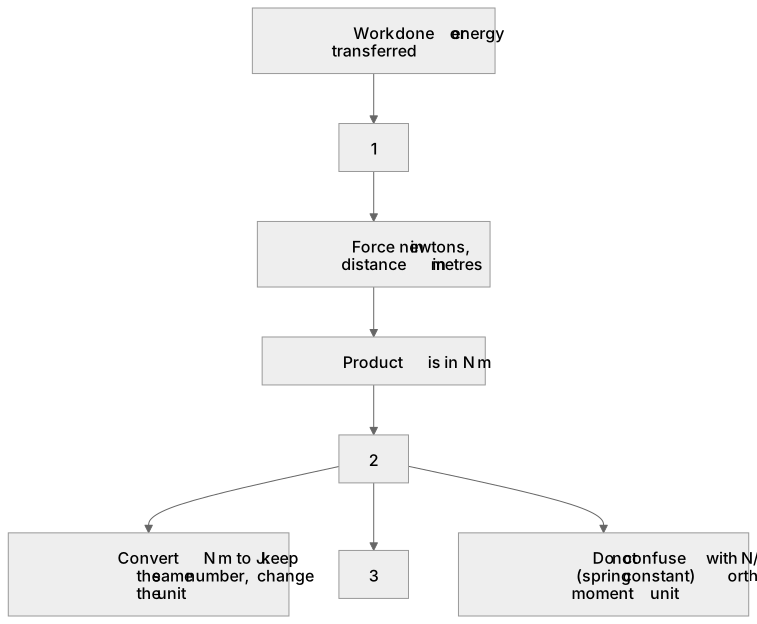
Some boxes have lost their names. Pick the right name for each number.
1Box 1
2Box 2
3Box 3
There is more to this lesson
The full lesson goes on to check your understanding and help you earn the marks. Create a free account to carry on, with your progress saved.
A week of Premium from your first lesson · Then the free plan continues · No card, no charge
Test your understanding of Work done and energy transfer: Students should be able to convert between newton-metres and joules.
Active recall beats re-reading. Take an instant quiz now to test what you’ve learned and lock it into long-term memory.
A week of Premium from your first lesson · Then the free plan continues · No card, no charge