AQA · GCSE · Combined Science
Course version: 8464 · Version from Sept 2018
Work done against the frictional forces acting on an object causes a rise…
Full specification wording
Work done and energy transfer: Work done against the frictional forces acting on an object causes a rise in the temperature of the object.
When a force moves an object, energy is transferred mechanically.
Checked against the AQA 8464 specification (opens in a new tab) on .
- Point 13 of 13
- 2 key terms
Study notes
From the checked teaching notes for this specification point.
The idea
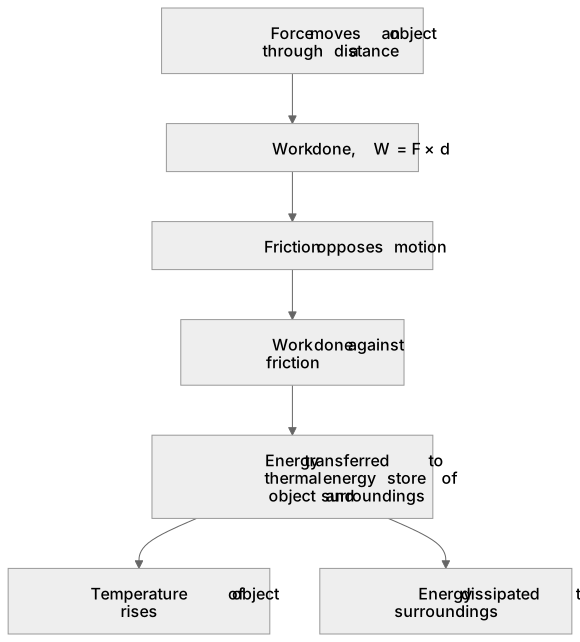
When a force moves an object, energy is transferred mechanically. If friction opposes the motion, some of that transferred energy is dissipated into the thermal energy store of the object and its surroundings, so the object warms up. For example, rubbing your hands together transfers energy from your muscles to the hands' thermal store, making them feel warm. Similarly, a bicycle braking hard converts kinetic energy into thermal energy in the brake blocks and rims. The work done against friction equals the force of friction multiplied by the distance moved along the surface, W = F × d, and this energy appears as a temperature rise rather than as useful kinetic energy.
What earns the marks
- State that work is done when a force moves an object through a distance, using W = F × d.
- Identify friction as a force that opposes motion and acts in the opposite direction to movement.
- Explain that work done against friction is transferred to the thermal energy store of the object and surroundings.
- Link the energy transfer to a measurable temperature rise in the object.
- Use a concrete example, such as brakes heating up or hands warming when rubbed together, to illustrate the process.
- Recognise that the energy is dissipated, meaning it spreads out to the surroundings and becomes less useful.
Common mistakes and how to put them right
Saying that friction creates energy.
Put it right by stating that energy is transferred from a kinetic or chemical store to a thermal store, not created.
Confusing work done with force alone.
Put it right by emphasising that work done depends on both force and distance moved in the direction of the force.
Assuming temperature rises only when objects are heated directly.
Put it right by explaining that mechanical work against friction also raises temperature.
Exam tips
- Always name the energy stores involved, for example kinetic to thermal, rather than saying energy is 'lost'.
- When calculating, check that distance is in metres and force in newtons before multiplying.
- Use the phrase 'work done against friction' explicitly to show the examiner you understand the mechanism.
Try the lesson
The start of the Work done and energy transfer: Work done against the frictional forces acting on an object causes a rise in the temperature of the object. lesson, made from checked teaching notes for this specification point.
Have a go first
A box is pushed across a rough floor. The force of friction acts against the motion of the box. What happens to the temperature of the box and the floor?
Listen
When a force moves an object, energy is transferred mechanically. If friction opposes the motion, some of that transferred energy is dissipated into the thermal energy store of the object and its surroundings, so the object warms up. For example, rubbing your hands together transfers energy from your muscles to the hands' thermal store, making them feel warm. Similarly, a bicycle braking hard converts kinetic energy into thermal energy in the brake blocks and rims. The work done against friction equals the force of friction multiplied by the distance moved along the surface, W = F × d, and this energy appears as a temperature rise rather than as useful kinetic energy. A strong answer earns marks for these points. State that work is done when a force moves an object through a distance, using W = F × d. Identify friction as a force that opposes motion and acts in the opposite direction to movement. Explain that work done against friction is transferred to the thermal energy store of the object and surroundings. Link the energy transfer to a measurable temperature rise in the object. A common slip: Saying that friction creates energy. Instead, stating that energy is transferred from a kinetic or chemical store to a thermal store, not created. Exam tip: Always name the energy stores involved, for example kinetic to thermal, rather than saying energy is 'lost'.
See it
Key words
Say what each word means before you turn the card.
Dissipation of energy
Try answering aloud or in your head before turning the card.
Friction
Try answering aloud or in your head before turning the card.
See every definition
- Dissipation of energy
- Energy is dissipated, meaning it spreads out to the surroundings and becomes less useful.
- Friction
- A force that opposes motion and acts in the opposite direction to movement.
Label the diagram
Some boxes have lost their names. Pick the right name for each number.
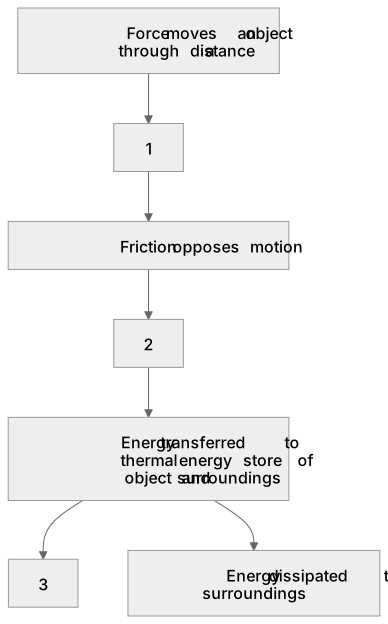
1Box 1
2Box 2
3Box 3
There is more to this lesson
The full lesson goes on to check your understanding and help you earn the marks. Create a free account to carry on, with your progress saved.
A week of Premium from your first lesson · Then the free plan continues · No card, no charge
Test your understanding of Work done and energy transfer: Work done against the frictional forces acting on an object causes a rise in the temperature of the object.
Active recall beats re-reading. Take an instant quiz now to test what you’ve learned and lock it into long-term memory.
A week of Premium from your first lesson · Then the free plan continues · No card, no charge