AQA · GCSE · Combined Science
Course version: 8464 · Version from Sept 2018
Work done and energy transfer: work done, W, in joules, J
Work done measures the energy transferred when a force moves an object.
Checked against the AQA 8464 specification (opens in a new tab) on .
- Point 6 of 13
- 4 key terms
Study notes
From the checked teaching notes for this specification point.
The idea
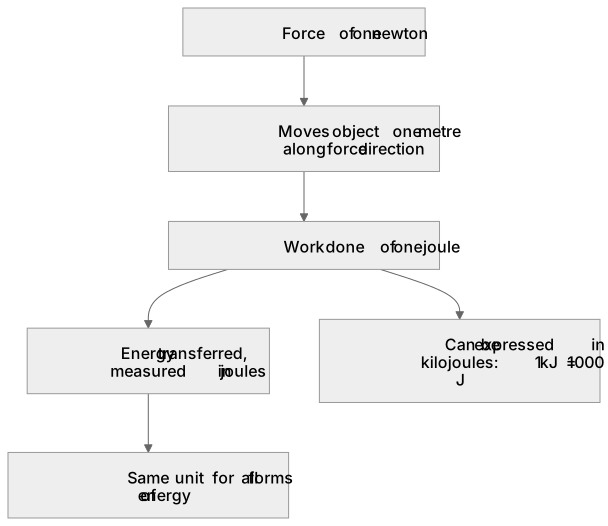
Work done measures the energy transferred when a force moves an object. Its symbol is W and its unit is the joule, J. One joule is transferred when a force of one newton moves an object one metre along the force's direction, so 1 J = 1 N m. Because work done is an energy transfer, it can also be expressed in kilojoules (1 kJ = 1000 J) or, for very small amounts, millijoules. In calculations, always give W in joules unless the question asks otherwise.
For example: Pushing a box with 15 N through 4 m transfers W = 15 N × 4 m = 60 J. The joule is the same unit used for all forms of energy, which reflects the principle that work done and energy transferred are equivalent.
What earns the marks
- States that W is the symbol for work done and that its SI unit is the joule, J.
- Defines one joule as the work done when a force of one newton moves an object one metre along the force direction.
- Links work done to energy transfer, so the joule also measures transferred energy.
- Converts between joules and kilojoules correctly, for example 2.5 kJ = 2500 J.
- Gives answers to calculations with the unit J and an appropriate number of significant figures.
Common mistakes and how to put them right
Writing the unit as N/m or N m⁻¹ instead of N m, which is the joule.
Put it right by remembering that work is force multiplied by distance.
Confusing W (work done) with the watt, the unit of power.
Put it right by stating that the watt measures energy transferred per second.
Omitting the unit or using J s⁻¹ when the answer is an energy.
Put it right by checking that the quantity is work done or energy transferred, so the unit is J.
Exam tips
- Always include the unit J with a numerical answer for work done unless told otherwise.
- If a value is given in kJ, convert to J before substituting into W = F s, then convert back if required.
- Use the definition of the joule to justify why work done and energy transferred share the same unit.
Try the lesson
The start of the Work done and energy transfer: work done, W, in joules, J lesson, made from checked teaching notes for this specification point.
Have a go first
A pupil pushes a box with a force of 30 N and the box moves 4 m in the direction of the force. What is the work done on the box?
Listen
Work done measures the energy transferred when a force moves an object. Its symbol is W and its unit is the joule, J. One joule is transferred when a force of one newton moves an object one metre along the force's direction, so 1 J = 1 N m. Because work done is an energy transfer, it can also be expressed in kilojoules (1 kJ = 1000 J) or, for very small amounts, millijoules. In calculations, always give W in joules unless the question asks otherwise. For example, pushing a box with 15 N through 4 m transfers W = 15 N × 4 m = 60 J. The joule is the same unit used for all forms of energy, which reflects the principle that work done and energy transferred are equivalent. A strong answer earns marks for these points. States that W is the symbol for work done and that its SI unit is the joule, J. Defines one joule as the work done when a force of one newton moves an object one metre along the force direction. Links work done to energy transfer, so the joule also measures transferred energy. Converts between joules and kilojoules correctly, for example 2.5 kJ = 2500 J. A common slip: Writing the unit as N/m or N m⁻¹ instead of N m, which is the joule. Instead, remembering that work is force multiplied by distance. Exam tip: Always include the unit J with a numerical answer for work done unless told otherwise.
See it
Key words
Say what each word means before you turn the card.
Work done
Try answering aloud or in your head before turning the card.
Joule
Try answering aloud or in your head before turning the card.
Kilojoule
Try answering aloud or in your head before turning the card.
Equivalence of work and energy
Try answering aloud or in your head before turning the card.
See every definition
- Work done
- Measures the energy transferred when a force moves an object, with symbol W and unit the joule, J.
- Joule
- The unit of energy and work, where one joule is transferred when a force of one newton moves an object one metre along the force's direction.
- Kilojoule
- A larger unit for work done and energy transfer, where 1 kJ = 1000 J.
- Equivalence of work and energy
- Work done and energy transferred are equivalent quantities, which is why the joule is the same unit used for all forms of energy.
Label the diagram
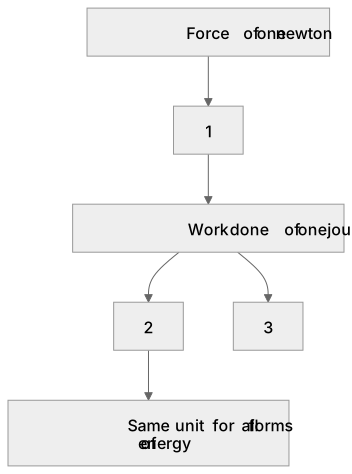
Some boxes have lost their names. Pick the right name for each number.
1Box 1
2Box 2
3Box 3
There is more to this lesson
The full lesson goes on to check your understanding and help you earn the marks. Create a free account to carry on, with your progress saved.
A week of Premium from your first lesson · Then the free plan continues · No card, no charge
Test your understanding of Work done and energy transfer: work done, W, in joules, J
Active recall beats re-reading. Take an instant quiz now to test what you’ve learned and lock it into long-term memory.
A week of Premium from your first lesson · Then the free plan continues · No card, no charge