Pearson Edexcel · GCSE · Combined Science
Chemical change
Master the preparation of pure, dry hydrated copper sulfate crystals—a core practical in GCSE Combined Science. This guide walks you through the exact method, the chemistry of neutralisation, and how to secure full marks on those tricky 6-mark method questions.
- 4 min read
- 3 worked examples
- 5 practice questions
- 6 key terms
Study Notes
Overview

Welcome to one of the most satisfying core practicals in GCSE Combined Science: the preparation of hydrated copper sulfate crystals. This topic is central to Topic 3: Chemical Change and is a classic example of an acid-base neutralisation reaction.
Understanding this practical is crucial because examiners frequently use it to test your knowledge of experimental methods, safe heating techniques, and separation processes like filtration and crystallisation. It connects directly to other topics, including atomic structure (ionic bonding in salts) and rates of reaction (surface area of powders). Typical exam questions range from 1-mark recall questions about apparatus to 6-mark extended response questions requiring you to describe the full method logically and safely.
Key Concepts
Concept 1: Acid-Base Neutralisation
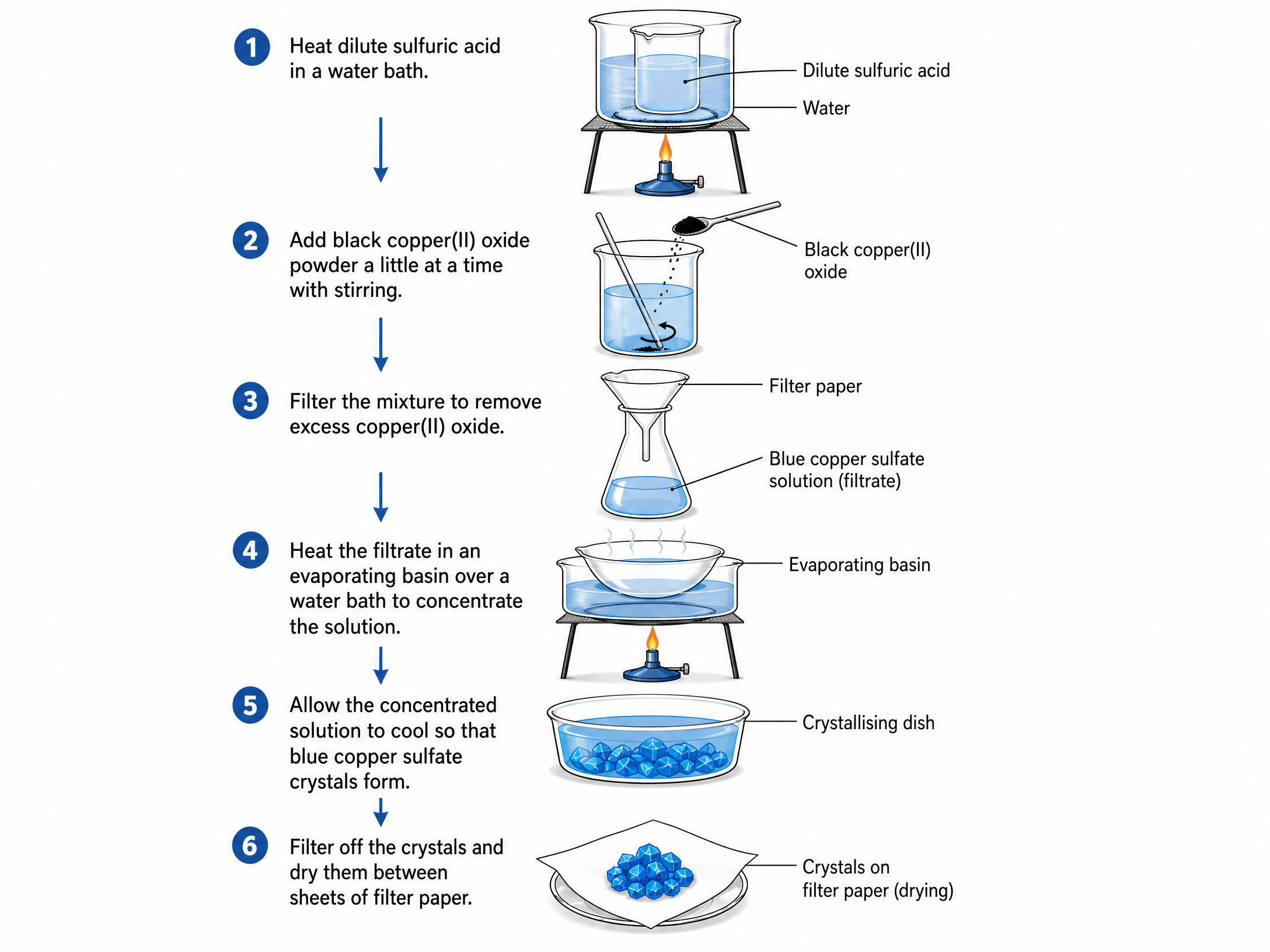
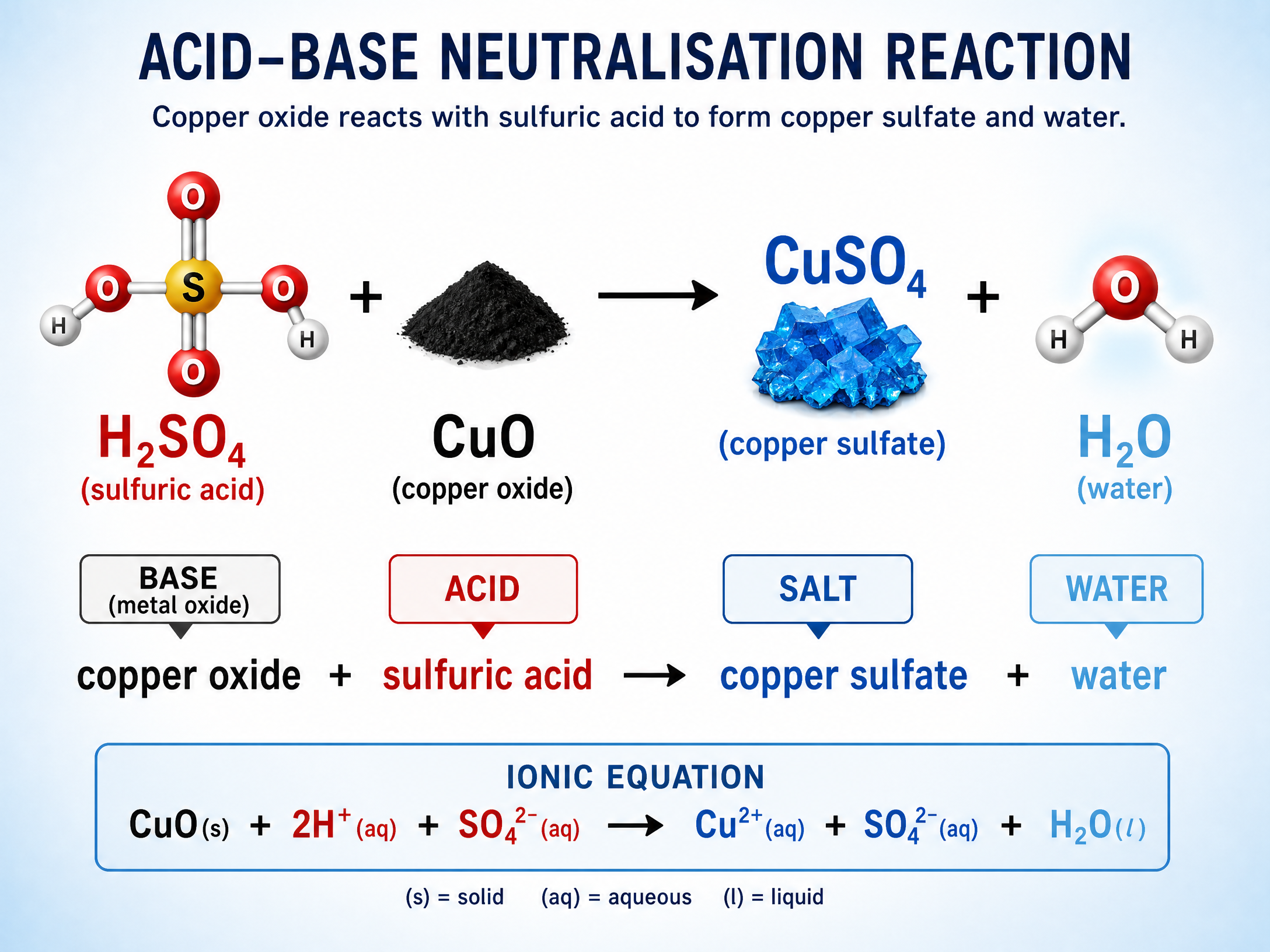
When an acid reacts with a base, they neutralise each other to form a salt and water. In this practical, dilute sulfuric acid (the acid) reacts with copper(II) oxide (the base). Copper oxide is an insoluble metal oxide. Because it is a solid base, we can easily see when the reaction is complete—the solid stops dissolving.

Example: The general equation is Metal Oxide + Acid → Salt + Water. Therefore, Copper Oxide + Sulfuric Acid → Copper Sulfate + Water.
Concept 2: The Limiting Reagent and Excess
In this experiment, the sulfuric acid is the limiting reagent—it must all be used up. We ensure this by adding copper oxide in excess (more than is needed).
Why does this matter? If any unreacted acid remains, the final copper sulfate crystals will be contaminated with acid and will not be pure. By adding excess copper oxide, we guarantee all the acid has reacted. The excess solid is then easily removed by filtration because it is insoluble.
Concept 3: Controlled Heating (The Water Bath)
We use a water bath to heat the acid and to evaporate the filtrate, rather than heating directly with a Bunsen burner.
Why? A water bath provides gentle, even heating and cannot exceed 100°C. Direct heating could cause the mixture to spit dangerously, or worse, cause the copper sulfate to thermally decompose (break down) and lose its water of crystallisation.
Concept 4: Crystallisation
To obtain crystals, we heat the blue copper sulfate solution to evaporate some of the water, making the solution more concentrated. We stop heating when crystals begin to form at the edges (the point of crystallisation). We do not evaporate to dryness. As the hot, concentrated solution cools, the copper sulfate becomes less soluble and crystallises out of the solution.

Mathematical/Scientific Relationships
Balanced Symbol Equation:
CuO(s) + H₂SO₄(aq) → CuSO₄(aq) + H₂O(l)
**Hydrated Salt Formula:**The blue crystals formed are hydrated, meaning they contain water molecules chemically bonded within the crystal lattice. The formula is CuSO₄·5H₂O. The ·5H₂O is the water of crystallisation.
Practical Applications
This exact method—reacting an insoluble base with an acid, filtering, and crystallising—is the standard industrial and laboratory technique for making any soluble salt from an insoluble reactant. For example, making magnesium sulfate from magnesium oxide follows the exact same steps.
🎧 Listen to the Podcast
Revise on the go! Listen to our 10-minute audio guide covering the method, common mistakes, and a quick-fire quiz.
Visual Resources
2 diagrams and illustrations
Interactive Diagrams
2 interactive diagrams to visualise key concepts
Conceptual Flow Outline
Flowchart showing the step-by-step preparation method.
Conceptual Flow Outline
The core chemical change occurring in this practical.
Worked Examples
3 worked examples — open one to explore the question and available guidance.
Practice Questions
Test your understanding — click to reveal model answers
Name the two reactants needed to produce copper sulfate. (2 marks)
Hint: Look at the name of the salt. 'Copper' tells you the metal part, 'sulfate' tells you the acid used.
Why is the mixture filtered after the reaction is complete? (1 mark)
Hint: What did you add in excess that is still floating in the beaker?
A student is evaporating the copper sulfate solution. They heat it until all the water is gone. Explain why this is an incorrect method. (2 marks)
Hint: Think about what happens to the water inside the crystal structure if it gets too hot.
Write the balanced symbol equation for the reaction between copper(II) oxide and sulfuric acid. (2 marks)
Hint: Copper is Cu, Oxide is O. Sulfuric acid is H2SO4. What are the products?
Explain how the student can ensure that all the acid has reacted. (2 marks)
Hint: What visual cue tells you the reaction has stopped?