Pearson Edexcel · GCSE · Combined Science
Energy - Forces doing work
Master the fundamental relationship between energy, forces, and motion. This topic covers how work is done, how energy is transferred between stores, and how to calculate power and efficiency—core concepts that appear in almost every physics paper.
- 4 min read
- 3 worked examples
- 5 practice questions
- 6 key terms
Study Notes
Overview

This topic is the beating heart of GCSE Physics. It answers a fundamental question: what happens to energy when a force causes an object to move? Understanding how energy is transferred, conserved, and dissipated is crucial for Combined Science, as these principles underpin almost every other physics topic, from electricity to radioactivity.
Examiners love testing this topic because it requires you to link concepts together. You won't just be asked to recall a formula; you'll be asked to apply it to real-world scenarios, like cars braking, cranes lifting loads, or athletes sprinting. You must be comfortable rearranging equations, converting units, and explaining why energy is never truly lost.
Key Concepts
Concept 1: Work Done
In everyday language, "doing work" means putting in effort. In physics, work is only done when a force moves an object through a distance. If you push against a solid brick wall all day, you might get tired, but you have done zero work on the wall because the distance moved is zero.
When work is done, energy is transferred. In fact, work done is exactly equal to energy transferred.
Example: If you apply a force of 50 N to push a box 3 m across a floor, the work done is 50 \times 3 = 150\text{ J}. You have transferred 150 J of energy to the box (mostly as kinetic energy and thermal energy due to friction).
Concept 2: The Direction of Force
Examiners frequently test a critical nuance: the distance moved must be in the direction of the applied force. If you carry a heavy bag horizontally across a room, your lifting force is acting upwards, but the movement is horizontal. Because the force and the movement are perpendicular, no work is done by the lifting force.
Concept 3: Energy Stores and Transfers

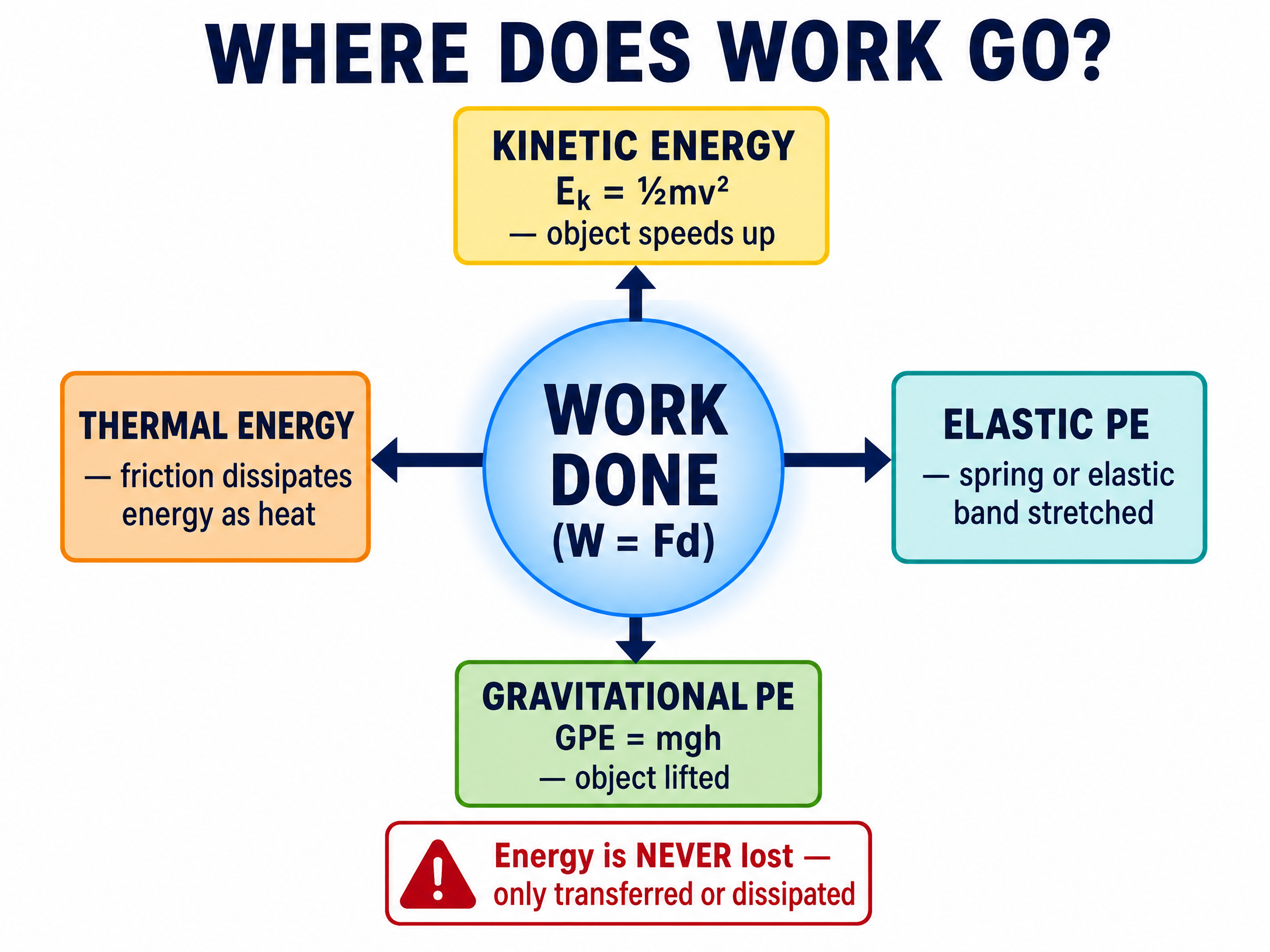
When work is done, energy moves from one store to another.
- Kinetic Energy (Ek): Energy an object has due to its motion. Because velocity is squared (v^2), doubling the speed quadruples the kinetic energy.
- Gravitational Potential Energy (GPE): Energy stored due to an object's height in a gravitational field.
- Thermal Energy: When forces act against friction, work is done against these resistive forces, and energy is dissipated (spread out) to the surroundings as thermal energy.
Concept 4: Power
Power is the rate of doing work or the rate of energy transfer. A powerful machine doesn't necessarily do more work; it does the same amount of work in less time.
Example: Two motors lift identical 100 kg loads by 5 m. Both do the same work. But Motor A does it in 10 seconds, while Motor B takes 20 seconds. Motor A is twice as powerful.
Concept 5: Efficiency
No real-world machine is perfect. Some energy is always dissipated (usually as heat or sound). Efficiency is a measure of how much of the input energy is transferred usefully. It is a ratio and has no units. It can never exceed 1 (or 100%), as this would violate the Law of Conservation of Energy.
Mathematical/Scientific Relationships

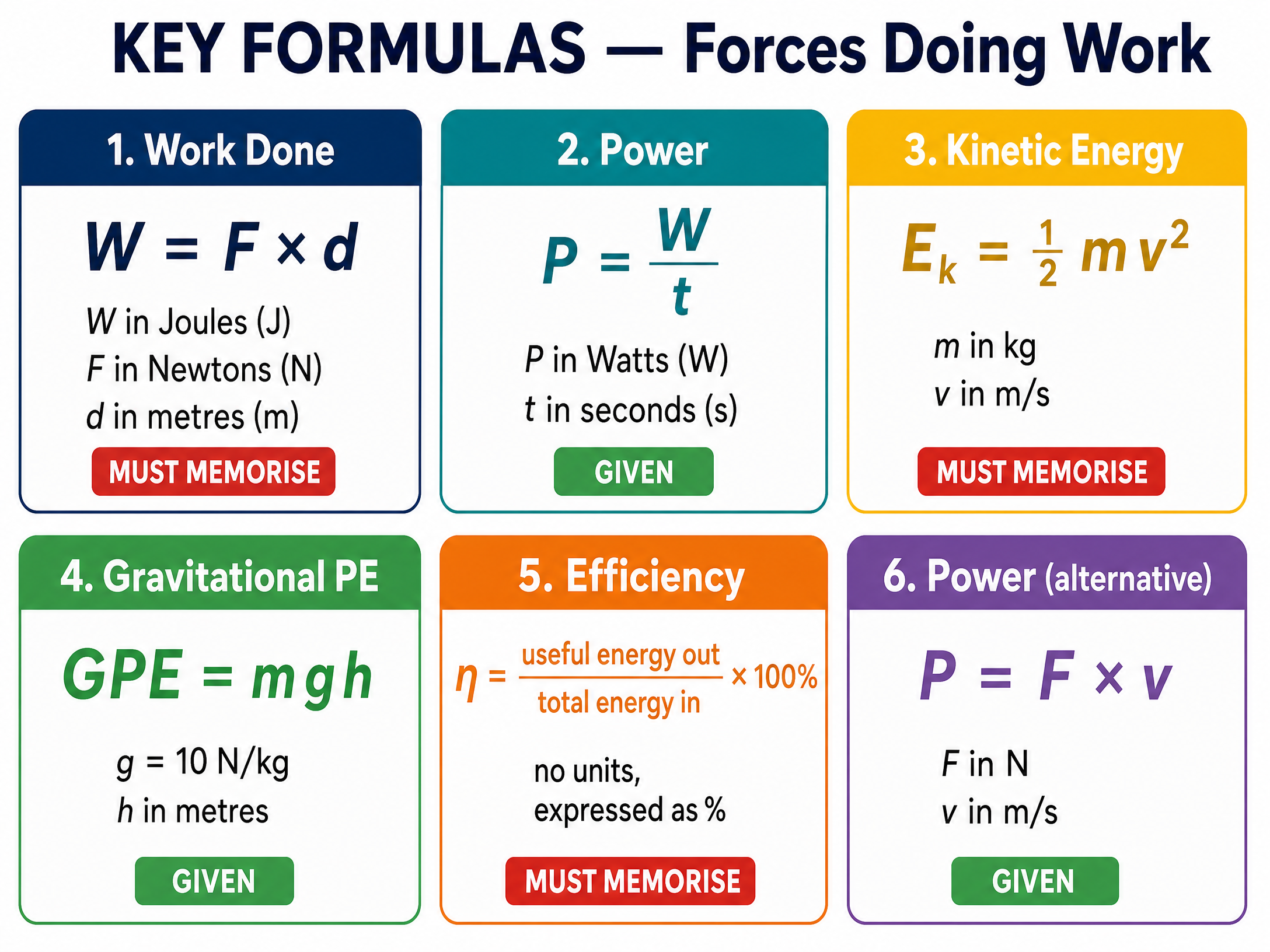
- Work Done: W = F \times d
- W = Work done in Joules (J)
- F = Force in Newtons (N)
- d = Distance in metres (m)
- Power: P = \frac{W}{t} or P = \frac{E}{t}
- P = Power in Watts (W)
- t = Time in seconds (s)
- Kinetic Energy: E_k = \frac{1}{2} m v^2
- m = mass in kilograms (kg)
- v = speed/velocity in metres per second (m/s)
- Gravitational Potential Energy: E_p = m g h
- g = gravitational field strength (usually 10 N/kg or 9.8 N/kg depending on your exact board)
- h = height in metres (m)
- Efficiency: \text{Efficiency} = \frac{\text{Useful energy output}}{\text{Total energy input}}
Practical Applications
Understanding these forces is vital in engineering and safety. For example, vehicle braking distances rely entirely on the concept of work done. The brakes apply a frictional force over a distance to reduce the car's kinetic energy to zero. If the car is going twice as fast, it has four times the kinetic energy, meaning the braking distance must be four times as long (assuming maximum braking force is constant).
Visual Resources
2 diagrams and illustrations
Interactive Diagrams
2 interactive diagrams to visualise key concepts
Conceptual Flow Outline
Sankey-style flowchart showing energy transfer and dissipation in an electric motor.
Conceptual Flow Outline
Energy transfer sequence for a falling object.
Worked Examples
3 worked examples — open one to explore the question and available guidance.
Practice Questions
Test your understanding — click to reveal model answers
State the equation linking work done, force, and distance.
Hint: Think about what two things you need to do work.
A crane lifts a 500 kg concrete block vertically by 20 m in 40 seconds. Calculate the power of the crane. Take g = 10 N/kg.
Hint: First calculate the weight of the block (which is the force needed to lift it). Then calculate work done. Then calculate power.
Explain why the efficiency of a mechanical system can never be 100%.
Hint: Think about moving parts and what happens when they rub together.
A cyclist of mass 80 kg is travelling at 12 m/s. Calculate their kinetic energy.
Hint: Use the formula Ek = 1/2 m v².
A car travelling at 30 m/s has a kinetic energy of 450,000 J. Calculate the mass of the car.
Hint: Rearrange the kinetic energy equation to make mass the subject.