Pearson Edexcel · GCSE · Combined Science
Forces and matter
Master Hooke's Law and the physics of springs with this comprehensive guide. Learn how to interpret force-extension graphs, calculate spring constants, and avoid the most common examiner traps in the required practical.
- 6 min read
- 3 worked examples
- 5 practice questions
- 6 key terms
Study Notes

Overview
Forces and Matter (Topic 15) is a core component of the GCSE Combined Science specification. This topic explores the fundamental relationship between the forces applied to objects and the resulting changes in their shape—specifically focusing on springs. Understanding Hooke's Law is crucial because it forms the basis for everything from car suspensions to measuring scales.
Examiners frequently test this topic through a combination of calculation questions (using F = kx and E = \frac{1}{2}kx^2), graph interpretation skills, and questions based on the required practical. The required practical on investigating the force-extension relationship of a spring is highly examinable, often appearing in 4-6 mark 'describe a method' questions or data analysis scenarios. This topic connects strongly to energy transfers and work done, making synoptic links highly likely in longer questions.
Listen to the revision podcast below for a comprehensive walk-through of the key concepts and common pitfalls:
Key Concepts
Concept 1: Hooke's Law and the Spring Constant
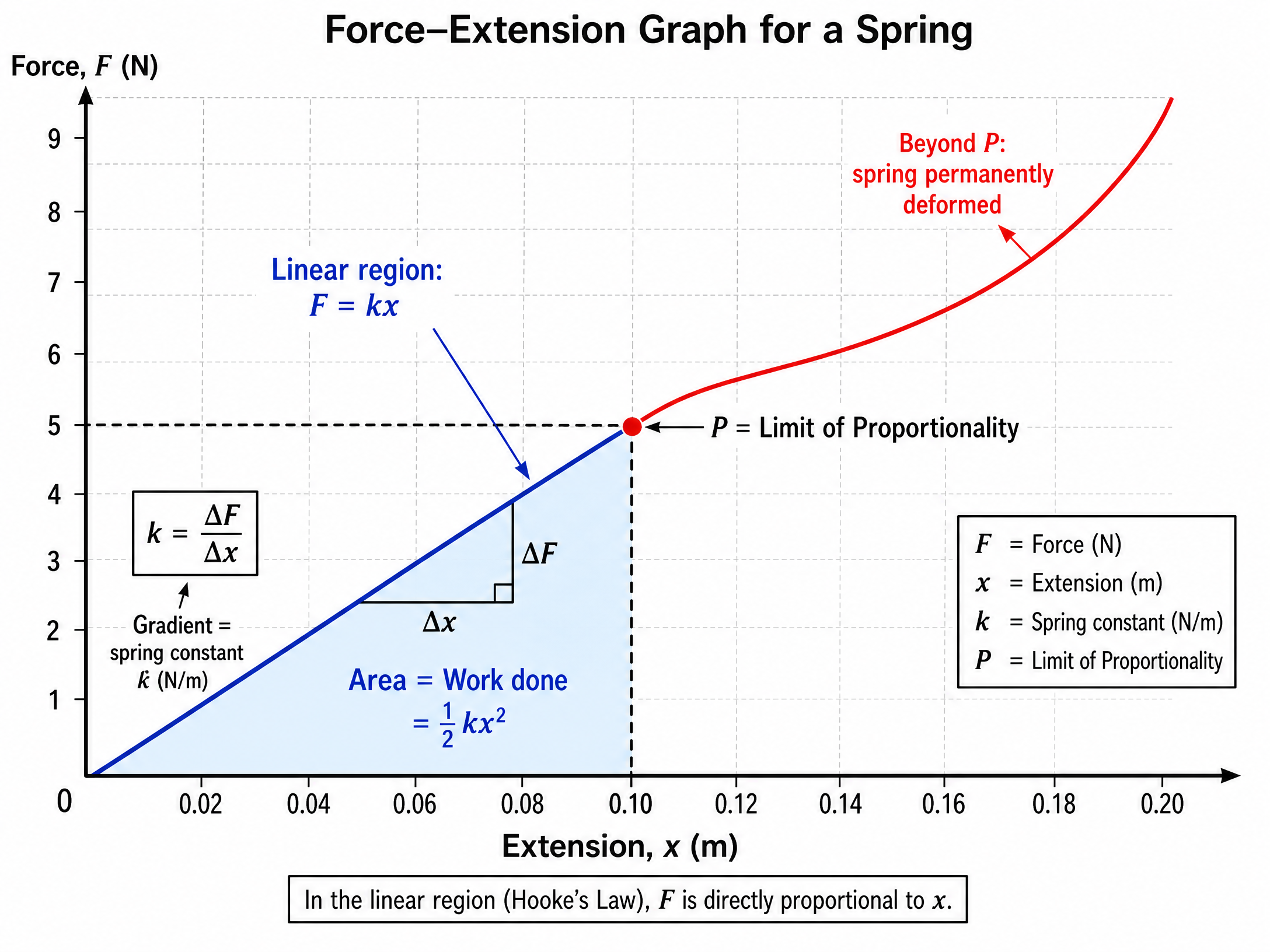
Robert Hooke discovered that when a force is applied to a spring, the extension is directly proportional to the force applied, provided the limit of proportionality is not exceeded. This linear relationship is what makes springs so useful for measuring forces (like in a newton meter).
The stiffness of the spring is defined by its spring constant (k). A spring with a large spring constant is very stiff and requires a large force to stretch it even a small amount. A spring with a small spring constant is flexible and stretches easily.
Example: If a spring has a spring constant of 50\text{ N/m}, it means you need 50\text{ N} of force to stretch it by 1\text{ metre} (or 0.5\text{ N} to stretch it by 1\text{ cm}).
Concept 2: Extension vs. Total Length
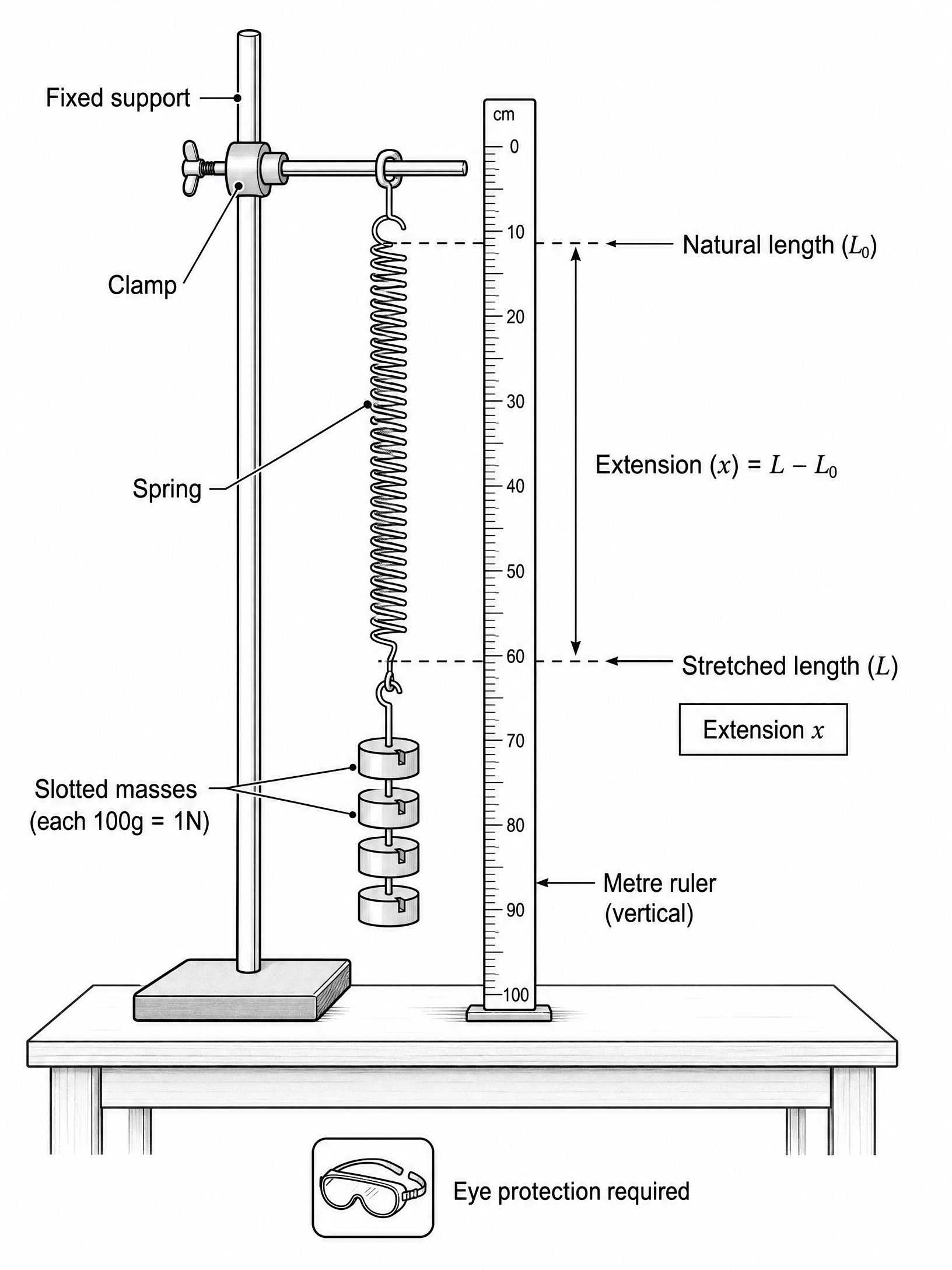
A critical distinction that examiners look for is the difference between the total length of a stretched spring and its extension. The extension (x) is the increase in length from its original, unloaded state (the natural length).
\text{Extension} = \text{Stretched Length} - \text{Natural Length}
When conducting experiments or performing calculations, you must always use the extension, not the total length. Furthermore, extension must always be converted to metres for standard calculations.

Concept 3: The Limit of Proportionality
Hooke's Law only applies up to a certain point. As you continue to add force to a spring, eventually the relationship breaks down. The point at which the extension is no longer directly proportional to the force is called the Limit of Proportionality.
On a force-extension graph, this is the exact point where the straight line begins to curve. If a spring is stretched significantly beyond this point, it may exceed its elastic limit, meaning it will be permanently deformed (inelastic deformation) and will not return to its original length when the force is removed.
Concept 4: Elastic Potential Energy and Work Done
When you apply a force to stretch a spring, you are doing work. This work done is transferred into the spring and stored as elastic potential energy. As long as the spring is not permanently deformed, all this stored energy can be recovered when the spring is released.
The amount of energy stored can be calculated using the formula E = \frac{1}{2}kx^2. Crucially, this energy is also represented graphically as the area under the linear section of the force-extension graph. Since the area of a triangle is \frac{1}{2} \times \text{base} \times \text{height}, and the base is x and height is F (where F=kx), the area is \frac{1}{2} \times x \times kx = \frac{1}{2}kx^2.

Mathematical/Scientific Relationships
Examiners expect you to be fluent with two primary equations in this topic.
-
Hooke's Law Equation (Must memorise):
F = kx- F = Force applied in Newtons (N)
- k = Spring constant in Newtons per metre (N/m)
- x = Extension in metres (m)
-
Elastic Potential Energy (Given on formula sheet):
E_e = \frac{1}{2}kx^2- E_e = Elastic potential energy in Joules (J)
- k = Spring constant in Newtons per metre (N/m)
- x = Extension in metres (m)
Unit Conversion Warning: Examiners frequently provide extension in centimetres (cm) or millimetres (mm) to test your unit conversion skills.
- To convert cm to m: Divide by 100 (e.g., 4\text{ cm} = 0.04\text{ m})
- To convert mm to m: Divide by 1000 (e.g., 40\text{ mm} = 0.04\text{ m})
Required Practical: Investigating Force and Extension
This is a core required practical. You must know how to set it up, execute it safely, and process the results.
Apparatus: Clamp stand, two bosses, two clamps, heavy weight (to prevent stand toppling), metre ruler, spring, mass hanger, slotted masses (100\text{ g} each), pointer (fiducial marker).
Method:
- Secure the clamp stand to the bench using a heavy weight.
- Attach the spring to the top clamp and a vertical metre ruler to the bottom clamp. Ensure the zero mark on the ruler aligns with the top of the spring.
- Record the natural length of the spring with no masses attached.
- Add a 100\text{ g} mass (1\text{ N} force) to the mass hanger.
- Record the new stretched length of the spring.
- Calculate the extension (x = \text{Stretched Length} - \text{Natural Length}).
- Repeat the process, adding 100\text{ g} (1\text{ N}) at a time up to a maximum safe load (e.g., 10\text{ N}).
- Plot a graph of Force (y-axis) against Extension (x-axis).
Common Errors & Examiner Focus:
- Failing to ensure the ruler is perfectly vertical (parallax error). Use a set square to check.
- Measuring the total length instead of calculating the extension.
- Not reading the ruler at eye level (parallax error). A fiducial marker (pointer) attached to the bottom of the spring improves accuracy.
- Safety: Always wear eye protection in case the spring snaps or slips.
Interactive Diagrams
2 interactive diagrams to visualise key concepts
Conceptual Flow Outline
Flowchart detailing the steps for the Hooke's Law required practical.
Conceptual Flow Outline
Concept map showing the relationships between Force, Extension, Spring Constant, and Energy.
Worked Examples
3 worked examples — open one to explore the question and available guidance.
Practice Questions
Test your understanding — click to reveal model answers
State the equation that links extension, force and spring constant. (1 mark)
Hint: Think of the 'Foxes Kick Xylophones' mnemonic.
A student plots a graph of force against extension for a spring. The graph is a straight line passing through the origin. What does this tell you about the relationship between force and extension? (1 mark)
Hint: What is the mathematical term for a straight line through the origin?
A spring has a spring constant of 25 N/m. Calculate the force required to produce an extension of 8 cm. (3 marks)
Hint: Check the units of extension carefully before using the formula.
A bungee jump rope behaves like a spring. It has a spring constant of 40 N/m. A jumper of weight 600 N hangs stationary at the end of the rope. Calculate the elastic potential energy stored in the stretched rope. (5 marks)
Hint: You need to use two formulas here. First find the extension using F=kx, then use that extension to find the energy.
Explain how the student could improve the accuracy of their extension measurements in the required practical. (2 marks)
Hint: Think about how you look at the ruler and how you mark the position of the spring.