Pearson Edexcel · GCSE · Combined Science
Forces and their effects
Master the fundamental principles of forces, from distinguishing contact and non-contact forces to calculating resultants using vector diagrams. This topic forms the foundation for understanding motion and is heavily assessed across all physics papers.
- 5 min read
- 3 worked examples
- 5 practice questions
- 6 key terms
Study Notes

Overview
Forces and their effects form the bedrock of classical physics. Whether you are analysing a skydiver in freefall, a car braking on a motorway, or the orbit of planets, forces are the fundamental interactions that dictate motion. In your GCSE Combined Science exams, this topic is heavily weighted because it tests your ability to apply core principles to unfamiliar contexts. You will need to confidently classify forces, draw accurate free body diagrams, and calculate resultant forces to predict how an object will move.
This topic links extensively with later modules on motion, momentum, and energy. Examiners frequently combine these areas, asking you to use a resultant force to calculate acceleration, or to explain how balanced forces relate to terminal velocity. The questions range from simple one-mark recall of definitions to complex six-mark calculations involving vector diagrams and trigonometry. Mastering forces now will make the rest of your physics course significantly easier.
Listen to the companion podcast for a complete audio review of this topic:
Key Concepts
Concept 1: Scalar and Vector Quantities
In physics, all measurable quantities are either scalars or vectors. This distinction is critical because it changes how we do calculations.
- Scalar quantities have only a magnitude (size). Examples include temperature, mass, time, and speed. If you have 5 kg of apples, the direction doesn't matter; it's just 5 kg.
- Vector quantities have both a magnitude and a direction. Examples include force, velocity, displacement, and acceleration. A force of 10 N pushing to the right is entirely different from a 10 N force pushing to the left.
Why it matters: When adding scalars, 5 + 5 always equals 10. But when adding vectors, a 5 N force right and a 5 N force left add up to 0 N because the directions cancel each other out.
Concept 2: Contact vs Non-Contact Forces
Forces are interactions between two objects, and they are categorised by whether those objects physically touch.
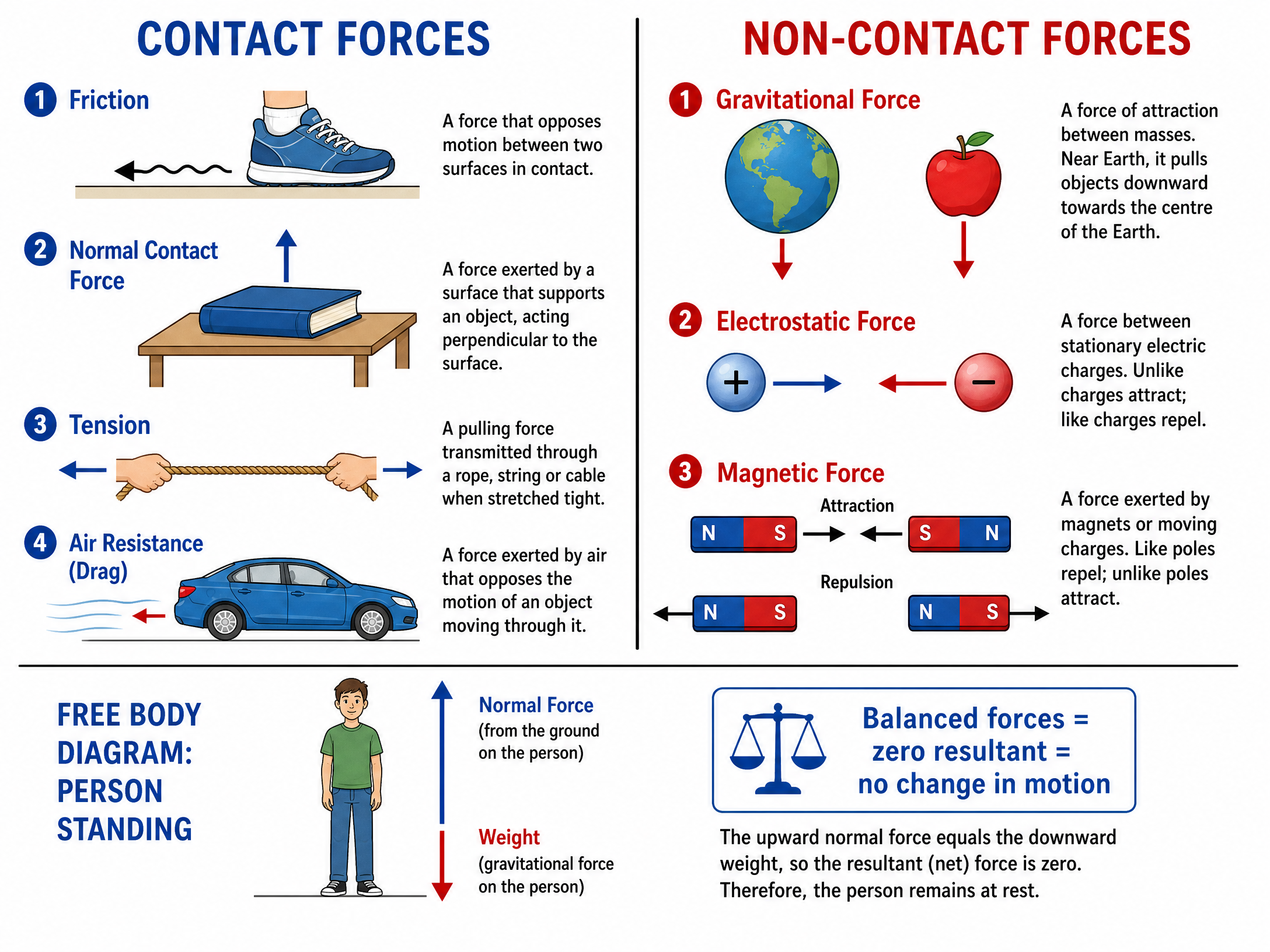
- Contact forces require the objects to be physically touching. Examples include friction (opposing motion between surfaces), air resistance (drag), tension (in a stretched rope), and the normal contact force (the support force exerted by a surface).
- Non-contact forces act at a distance, without the objects touching. The three you must know are gravitational force (attraction between masses), electrostatic force (between charges), and magnetic force (between magnets).

Concept 3: Free Body Diagrams
A free body diagram is a simplified model used to show all the forces acting on a single object. The object is usually drawn as a box or a dot. Arrows represent the forces.
The Rules of Drawing:
- The length of the arrow represents the magnitude of the force.
- The direction of the arrow represents the direction of the force.
- Arrows must be drawn originating from the object.
- Always label the arrows with the name of the force and its value (if known).
Example: A book resting on a table has a downward arrow labelled 'Weight' and an upward arrow of the exact same length labelled 'Normal Contact Force'.
Concept 4: Resultant Forces and Equilibrium
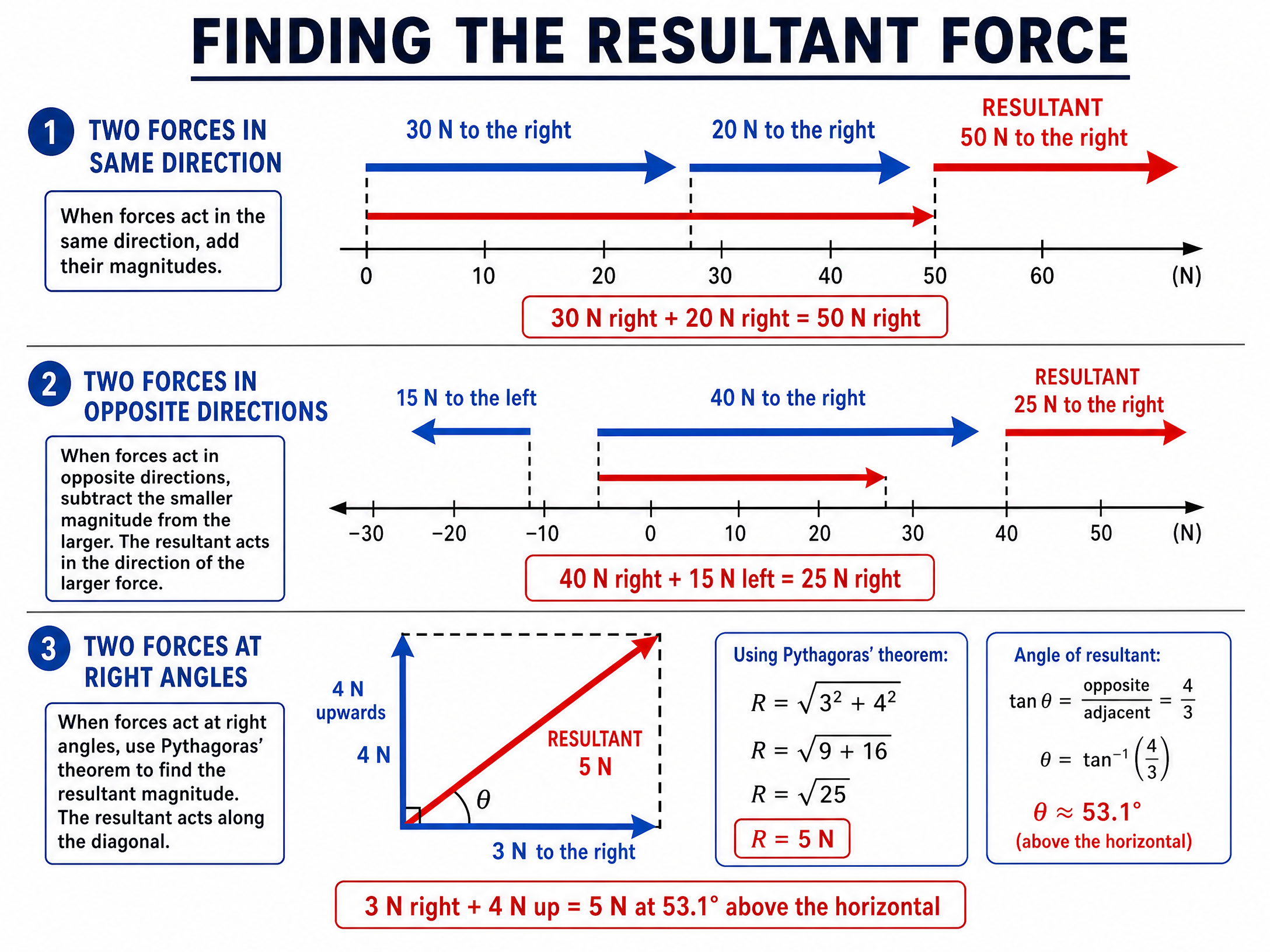
When multiple forces act on an object, they can be replaced by a single force that has the exact same effect. This is the resultant force.
- Forces in the same direction: Add them together.
- Forces in opposite directions: Subtract the smaller force from the larger force. The resultant acts in the direction of the larger force.
- Balanced forces (Equilibrium): If the resultant force is zero, the forces are balanced. According to Newton's First Law, an object with balanced forces will either remain stationary or continue moving at a constant velocity.
- Unbalanced forces: If the resultant force is not zero, the object will accelerate in the direction of the resultant force.

Mathematical/Scientific Relationships
Calculating Weight
W = m × g
- W = Weight (measured in Newtons, N)
- m = Mass (measured in kilograms, kg)
- g = Gravitational field strength (measured in Newtons per kilogram, N/kg. On Earth, this is approximately 9.8 N/kg or 10 N/kg depending on your specific exam board — always check the front of your paper).
When to use: Use this whenever you need to convert an object's mass into the gravitational force acting upon it. This is essential before drawing weight arrows on free body diagrams.
Vector Resolution (Higher Tier Only)
For two forces acting at right angles, you can find the resultant force using Pythagoras' theorem.
R² = a² + b²Where R is the resultant force, and a and b are the two perpendicular forces. You can also use trigonometry (SOH CAH TOA) to find the exact angle of the resultant force.
Practical Applications
Understanding forces is essential in engineering and safety design. For example, when designing a bridge, engineers must calculate all the tension and compression forces to ensure the resultant force on every joint is zero (equilibrium), so the bridge doesn't collapse.
In sports, aerodynamic design (like the shape of a racing cyclist's helmet) is all about reducing the contact force of air resistance to increase the resultant forward force, thereby increasing acceleration.
Visual Resources
2 diagrams and illustrations
Interactive Diagrams
2 interactive diagrams to visualise key concepts
Conceptual Flow Outline
Flowchart for classifying forces.
Conceptual Flow Outline
The relationship between resultant force and motion (Newton's First Law).
Worked Examples
3 worked examples — open one to explore the question and available guidance.
Practice Questions
Test your understanding — click to reveal model answers
A student pushes a box across a desk with a force of 15 N to the right. Friction acts on the box with a force of 5 N. Calculate the resultant force and state its direction.
Hint: Since the forces are in opposite directions, what mathematical operation should you use?
Which of the following is a vector quantity? A) Mass B) Time C) Force D) Temperature
Hint: Which of these requires a direction to make sense?
A drone is falling vertically at a constant velocity. The weight of the drone is 45 N. State the magnitude and direction of the air resistance acting on the drone.
Hint: If velocity is constant, what must the resultant force be?
Describe the difference between a contact force and a non-contact force, giving one example of each.
Hint: Define both terms clearly, then pick one from the GEM list and one from the other list.
(Higher Tier) A boat is pulled by two ropes. Rope 1 pulls with a force of 500 N North. Rope 2 pulls with a force of 1200 N East. Calculate the resultant force on the boat.
Hint: Draw a quick sketch. The forces form a right-angled triangle. What theorem do you need?