Pearson Edexcel · GCSE · Combined Science
Health, disease and the development of medicines
This topic covers how antibiotics fight bacterial infections and why they are useless against viruses. It also details the rigorous multi-stage pipeline—from discovery to clinical trials—that ensures new medicines are safe and effective before they reach patients.
- 5 min read
- 3 worked examples
- 5 practice questions
- 6 key terms
Study Notes

Overview
Welcome to Health, Disease and the Development of Medicines, a core topic in your GCSE Combined Science specification. This section is fundamentally about how we treat disease and how scientists ensure those treatments are safe. You will explore the specific mechanisms of antibiotics—learning exactly why they kill bacteria but have absolutely no effect on viruses. You will also trace the journey of a new medicine from its initial discovery in a laboratory to its approval for public use.
This topic is heavily tested in exams. Examiners frequently ask candidates to explain the antibiotic-virus distinction (often a 3-4 mark question) or to sequence and describe the stages of medicine development. Understanding the crucial difference between preclinical testing (on cells and animals) and clinical trials (on humans) is essential for securing top marks.
Key Concepts
Concept 1: How Antibiotics Work
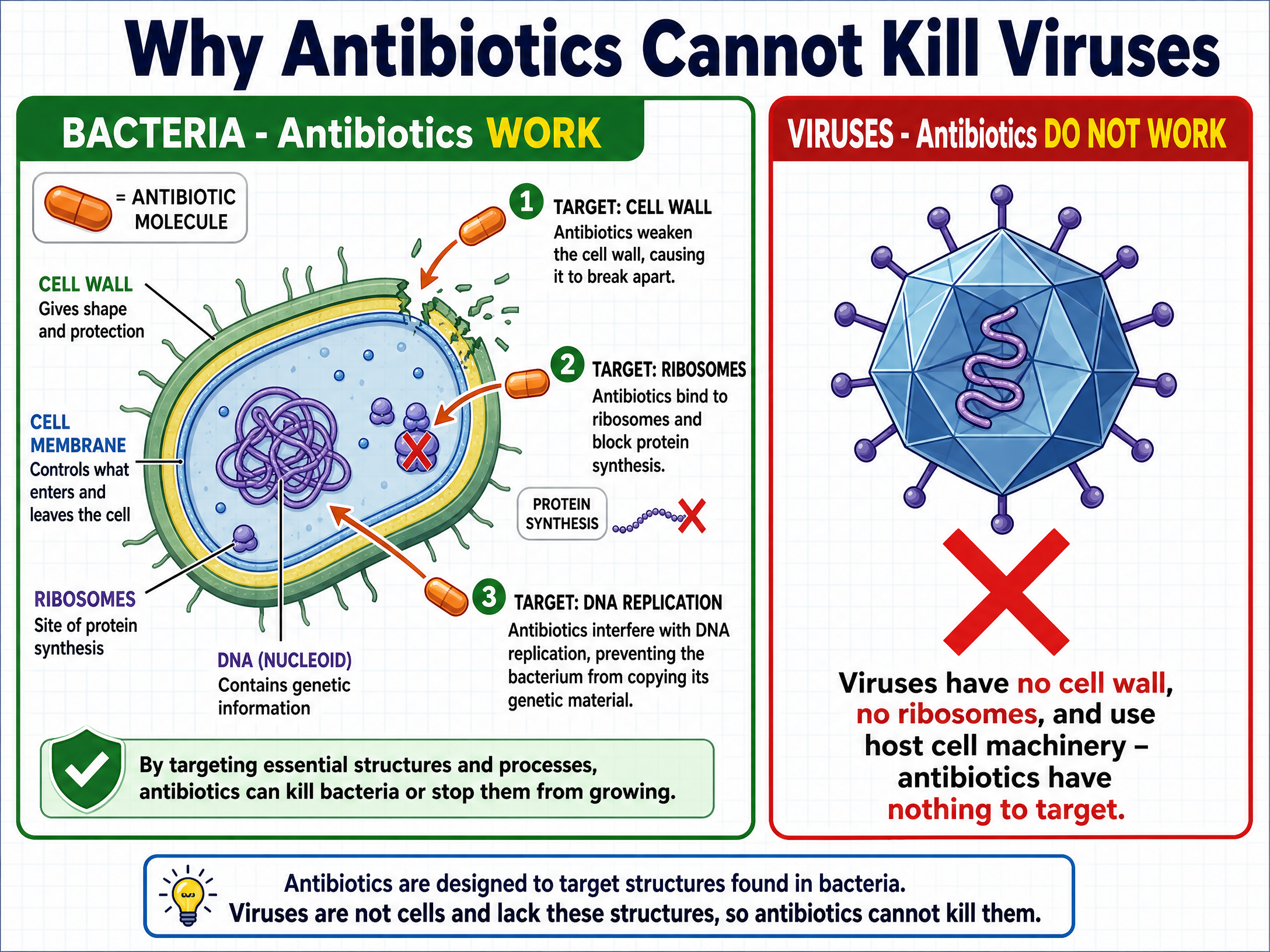
Antibiotics are medicines designed to kill bacteria or inhibit their growth. They achieve this by targeting specific structures or metabolic processes that are unique to bacterial cells. For example, many antibiotics target the bacterial cell wall. By preventing the cell wall from forming properly, the bacterium becomes weak, bursts, and dies. Other antibiotics target bacterial ribosomes, blocking protein synthesis so the bacterium cannot function or reproduce.
Example: Penicillin works by interfering with the synthesis of the peptidoglycan cell wall in bacteria. Without a strong wall, water enters the bacterium by osmosis, causing it to lyse (burst).

Concept 2: Why Antibiotics Do Not Work on Viruses
This is a classic exam question. Viruses are not living cells; they are simply genetic material wrapped in a protein coat. They do not have a cell wall, they do not have ribosomes, and they do not carry out their own metabolic processes. Instead, viruses reproduce by entering a host cell and hijacking its cellular machinery.
Because antibiotics are designed to attack specific bacterial structures (like the cell wall), and viruses lack these structures, the antibiotic has nothing to target. Furthermore, because viruses hide inside the host's own cells, it is very difficult to develop drugs that destroy the virus without also damaging the host's tissues.
Concept 3: The Medicine Development Pipeline
The journey of a new medicine is long, expensive, and rigorously controlled to ensure safety and efficacy. Candidates must know the correct sequence of these stages.
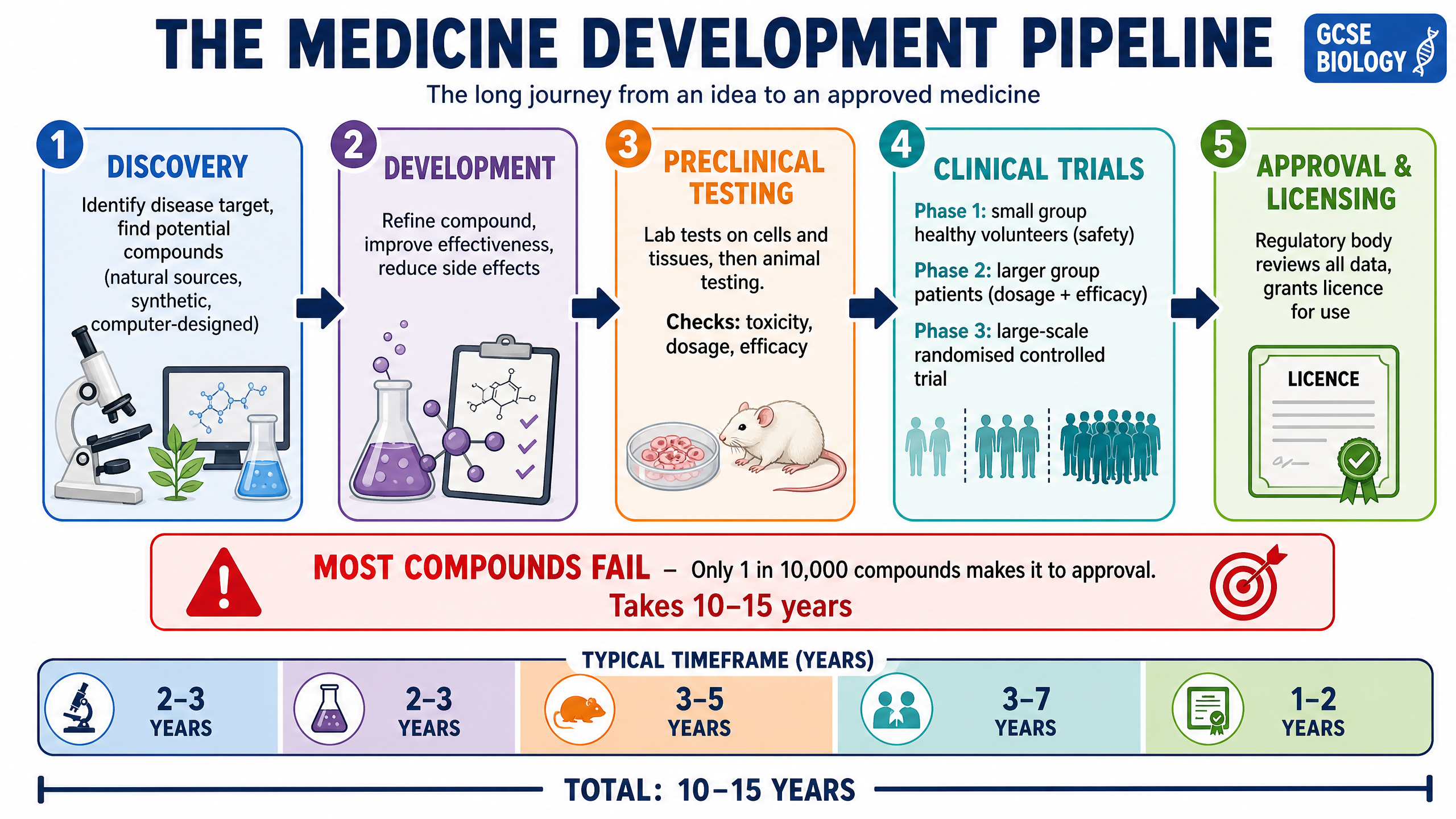
1. Discovery: Scientists identify a disease target and search for potential compounds. These can be extracted from natural sources (like plants or microorganisms) or synthesised in a laboratory.
2. Development: The compound is refined to improve its effectiveness and reduce potential side effects.
3. Preclinical Testing: This stage takes place in a laboratory, before any human testing. The drug is tested on cultured cells, tissues, and live animals. The primary purpose here is to check for toxicity (is it safe?), efficacy (does it work?), and to determine a starting dosage.
4. Clinical Trials: If preclinical testing is successful, the drug moves to human trials, which occur in three phases:
- Phase 1: Tested on a small group of healthy volunteers to check for safety and side effects at low doses.
- Phase 2: Tested on a small group of patients suffering from the disease to test for efficacy and determine the optimum dose.
- Phase 3: A large-scale, randomised, double-blind trial (often using a placebo) on many patients to confirm efficacy, monitor rare side effects, and compare with existing treatments.
5. Approval and Licensing: Regulatory bodies review all the trial data. If the medicine is deemed safe and effective, it is granted a licence to be prescribed.

Mathematical/Scientific Relationships
While this topic is less calculation-heavy than physics topics, you may be asked to calculate the percentage of drugs that pass from one stage of clinical trials to the next, or to calculate the area of a zone of inhibition in an agar plate practical.
Area of a circle = \pi r^2
(Used to calculate the clear zone around an antibiotic disc. r is the radius of the clear zone.)
Practical Applications
Understanding medicine development is highly relevant to the real world, as seen during the rapid development of vaccines and antiviral treatments during global pandemics. The rigorous testing pipeline ensures that tragedies like the Thalidomide disaster of the 1950s—where an inadequately tested drug caused severe birth defects—are not repeated.
Visual Resources
2 diagrams and illustrations
Interactive Diagrams
2 interactive diagrams to visualise key concepts
Conceptual Flow Outline
Flowchart showing the transition from Preclinical Testing to Clinical Trials.
Conceptual Flow Outline
The three phases of clinical trials.
Worked Examples
3 worked examples — open one to explore the question and available guidance.
Practice Questions
Test your understanding — click to reveal model answers
State what is meant by the term 'antibiotic'.
Hint: Think about what type of pathogen it targets.
A new drug has been discovered. Describe the testing that must be done before it can be used to treat humans. [4 marks]
Hint: Start with preclinical testing, then describe the human phases.
Explain why it is difficult to develop drugs that kill viruses without damaging the body's tissues. [2 marks]
Hint: Where do viruses live and reproduce?
During Phase 3 clinical trials, patients are often split into two groups. One group receives the new drug, and the other receives a placebo. Explain why this is done as a double-blind trial. [3 marks]
Hint: Who knows what in a double-blind trial, and what does this prevent?
A student suggests treating a common cold with penicillin. Evaluate this suggestion. [3 marks]
Hint: What causes a cold, and what does penicillin do?